A place smaller than some cities can outweigh millions of suns, yet it isn’t really a “place” at all. A star dies, space itself cracks, and suddenly there’s a region where “inside” and “outside” stop making sense. Today, we’re diving straight toward that invisible edge.
A black hole doesn’t just sit in space; it edits its own neighborhood. Orbits stretch, time slows, and any loose matter—gas, dust, even stars—can be fed into a vast, invisible engine. Strangely, some of the brightest objects in the universe are powered by something that itself cannot be seen: when matter spirals in, it heats up and blazes across the cosmos in X-rays and radio waves. These outbursts can outshine entire galaxies and sculpt the growth of everything around them. Our own Milky Way carries such a monster at its core, mostly quiet for now, but holding the orbits of hundreds of billions of stars in its gravitational grip. And when black holes collide, they don’t just merge; they ring spacetime like a struck bell, sending out ripples we can now detect on Earth.
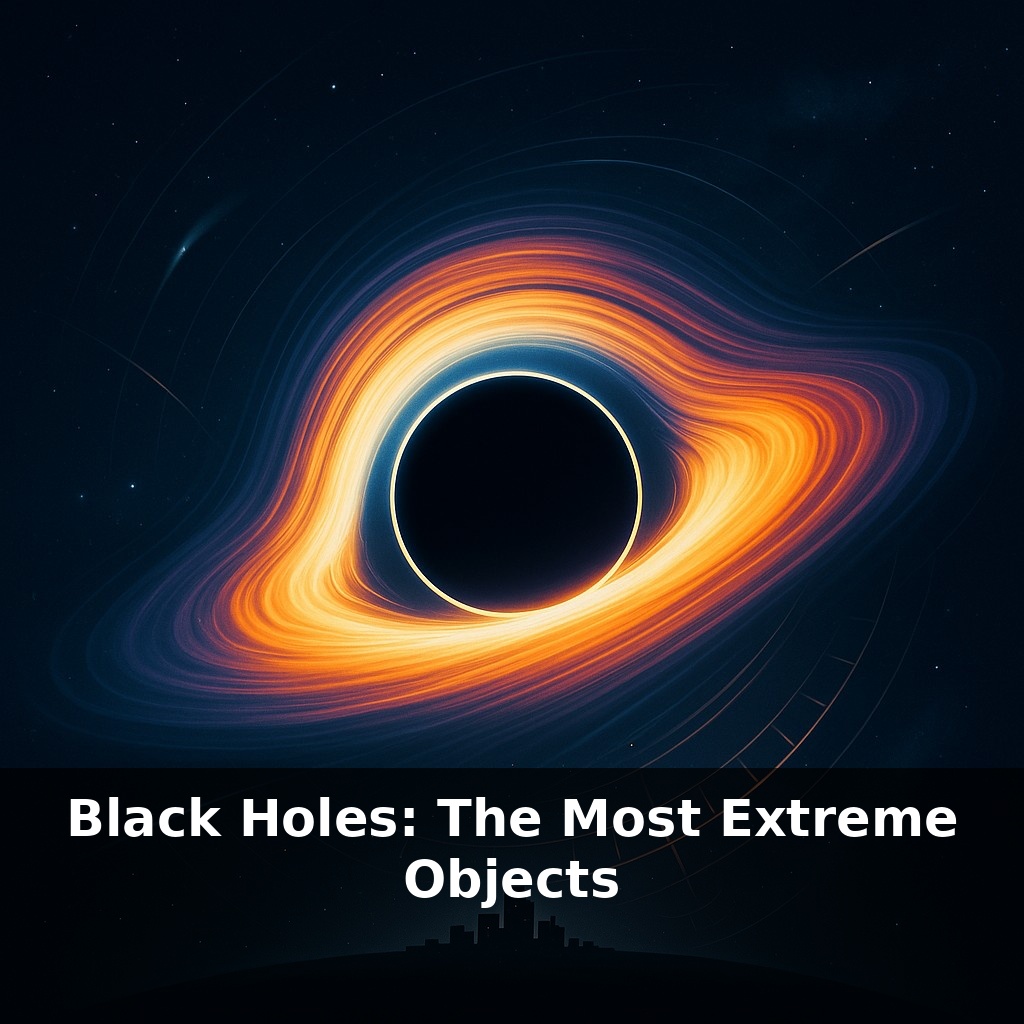
Some of the black holes we know best were found almost by accident. In the 1960s, astronomers chasing Cold War-era X-ray signals stumbled onto sources like Cygnus X‑1: not a star, but a dark companion tearing gas from a neighbor and heating it until it glowed in X-rays. Decades later, radio dishes linked across Earth sharpened their “vision” enough to glimpse the dark silhouette of M87*, while ultra-precise clocks on Earth felt distant collisions as faint shivers. Step by step, the cosmos has been revealing where its heaviest machinery is hidden.
Far from being all the same, black holes come in wildly different sizes and roles. At one end are “stellar-mass” black holes, tens of times the Sun’s mass. At the other are giants in galactic centers, millions to billions of times heavier. Both follow the same basic physics, but they live very different lives.
A typical stellar-mass black hole might be about 10 solar masses, with a boundary only a few tens of kilometers across. Put the Sun’s mass into that scale of volume and you get an object whose gravity is so intense that getting away would require moving faster than light. The radius that marks that point of no return—the Schwarzschild radius—grows in direct proportion to mass. Scale up from 10 Suns to a billion, and the “edge” swells from tens of kilometers to a size comparable to the Solar System.
Those supermassive black holes don’t just sit in the middle of galaxies; they help organize them. Stars near Sagittarius A* in the Milky Way whip around at thousands of kilometers per second, tracing out a deep central well of gravity. In more active galaxies, torrents of infalling gas light up as quasars, powered by disks so hot they radiate across the electromagnetic spectrum and drive jets that can punch through hundreds of thousands of light-years of space.
The extremes show up most clearly when black holes interact. Take GW150914, the first gravitational-wave signal we caught from a black hole merger. Two heavyweights spiraled together and, in just two tenths of a second, turned the mass of roughly three Suns entirely into gravitational radiation. For a brief instant, that system outshone all the stars in the observable universe in gravitational waves.
Yet on the longest timescales, black holes are surprisingly fragile. Quantum effects imply that they very slowly leak energy as Hawking radiation. The smaller the black hole, the faster this leak. A modest 10-solar-mass black hole would take on the order of 10⁶⁶ years to fully evaporate—fantastically longer than the universe’s current age—while the supermassive ones would persist even more absurdly long.
These details matter because they sharpen our questions. If black holes can, in principle, evaporate away, what happens to the information about everything that fell in? Does it emerge scrambled in the radiation, get stored on the horizon, or is our whole notion of information incomplete? Black holes have gone from mathematical oddities to precision experimental tools, and they’re now pressing us on what “reality” even means at the deepest level.
Seen up close—at least in simulations—black holes act less like vacuums and more like cosmic triage wards. Most material skims past or slingshots away; only a fraction actually makes it in. Around many of them, matter flattens into a thin, whirling disk where magnetic fields twist and reconnect, flaring like storms in an extreme space-weather system. In some galaxies, those flares help regulate how many new stars can form by heating or expelling surrounding gas.
Now zoom in further: to an infalling astronaut, clocks and rulers disagree with those used by a distant observer. One might claim the crossing happens quickly; the other insists it never quite occurs. This tension between viewpoints is exactly why black holes are test beds for theories that try to merge quantum physics with relativity. Any successful theory of “everything” has to say, in detail, what both observers are allowed to see—and how their stories fit together without contradiction.
Black holes may become our sharpest tools for mapping the invisible cosmos. As LISA and future detectors “listen” to mergers across billions of light‑years, they’ll trace how structure grew, much like doctors inferring a heart’s history from its pulse. Precise images of Sagittarius A* could expose tiny deviations from Einstein’s predictions, hinting at new physics, while quantum‑information approaches may turn the information paradox into a blueprint for next‑generation computation.
Your challenge this week: whenever you hear about a newly detected black hole or gravitational‑wave event in the news, pause and ask two questions: “What does this reveal about the environment it came from?” and “What hidden quantity—like spin, merger history, or surrounding matter—are scientists trying to decode from the signal?” Then, look up one technical term from that story—such as “ringdown” or “accretion flow”—and read a primary-source figure or plot related to it instead of a summary.
In the end, black holes act less like cosmic trash cans and more like editors of history, trimming and reshaping galaxies while quietly archiving their past in gravity and light. As detectors sharpen, each signal becomes a clue in an unfinished mystery novel, hinting that the universe is still revising its own deepest chapters.
Try this experiment: grab a bright flashlight, a round object (like an orange), and a dark room to model how light behaves near a black hole. Shine the flashlight directly at the “black hole” (the orange) and slowly move the beam so it just grazes the edge—you’ll see how a tiny change in angle dramatically changes what’s illuminated, similar to how light can just miss or be captured by a black hole. Then, place a second small object (like a coin) between the flashlight and the orange and move it around to mimic how a massive object can “bend” the light path, giving you a hands-on feel for gravitational lensing. As you adjust angles and distances, pay attention to when light disappears, reappears, or bends around edges—that’s your mini-lab for event horizons and warped spacetime.