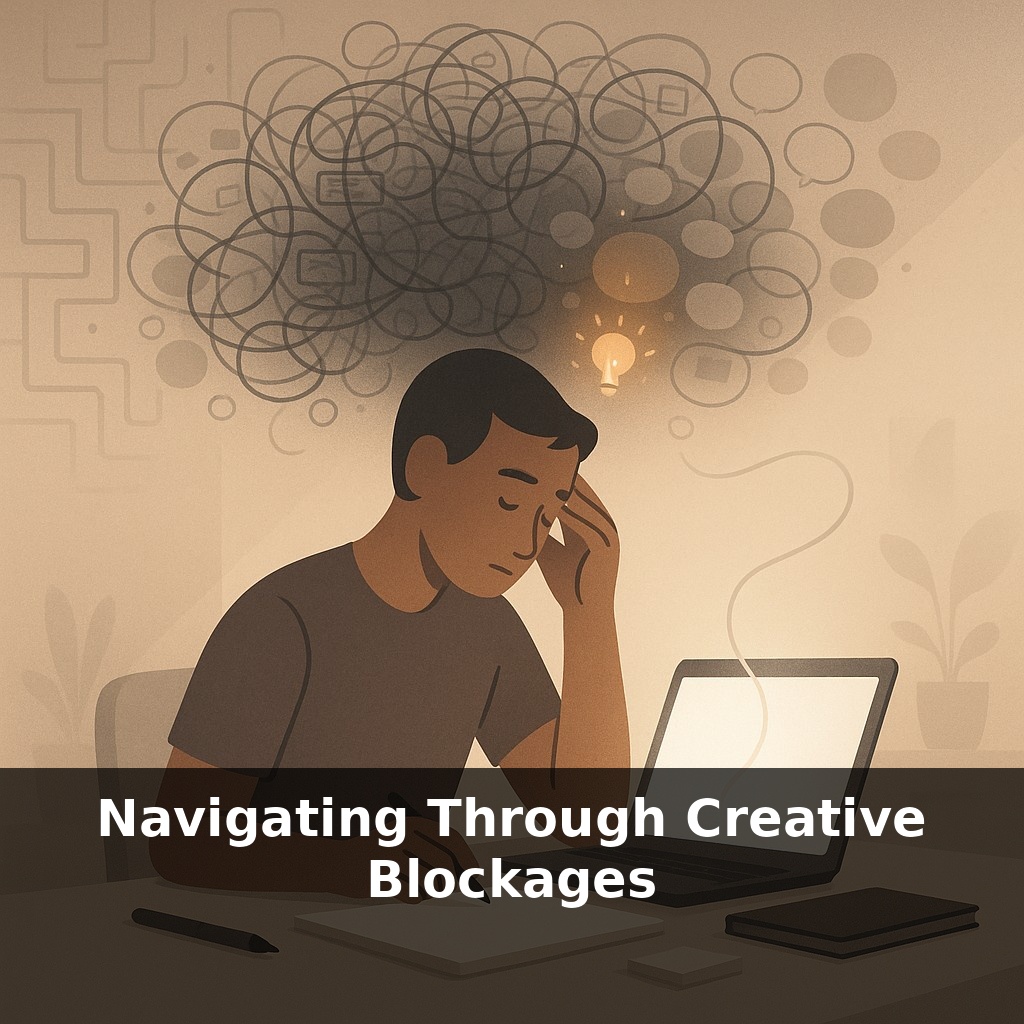
“Blocks aren’t proof your creativity is broken; they’re proof it’s working too hard in the wrong way.” You’re staring at the screen, ideas racing and colliding, yet nothing lands. The paradox: your mind is crowded, but the page is empty—and that tension is where we’ll dig in.
Creative block rarely shows up as a dramatic crisis; it seeps in through small, ordinary moments. You open your notebook and suddenly feel an urgent need to tidy your desk. You sit down to draft a scene and, without noticing, you’re comparing yourself to three other writers and a decade‑old version of you. The blockage hides inside those micro‑choices.
What’s actually happening is less “I have no ideas” and more “my ideas are getting jammed at the doorway.” Sometimes it’s because your standards sprint ahead of your skills. Other times, it’s because your brain is still carrying the weight of unfinished conversations, notifications, and worries. Before we talk about fixing it, we’ll dissect these hidden logjams: the quiet perfectionism, subtle fear of wasting time, and the environments that quietly train you not to focus at all.
Some of what we call “block” is actually your brain trying to protect you. When a draft threatens your self‑image, your mind throws up smoke screens: sudden exhaustion, a craving to “research just a bit more,” an urge to reorganize your notes like books on a shelf you’ll never open. Underneath is a conflict between two systems: one that wants to explore and one that wants to avoid risk. Rather than forcing yourself through, we’ll learn to notice these protective moves, work with them, and gently convince your nervous system that experimenting on the page is a safe place to be.
A University of York team has suggested that even moderate mental fatigue can slash creative performance by a third—not because you’re less “talented,” but because your brain’s energy budget has been quietly drained. This is where the neuroscience of block becomes useful, not as jargon, but as a map.
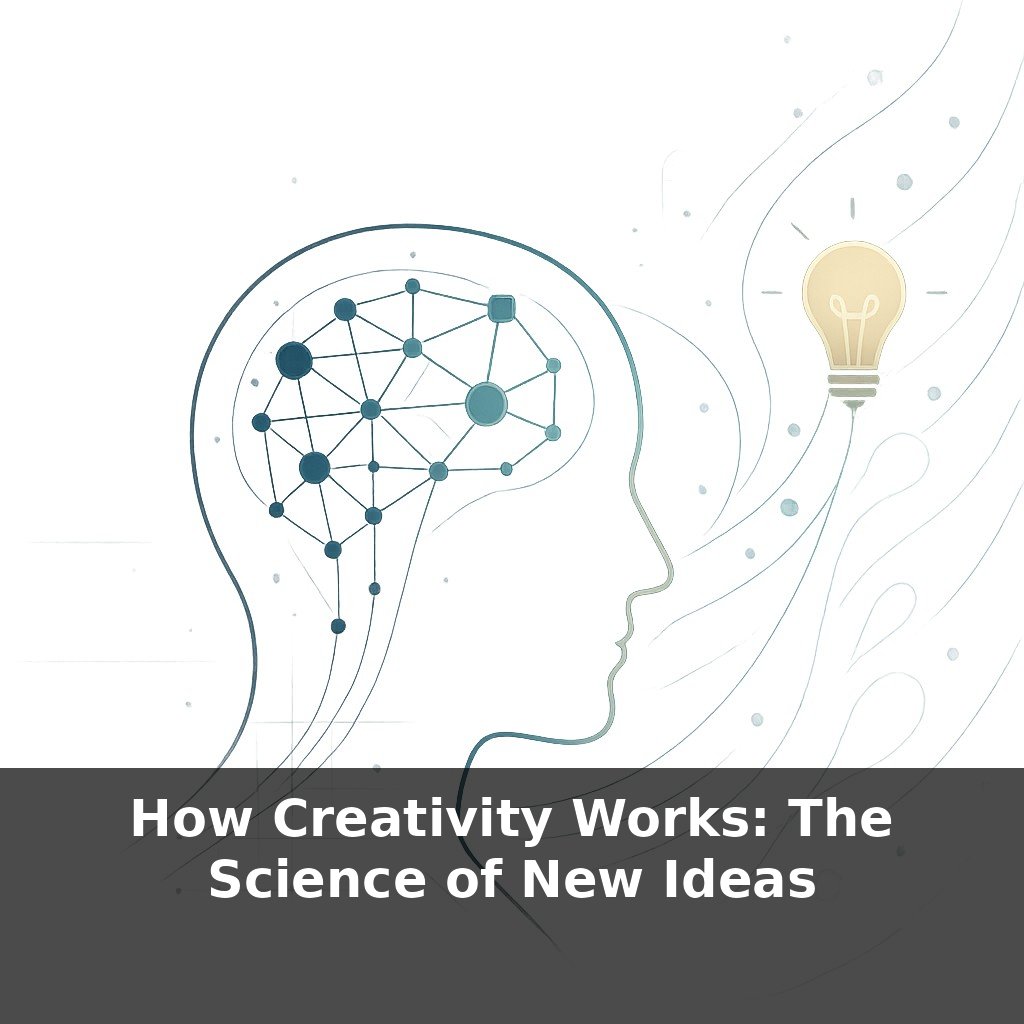
Two big networks matter here. One is the wandering, story‑spinning part of your brain that links distant ideas and daydreams into surprising combinations. The other is the strict editor that checks for logic, relevance, and risk. When things are clicking, they trade the wheel: one roams, the other refines. Under stress, they start talking over each other. You get either a flood of half‑formed notions you instantly dismiss, or a rigid silence in which nothing feels worth starting.
That dysregulation can come from overload (too many inputs, too fast), from chronic stress, or from the belief that every attempt must count. In all three cases, your evaluative side starts supervising every move. Drafting becomes a performance review.
Notice how different practices target different sides of this tug‑of‑war. Mindfulness doesn’t “make you creative”; it lowers background noise so ideas can surface without being instantly judged. Incubation—walking, showering, folding laundry after an intense work burst—hands the reins back to your wandering network for a while. Deliberate constraints (a 200‑word limit, one scene in one room, only dialogue) calm the anxious evaluator by shrinking the playground to something it can oversee without panicking.
Think of a photographer switching lenses: a wide‑angle for exploration, a prime lens for detail. You’re not choosing one forever; you’re learning when to swap. Short, protected bursts of messy generation train you to let the exploring system lead, while scheduled passes of cool‑headed editing reassure the part of you that craves order.
The more consciously you alternate these modes, the less “blocked” you feel and the more you experience what Pixar’s Braintrust relies on: a rhythm where scrutiny is intense but time‑boxed, and idea‑making is wild but temporarily off the hook.
A useful way to test this in real life is to watch how quickly different “modes” flip when the context shifts. A songwriter might be stuck on a verse at their desk, then get one sharp line while rinsing a mug in the kitchen. Nothing mystical happened; the task simply stopped looking like “Write the verse that proves you’re good” and started looking like “Hum a line while you move.” Likewise, some teams schedule “bad idea sprints” where the only rule is to propose the most unworkable solutions possible; five minutes of gleeful sabotage often shake loose one oddly promising angle they’d never have voiced in a serious meeting. You can do a solo version: set a timer for seven minutes and list the worst openings for your chapter.
Like an artist swapping from oil paint to charcoal, changing tools (location, medium, time limit) doesn’t fix the work for you, but it does invite a different part of your mind to take the lead.
Studios are already treating stuckness as a signal about systems, not just individuals: rotating writers’ rooms, project “cooling off” weeks, even budgets for playful experiments that never have to ship. As AI joins the circle, its real value may be in holding a mirror to your patterns—surfacing themes you return to, gaps you avoid, rhythms that energize you—so you can redesign your practice like an evolving studio, not a fixed identity.
Treat this phase less like a wall and more like weather on a long hike: sometimes you wait out the storm, sometimes you choose a different path, but you keep moving. Your challenge this week: swap one “stuck” session for a playful experiment—new tool, shorter time, stranger prompt—and note what surprises show up in the space that opens.