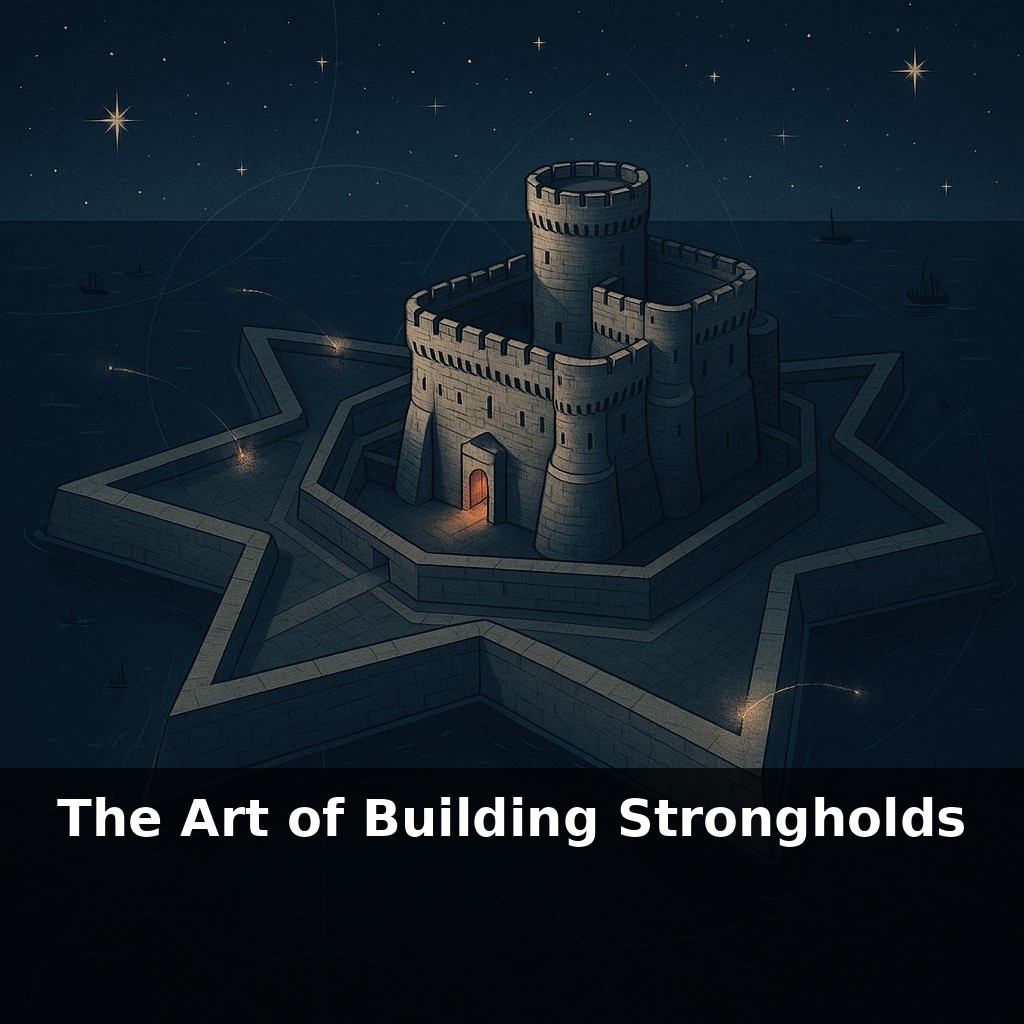
Under a star-shaped fort in Baltimore, only four defenders died during a full day of British bombardment. Not because the cannons were weak—but because the stronghold was smarter. In this episode, we’re going inside the logic of defenses built to outthink attackers.
Krak des Chevaliers stretched this “smart defense” thinking to the limit: its outer and inner walls sat up to 30 meters apart, turning the gap into a controlled killing zone. Any force that breached the first line was not victorious—it was trapped. Across centuries, the best designers learned that survival depended as much on planning the *inside* as fortifying the outside. Masada’s 12 cisterns held roughly 40,000 cubic meters of water—enough to sustain about 1,000 people for years. That storage wasn’t an architectural flourish; it was a deliberate choice to make siege threats strategically expensive. Likewise, a modest 200-person medieval garrison needed around 66 tons of grain for a single year under siege. In this episode, we’ll extract the principles behind such numbers: how layered barriers, time, and resources combine into a system that deters attack before it begins.
Designers also planned for *change*. When gunpowder spread in the 14th–15th centuries, walls in Europe thickened from under 2 m to 8–12 m in key sectors, and heights dropped to reduce collapse risk. By Vauban’s era, some glacis slopes extended over 300 m to keep enemy artillery at awkward angles. Internally, commanders modeled time as precisely as stone: if a force could only haul 20 days of supplies, a fort built to last 120 days made assault mathematically irrational. The real art wasn’t invincibility; it was making attack the worst possible option.
The masters of defense worked backwards from one question: “How does the attacker *think*?” Then they shaped stone, earth, and schedules to quietly sabotage that thinking.
Step one was forcing commitment in stages. At Carcassonne, for example, attackers first met a ring of outer towers, then a deep dry ditch, then an inner wall with its own towers and gates. Crossing each line required different tools and risks. A force might need 3–4 days to emplace ladders and rams for the first wall, another week to drag up and assemble siege towers for the ditch, and still more time to reposition heavy engines for the inner defenses. Every 24 hours spent “preparing” under arrows, stones, and disease chipped away at morale and manpower.
Designers quantified those delays. If intelligence suggested an enemy could keep 15,000 troops in the field for 60 days before food shortages hit, engineers aimed for 90–180 days of sustainable resistance. Vauban refined this into an almost mathematical art: he stacked outworks—ravelins, hornworks, half-moons—so an army might need 10–15 days just to dig trenches close enough to seriously threaten the main walls. His forts were not simply hard to crack; they were designed to *waste* the attacker’s irreplaceable campaigning season.
Depth wasn’t only horizontal. At places like Himeji in Japan, gates zigzagged so a straight-line distance of a few hundred meters turned into a twisting path of more than a kilometer through courtyards and switchbacks. Each bend exposed attackers to fresh firing angles from multiple levels. A rush that might have taken minutes in open ground stretched into an exhausting, confusing fight under constant fire.
Inside, commanders built time-buffers into everything: extra grain stores beyond the calculated yearly need, redundant wells, and repair materials. A garrison might keep timber to rebuild hoardings three or four times, lime and sand for continuous mortar mixing, even spare weapon parts. The aim was simple: each day the attacker stayed, the defender’s relative position improved.
Your challenge this week: map one project, team, or personal goal as if it were a fortified route. Identify 3–5 “gates” someone or something must pass to derail it. For each gate, define a concrete delay or cost you can impose—an approval, a test, a buffer of materials or time. Build at least one additional “outwork”: a small, expendable safeguard whose whole purpose is to give you warning and time before real damage begins.
In your own work, think in the same hard numbers that fortress builders used. If a critical project can only tolerate 8 hours of downtime per quarter, but your current “defensive depth” (backups, alternate workflows, cross-trained staff) covers just 2–3 hours, you’ve effectively built a single thin wall. Add a “cistern” equivalent: for instance, 72 hours of offline-capable procedures for your top 3 revenue-generating processes.
Resource math clarifies priorities. If your team of 10 burns through roughly 400 focused hours a week, then a surprise initiative that needs 200 hours isn’t “small”; it’s half a week of garrison strength. Leaders who budget that time like grain ensure they can last the full “campaign season” of a product launch or crisis.
One practical pattern: create a 3-layer review path for decisions above a certain dollar value—say, $10,000—so any risky commitment must cross financial, technical, and operational “walls.” Each review adds maybe 24–48 hours, but collectively they filter out the worst 5–10% of choices that could trigger your equivalent of a breached gate.
Treat modern risk like a long siege. Assume power outages for 7 days, lost networks for 72 hours, or supply shocks that triple delivery times. Design for graceful failure, not perfection. For example, specify that 30% of your team’s work can shift to offline tasks, keep at least 14 days of critical inputs on hand, and pre-assign rotation plans so no role is single-point. Test one stress scenario per quarter to expose weak “gates” before a real crisis does.
Translate these ideas into practice by setting explicit “hold times” for your key assets. For example, require that core savings could cover 90 days of expenses, or that your team can run 30 days with 20% capacity lost. Review these numbers every 6 months, and adjust a single policy, contract, or habit to extend your endurance by at least 10%.
Before next week, ask yourself: 1) “If someone watched my last 24 hours, what ‘strongholds’—routines, habits, or default reactions—would they say I’m actually building, and do those really protect what matters most to me or just keep me comfortable?” 2) “In the specific moment I usually feel attacked—like scrolling at night, arguments with my spouse, or pressure at work—what concrete ‘wall’ could I start building this week (a boundary, a script I’ll say, a non-negotiable practice) so that next time I’m not starting from zero?” 3) “Whose ‘stronghold’ do I quietly admire (a mentor, a friend, someone from the episode), and what is one practice they have that I can experiment with for the next seven days, exactly as they do it—not my easier version of it?”