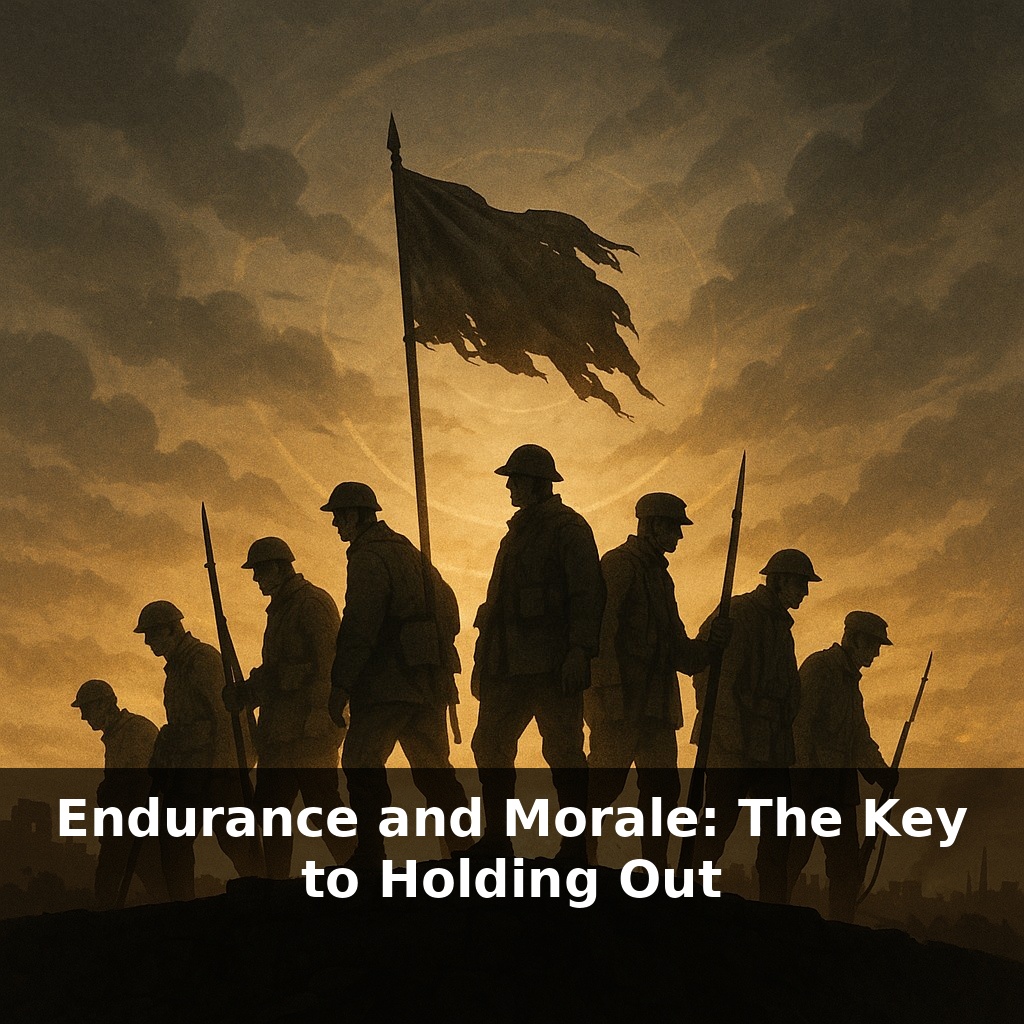
Artillery falls, supplies are gone, and yet the defenders don’t break. Here’s the twist: history shows the last side standing is often not the richest or strongest—it’s the one that can keep believing, together, that holding on still matters, even when logic screams to quit.
A frontline that refuses to fold isn’t just “tough”—it’s carefully managed. When pressure stretches from hours into months, endurance stops being a heroic trait and becomes a system: how leaders communicate, how routines are structured, how small wins are marked, how rest is protected even when danger is constant. Look at long, grinding defenses in history and you’ll see patterns: commanders rotating units before they crack, underground schools or religious services continuing during bombardment, tiny rituals around meals or briefings that signal, “We’re still us. This isn’t over.” Modern teams in crises do the same, whether it’s engineers nursing a failing mission or medical staff riding out a pandemic wave. The lesson: morale isn’t a mood; it’s infrastructure. You can design it, reinforce it, and—if you’re careless—accidentally destroy it long before the enemy does.
Morale, then, isn’t only about surviving hardship; it’s about deciding *why* to keep going when outcomes are uncertain and costs are undeniable. Under siege, people quietly run psychological “cost–benefit” checks: Is anyone noticing my effort? Does this sacrifice move us closer to something I value? Behavioral research shows that when those answers tilt toward “yes,” stress hormones still spike, but people interpret the strain as proof of commitment instead of a signal to bail out. That reframe matters. It’s the difference between a storm you’re trapped in and rough weather you’ve chosen to sail through together.
Morale starts to look less mystical when you zoom in on *what* people are actually doing together during long strain. In Leningrad, theaters weren’t just “distractions”; they were living proof that the city still had a culture worth defending. That’s a pattern you see across very different contexts: defenders improvise ways to keep identity, competence, and connection visible when everything else is being stripped away.
Behaviorally, three levers show up again and again.
First, **shared competence in motion**. Collective efficacy isn’t only a belief; it’s updated by fresh evidence. NASA’s Spirit rover team didn’t stay energized for years on slogans alone. They broke the mission into solvable daily puzzles: one more meter of movement, one more data packet salvaged. Each tiny technical win said, “We can wrestle this environment.” Under pressure, people tolerate more deprivation when they repeatedly *see* their group turn effort into results, however small.
Second, **a story that can absorb losses**. In long sieges, casualty lists, failed sorties, and broken equipment are inevitable. Groups that endure don’t deny bad news; they fold it into a narrative where suffering still points in a direction—defending a city, buying time for allies, protecting patients on the next shift. Modern research on meaning-making shows that when setbacks can be interpreted as costly but coherent steps within a larger arc, motivation drops less sharply and recovers faster.
Third, **micro-anchors of control**. Gallup’s engagement data often gets framed as “happier workers are more productive,” but under stress the mechanism is subtler: people who feel they can influence *something*—their schedule, their methods, their immediate environment—are less likely to slide into learned helplessness. In hospitals during crises, for instance, small team-level decisions about how to run handovers or distribute the hardest tasks can sustain a sense of agency even when the wider situation is grim.
Taken together, these levers turn endurance into a kind of mental “climate control.” You can’t stop the storm, but you can keep the internal weather just stable enough that people choose, day after day, to stay at their posts instead of quietly detaching.
When you strip it down, endurance often hinges on very ordinary choices made stubbornly consistent. A startup in a brutal funding winter, for example, might quietly reframe “survival” from chasing flashy launches to hitting one meaningful customer outcome per week. Every Friday, the team shares one story of a user genuinely helped—not as cheerleading, but as a running log of “this is still worth doing.” Over months, that archive becomes a shield against the drip of bad news.
Or take a fire crew in a long wildfire season. They can’t shorten the campaign, but they can tighten their circle: a standing rule that after each shift, no matter how late, they eat one hot thing together and debrief for ten minutes. No speeches, just practical talk and human contact before collapsing into sleep. It’s almost mundane, yet those repeated touchpoints keep people from mentally “checking out” while their bodies are still on the line—exactly the gap that breaks units long before they’re physically beaten.
Morale systems will soon be designed as carefully as supply chains. Distributed teams may get “stress dashboards” where AI quietly tracks language drift—shorter messages, rising sarcasm, unusual silence—as early frost on the field. Leaders could respond with micro-adjustments: rebalancing workloads, pairing veterans with new hires, or injecting fresh purpose through rotating “mission leads,” much like rotating crops to keep soil from exhaustion. The real innovation won’t be tougher people, but smarter atmospheres.
Endurance, then, isn’t about bracing forever; it’s about learning when to tighten and when to loosen. The groups that last treat pressure like changing weather: they scan the horizon, shorten sails early, and only sprint when the wind truly shifts. Over time, this rhythm becomes its own quiet advantage—others burn out trying to be heroic; you stay to finish the siege.
Try this experiment: For the next 7 days, set a visible “morale meter” for yourself (0–5) that you update twice a day—once before your hardest task and once right after—based on how willing you feel to keep going, not how successful you were. Each morning, deliberately change just one variable that the episode tied to endurance—sleep amount, pre-task ritual (like a specific song or 3-minute walk), time of day you tackle the hard thing, or whether you text a “battle buddy” for accountability—then note how your morale meter shifts. By the end of the week, look for the pattern: which specific combo (sleep, ritual, timing, support) most reliably keeps your morale above a 3 when things get tough, and lock that in as your personal “hold-out” protocol.