Fighter pilots make life-or-death decisions in under two heartbeats—yet most leaders still run crises with meeting calendars and slide decks. A cyberattack hits, a supply line fails, a virus spreads. Who on your team is allowed to act fast, and who’s stuck waiting for permission?
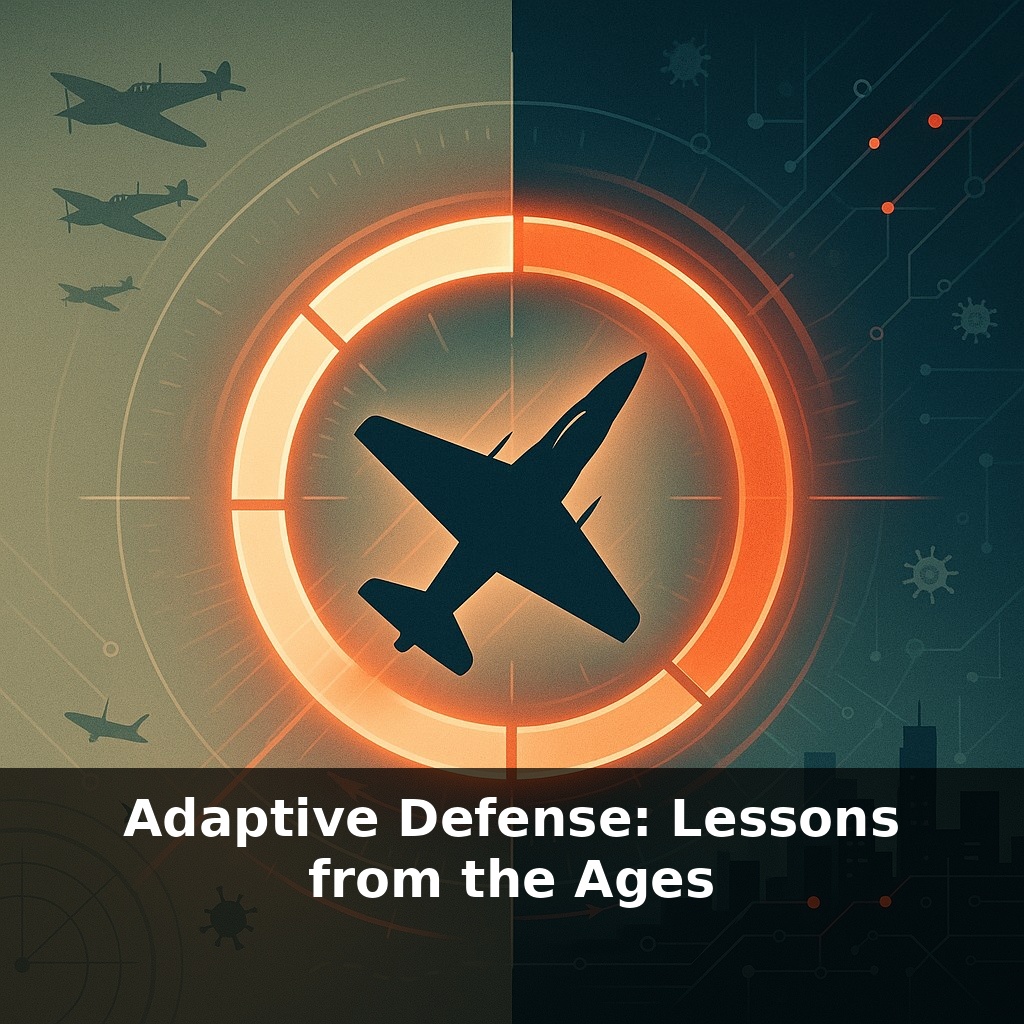
Elite fighter pilots cycle through Observe–Orient–Decide–Act in under two seconds. The RAF shifted entire squadrons within five minutes in the Battle of Britain. During COVID, the most adaptive companies rewired half their capital plans in a single year. These aren’t stories about heroism; they’re stories about system design.
The pattern is consistent: organizations that survive shock don’t just react faster—they shorten the distance between new information and meaningful change. They invest in sensors, not slogans; in decision rights, not memos.
Think of a jazz trio on stage: the drummer changes tempo, the bassist adjusts instantly, the pianist finds a new melody. No one calls a meeting; they’re all listening, all the time.
In this episode, we’re going to steal three design principles from history’s best defenders and translate them into practical playbooks for modern leaders.
History’s most resilient defenders treated uncertainty less like a storm to “wait out” and more like shifting wind to constantly trim their sails against. Their edge wasn’t perfect foresight, but the way they turned fresh information into coordinated movement before the situation hardened against them. In business, public health, or cybersecurity, that same edge comes from three often-neglected muscles: how quickly you update your shared picture of reality, how safely people can change course without asking permission, and how easily resources can be pulled from what matters less to what matters now.
When historians dissect surprisingly resilient defenses, they almost always find three quiet systems at work: shared awareness, local authority, and fluid logistics. Strip away the banners and battlefields, and you’re left with the same structural questions every modern organization faces under pressure.
First, shared awareness. In the Battle of Britain, radar wasn’t valuable just because it “saw” incoming aircraft—it was valuable because information flowed quickly into a single, evolving picture that everyone used. In modern terms: what’s your equivalent of the radar room wall? Elite teams don’t drown in data; they converge on a small set of live, trusted signals that update the group’s mental map in near real time. That might be a rolling incident channel in cybersecurity, a daily bed-capacity huddle in a hospital, or a live margin dashboard in a volatile market.
Second, local authority. Medieval commanders at Agincourt couldn’t micromanage every archer; they set simple priorities—hold the line, target the advancing knights—and then let the front adapt to mud, terrain, and chaos. Today, the question isn’t “Is my strategy good?” so much as “Who can change the plan in the next ten minutes without asking me?” The most adaptive organizations pre-negotiate these boundaries: who can spend what, shut down which systems, re-route which teams. This is preparation, not improvisation.
Third, fluid logistics. Every historic defender that lasted did one thing relentlessly: they pulled resources away from prestige projects and toward the current point of maximum leverage. That’s exactly what the most successful companies did during COVID when they rewired over half of their capital plans. In practice, this means designing budgets, staffing models, and contracts with built-in “break glass” clauses—explicit mechanisms to pause, redirect, or strip resources from low-value uses quickly.
Here’s the deeper pattern: adaptability depends far less on prediction than on reversible moves. The more decisions you can safely revisit, the braver you can be in the moment. Like a coastal city that expects shifting tides, the work is done long before the storm: building seawalls with gates, not concrete slabs; channels that redirect surges, rather than hoping the water never rises.
A hospital network facing a sudden regional outage doesn’t start by rewriting its strategy deck; it starts by tightening its feedback loop. One system pages live bed counts every 15 minutes and flags emergency-room backups; local administrators can divert ambulances on the spot, while a central “ops cell” decides which elective procedures to pause. Notice the layering: frontline teams adjust flow within hours, leadership reallocates staff and ventilators across the region within a day.
A different example: a software company runs weekly “kill, shrink, double” reviews. Teams nominate features or projects to kill outright, shrink to minimal maintenance, or double in investment based on fresh performance data. That practice makes shifting 50% of resources in a year feel normal, not catastrophic.
Think of it like a river system in heavy rain: healthy banks don’t try to stop the water; they give it channels, spillways, and wetlands so sudden surges can spread without wiping everything out.
Fighter pilots cycling an OODA loop in under two seconds hint at where leaders are headed: decisions shaped by streams of live signals, not quarterly reviews. As AI quietly becomes your fastest “staff officer,” the real differentiator won’t be speed alone, but what you’re willing to let it touch. Think less about single crises and more about seasons: like a coastline adapting to shifting currents, the organizations that endure will treat structure itself as something they can routinely redraw.
Your challenge this week: pick one ongoing initiative and shorten its feedback loop. Cut the distance between “something changed” and “we adjust” by half—fewer people in the chain, tighter metrics, faster check-ins. Treat your org like a sound check before a concert: small tweaks now prevent blown speakers when the volume suddenly jumps.