By your early teens, many of your lifelong favorite songs are already locked in. Yet tomorrow, a track you’ve never heard could still blow your mind. How can your taste feel so fixed and so changeable at the same time? Stay with me—your brain’s playlist is stranger than it seems.
Some of the songs you swear you “hate” today could become your future nostalgia triggers. That’s not just mood swing—it’s your brain quietly updating its settings. As you move through different scenes in life—first heartbreak, late-night study sessions, long commutes—your musical taste doesn’t just tag along; it rewires. A track that felt noisy or boring can suddenly click when it soundtracks the right moment, like a photograph that only makes sense once you know the story behind it.
There’s another twist: your taste is partly a social technology. Friends, scenes, and online communities don’t just recommend tracks; they train your ear toward certain rhythms, production styles, and even lyrical attitudes. Over time, these micro-influences stack, shaping what feels “authentic,” “basic,” or “genius” to you far more than you might admit.
Streaming platforms quietly map this shifting landscape. Every skip, replay, and “add to playlist” is logged, turning your listening into training data—not just for recommendation engines, but for the industry itself. Labels now watch which chord progressions, vocal timbres, and tempos light up listener stats long before a song “blows up.” At the same time, your brain is running its own experiments: tiny prediction errors when a chorus swerves or a bass line drops just late enough can feel thrilling. You’re not only consuming music; you’re constantly co-creating what “good” sounds like, both for yourself and, indirectly, for everyone else.
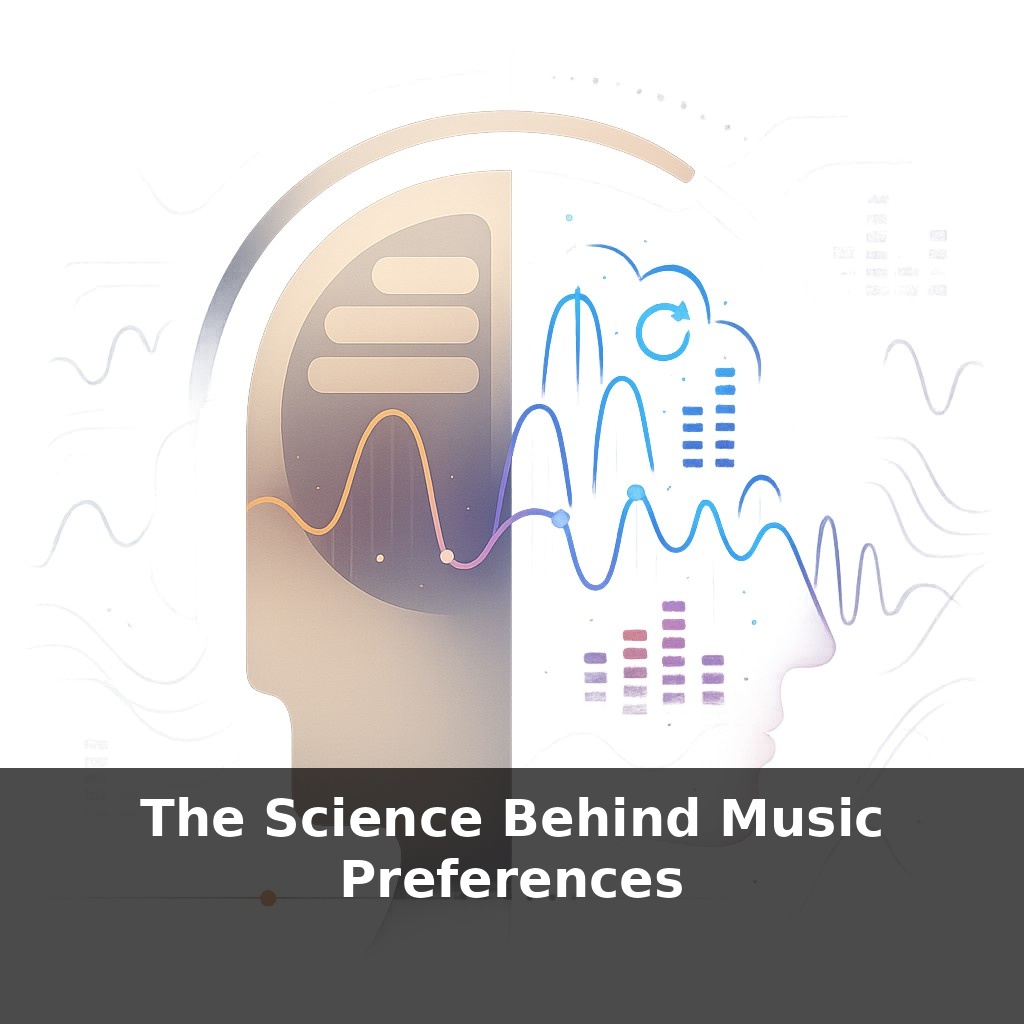
When researchers slide people into fMRI scanners and play their favorite tracks, the brain behaves less like it’s “appreciating art” and more like it’s scoring a hit of something potent. Activity ramps up in the same reward circuits that respond to food, sex, and some drugs, and dopamine jumps during the most emotional musical moments. Those chills you get at a key change or a sudden beat switch are your prediction systems being stretched just enough to be exciting, not so much that they give up.
That balance—between the expected and the surprising—turns out to be one of the most reliable signatures of what people end up liking. Songs that are too predictable fade into the background; songs that are too chaotic never “land.” Different genres sit at different sweet spots, and your own sweet spot shifts as you learn. The more you’ve heard a style, the more complexity your brain can comfortably track inside it.
Memory quietly layers on top of this. Your auditory cortex doesn’t just store how songs sound; it stores where they happened in your life. A track you first heard during an intense period—moving cities, falling for someone, grinding through exams—gets extra priority. Later, hearing just a few seconds can unlock that whole context. This is why certain tracks stick, even if you wouldn’t call them “objectively” great.
Genetics add another twist. Twin studies suggest that some of your leaning toward, say, high-energy music versus mellow, or vocals versus instrumental, is partly inherited. But those inherited biases don’t specify “you’ll love Korean R&B at 84 BPM.” They nudge broader traits: sensation-seeking, sensitivity to rhythm, comfort with novelty. From there, culture does the fine-tuning.
Personality research completes the picture. People high in openness tend to roam across styles and eras; those high in extraversion often favor danceable, socially shared music; those high in neuroticism may gravitate toward more emotionally intense or melancholic tracks. None of this is destiny, but it means your playlists carry a rough sketch of how you move through the world.
So even as recommendation systems watch your habits, your brain, history, and social world are constantly updating the rules of what can delight you next.
A quick real‑world snapshot: two friends grow up in the same city, same apps, same charts. One ends up deep into experimental jazz, the other into big-room EDM. Under the hood, their brains may be weighting “novelty” versus “energy” differently, nudged by both genes and personality. As they go to different shows, join different group chats, and fall down different TikTok rabbit holes, those early leanings get amplified into distinct identities.
Artists and platforms read this divergence in real time. Billie Eilish’s whispery, close-mic vocals, for instance, resonated strongly with listeners who tend to favor intimacy and detail over bombast, and that pattern showed up quickly in play data and crowd behavior at small shows. Meanwhile, K‑pop labels routinely A/B test song sections on tiny audiences, then tweak arrangements to better fit the “surprise tolerance” of their target fandoms.
In nature terms, your taste behaves a bit like a responsive ecosystem: subtle climate shifts—new friends, new city, new job—quietly reroute which musical “species” thrive.
Your favorite songs are starting to function like a physiological interface. As biometric wearables track stress, sleep, and focus, music apps could become more like adaptive lighting: brightening your rhythm when you slump, dimming it when you’re overloaded. Clinics are already testing playlists as “precision medicine” for pain and anxiety, fine‑tuned to your nervous system the way running shoes are tuned to your gait. The open question: who controls that tuning—you, or whoever owns the knobs?
Your challenge this week: pick one song you “shouldn’t” like—outside your usual lane—and live with it. Play it in three different contexts: walking, working, and winding down. Notice how your body and attention shift, the way a camera angle changes a scene. By next week, you’ll know whether it joins your canon—or stays a beautiful outlier.