The Forgotten Queen: Hatshepsut of Egypt
📝 Transcript
A pharaoh who ruled a golden age of peace and wealth… then was nearly erased from history. In a royal court where queens were meant to stand beside the throne, she sat on it. Tonight, we step into an Egypt that tried—and failed—to hide its most audacious king.
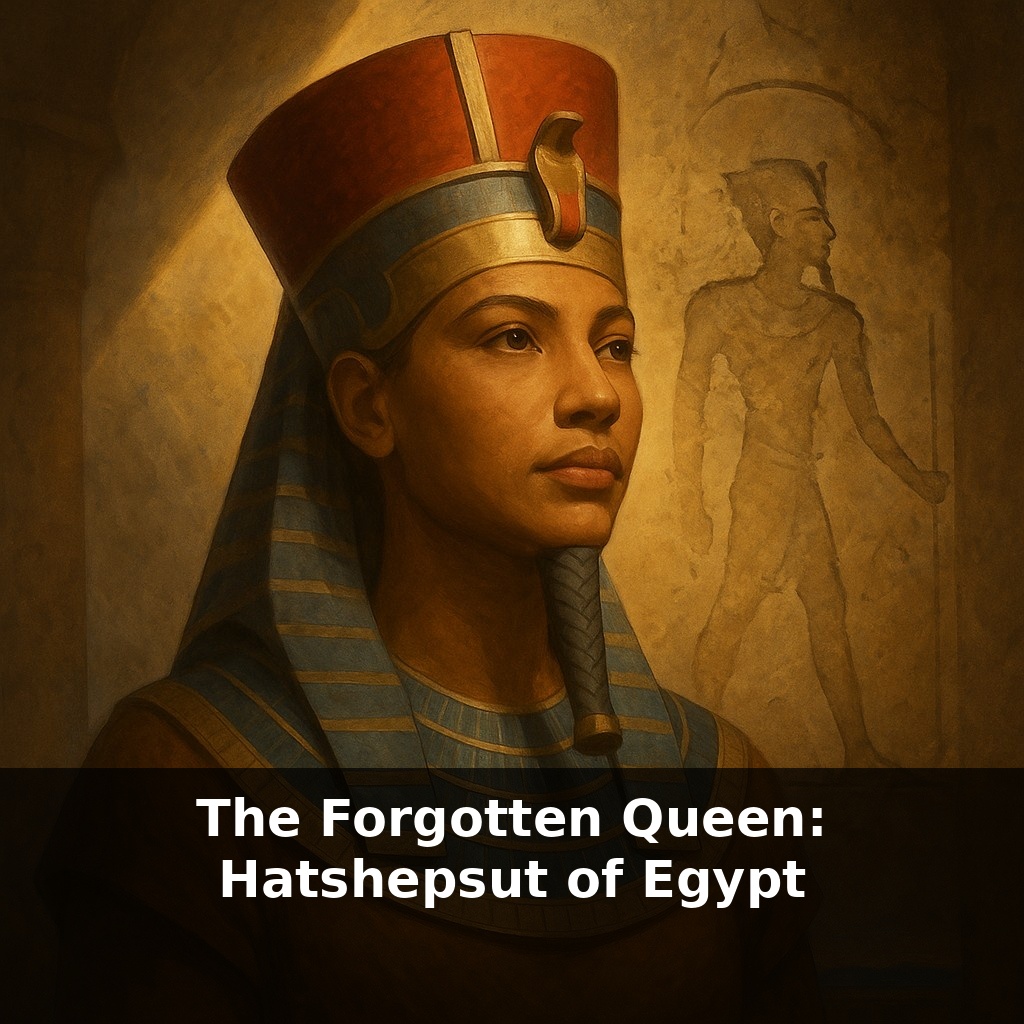
On temple walls along the Nile, Hatshepsut doesn’t appear as a timid placeholder but as a ruler mid‑stride: crown stacked high, false beard, striding like any other king of the 18th Dynasty. Yet behind that carved confidence lay a problem no sculptor could chisel away—she ruled in a system built to pretend she shouldn’t. Her authority rested on a tightrope of tradition, faith, and family politics, where one misstep could send a dynasty crashing. Priests, generals, and foreign envoys all had to be convinced that the cosmic order still held, even with a woman at its center. To pull this off, Hatshepsut didn’t just “fill in” for a boy-king; she rewrote the script, line by line, in stone, incense, and stone‑splitting ambition. Tonight, we follow the traces that survived the erasers.
Hatshepsut began not with a crown, but with a title: “God’s Wife of Amun,” a role that tied her directly to the great temple at Karnak and its powerful priesthood. From there she moved, step by deliberate step, through layers of influence—first as royal daughter, then great royal wife, then regent—until the line between “standing in for the king” and “being the king” blurred. In court scenes, she’s shown orchestrating rituals beside the boy Thutmose III; in the records, decrees shift subtly, like a river changing course, until her name alone carries the full flood of royal command.
Hatshepsut’s real leap wasn’t just from “queen” to “king,” but from caretaker to architect of Egypt’s future. Once her name began appearing alone in decrees, she moved quickly to anchor that authority in places no rival could easily uproot: stone, ceremony, and international reach.
On the ground, that meant workers hauling limestone and sandstone along the Nile in a near‑constant flow. Her projects didn’t just beautify the landscape; they redirected labor, wealth, and loyalty. At Karnak, she ordered towering obelisks that forced anyone entering the temple to pass through shafts of stone literally carved with her right to rule. Each monument quietly answered the same question: “Who keeps Egypt’s gods satisfied and its people fed?” The walls replied with her throne name.
She also pushed Egypt’s influence outward. In her ninth year, a fleet set off toward Punt, a land Egyptians treated as both trading partner and sacred origin of incense. The expedition’s reliefs show awkward‑legged ships overloaded with myrrh trees, fragrant resins, and exotic animals—proof that under her rule, Egypt reached beyond familiar horizons. Incense burned in Amun’s sanctuary wasn’t just piety; it was foreign policy made aromatic, binding priestly support to her success overseas.
At Deir el‑Bahri, her terraced mortuary temple rose in clean horizontal lines against the cliffs, its ramps guiding processions up like staged arguments in her favor. Scenes didn’t merely praise her; they rewrote her biography, tracing her selection by the god Amun himself. In a world where bloodlines and divine favor were everything, she had her case carved chapter by chapter so future generations would read her kingship as destiny, not improvisation.
All of this worked—so well that when Thutmose III later tried to pare her out of the record, he faced an impossible task. Chisel her name off a wall, and the empty cartouche still hinted at a missing presence. Smash a statue, and the broken base kept her titulary underfoot. The very scale of what she built became her most stubborn form of survival.
Hatshepsut’s genius shows most clearly in where she chose to leave fingerprints. Think less about her titles and more about how she quietly rewired who answered to whom. Consider the supply chains behind her building spree: quarry crews, boatmen, stonecutters, temple workshops. Each depended on her projects continuing. Stop the flow, and thousands felt it. Support her, and your district thrived. It’s no accident that many places that boomed under her kept honoring her long after the official line pretended she hadn’t mattered.
A modern historian once traced the inscriptions of minor officials whose careers peaked under her—scribes, overseers, ship captains. Their tombs brag not about “the king” in the abstract, but about serving “when Maat‑kare made monuments.” These side characters form a shadow archive, like backup files untouched by later censors. Even in foreign records, where Egypt appears as a trading giant rather than a pious kingdom, the prosperous decades line up suspiciously well with her time on the throne, a weather front of stability that passes—and then breaks.
Hatshepsut’s afterlife now unfolds in labs and databases as much as in tombs. CT scans, pigment analysis, and 3D models are turning scraped walls into legible archives, like rain slowly revealing faint tracks in dried mud. As more “missing” cartouches emerge, timelines of the 18th Dynasty may shift by years. Classroom stories, museum labels, even which statues get prime display space are quietly changing, testing whether modern gatekeepers will repeat Thutmose III’s edit—or correct it.
Her story isn’t just about a missing name; it’s a reminder that power often survives in side notes and scratch marks. As researchers stitch together shards, ship registries, and faint pigment traces, Hatshepsut reappears like a low tide revealing a long‑buried harbor. Your history book’s neat timeline? It’s still under renovation.
Start with this tiny habit: When you open a door at home or work, pause for two seconds and quietly say, “I am Hatshepsut-level capable.” As you walk through, picture one bold decision she made—like sending out the Punt expedition or carving her story into temple walls. Then ask yourself one quick question: “What’s one small thing I can do today that future-me would be proud I didn’t hide from?”
From this course
Unsung Monarchs: Royals in the Shadows
5 episodesUnlock all episodes
Full access to 5 episodes and everything on OwlUp.
Subscribe — $1.99/monthLess than a coffee ☕ · Cancel anytime