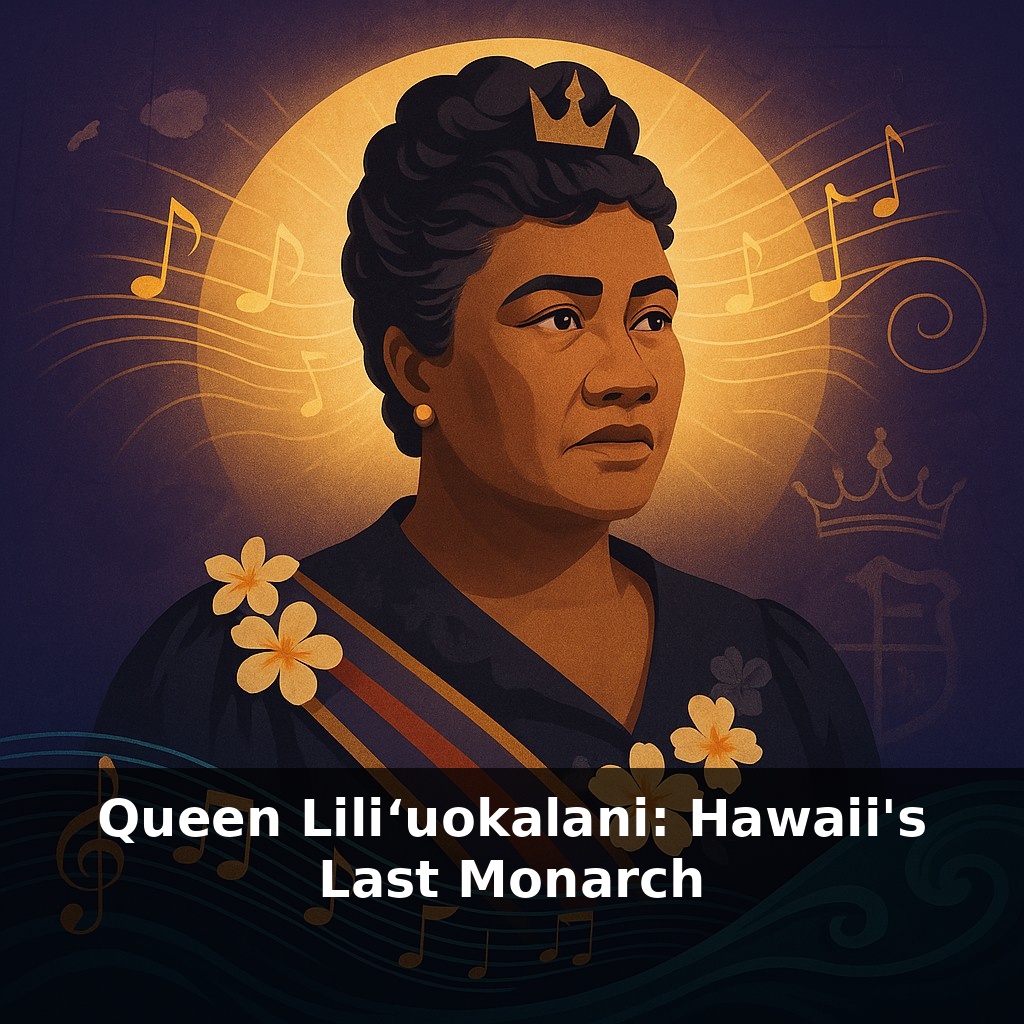
A queen writes a song so famous its royalties still fund her people today—while the country she ruled no longer officially exists. In this episode, we step into the brief, electric reign of Liliʻuokalani, Hawaii’s last monarch, and ask: how does a crown become a resistance?
Liliʻuokalani did not grow up expecting to rule. She was trained instead as a kind of cultural diplomat: fluent in multiple languages, steeped in Hawaiian history, and educated in Western politics and music. Think of her early life less like a royal fairytale and more like a rigorous dual-degree program—one foot in Native tradition, one in the shifting geopolitics of the Pacific. By the time she took power, the islands were already a strategic obsession for foreign powers, especially the United States, which coveted Pearl Harbor the way a chess player eyes the center of the board. At home, a powerful bloc of sugar planters and businessmen had learned to treat laws like levers, pulling them whenever profits were threatened. Liliʻuokalani stepped into this storm believing law, diplomacy, and culture could still protect her people’s future.
Her path to the throne ran straight through a political earthquake. In 1887, a small group of foreign-aligned elites forced her brother to accept the “Bayonet Constitution,” a charter signed under threat that slashed Native Hawaiian voting power and boosted property-based influence. It was as if the rules of the game changed mid-match and most hometown players were suddenly benched. By the time Liliʻuokalani inherited the weakened office, she faced a puzzle: how to restore real authority without triggering the very intervention her opponents were quietly preparing.
Liliʻuokalani stepped into office with a clear priority: unwind the damage of the 1887 charter without giving her opponents the pretext they wanted. That charter had tilted power toward wealthy property owners, many of them foreign-born, and away from the makaʻāinana—ordinary Native subjects who had long formed the backbone of the kingdom’s civic life. In speeches and private letters, she framed the problem not as royal ego, but as basic political math: if most of the population had been pushed to the margins, how legitimate could any government be?
Her solution was a new constitution. Crucially, it was not a plan to rule by decree. The draft required a three‑quarters vote of her own cabinet to take effect. In other words, she built in internal brakes, betting that a legal, consultative process could correct an unjust system. Supporters packed palace grounds when word spread that change might be coming. For many Kanaka ʻŌiwi, this wasn’t just about election rules; it was a chance to reverse years of watching land, language, and law slide out of their hands.
On the other side, the alarm was immediate. A tight circle of businessmen and lawyers—many with deep ties to sugar exports and U.S. tariffs—saw any expansion of Native voting power as a threat to their leverage. They formed the self-styled “Committee of Safety,” a name that framed their move as protection rather than seizure. Within days they were drafting not legislation, but letters to the U.S. minister and military, arguing that American lives and property were in danger.
Here the tempo changed. U.S. Marines landed from the cruiser Boston, not after street fighting, but before it—positioned where their presence alone could decide which side blinked first. Liliʻuokalani’s advisors warned her that any attempt to mobilize loyal forces might trigger a massacre; she knew many of the rank‑and‑file on both sides were kin or neighbors. Choosing to avoid a civil clash, she issued a carefully worded statement: she “yielded her authority” not to the insurgents as rightful rulers, but to the United States, explicitly expecting an investigation and restoration.
It was a legalistic move with moral weight, like a patient agreeing to painful treatment only because she trusts the doctor’s oath. She was betting that if the facts reached Washington clearly enough, the larger power would live up to its own stated principles.
Think about how she chose to respond after that calculated “yielding.” She didn’t retreat into private life; she shifted the battlefield. When annexation loomed, ordinary kānaka and allies gathered signatures for the Kūʻē Petitions—so many that, stacked, they would have formed a column thicker than many small-town phone books of the era. Names filled page after page in looping script, an analog data set documenting political will long before pollsters and spreadsheets.
Liliʻuokalani matched that grassroots energy with a different kind of pressure campaign. She traveled to Washington, not as a supplicant but as a head of state in exile, quietly lobbying senators, cultivating sympathetic journalists, and documenting her case in writing. Think of it as a marathoner’s strategy in a race built for sprinters: conserve energy, choose moments, never break form. Her memoirs, translations of traditional mele, and careful public statements turned personal loss into a paper trail—evidence for future generations that the overthrow was contested in real time, not merely mourned in hindsight.
Today, her legacy shapes court filings, classroom standards, and policy debates. Law students cite her protests like case precedents; organizers treat her petitions as an early opinion poll. Discussions about land return, self‑governance, and Pacific decolonization now treat her choices as a kind of long‑range weather pattern—still steering currents more than a century later, forcing Hawaiʻi and the U.S. to rethink what “consent of the governed” should mean.
Liliʻuokalani’s story doesn’t wrap up neatly; it lingers, like a low tide exposing what’s usually hidden. Her careful words in treaties and testimonies now surface in legal briefs and community meetings, quiet but stubborn. As you move through spaces named for her, it’s worth asking: whose decisions are still echoing beneath today’s headlines?
Before next week, ask yourself: 1) “Where in my own life or community do I see a ‘quiet annexation’ happening—situations where power or decisions are being taken without everyone’s full, informed consent—and what’s one conversation I can start this week to surface that?” 2) “If I took Queen Liliʻuokalani’s insistence on kuleana (responsibility) seriously, what is one concrete way I could show up for Native Hawaiian sovereignty or another Indigenous rights issue today—whether that’s whose voices I follow, what sources I learn from, or which local effort I choose to support?” 3) “How do I benefit from or participate in tourism, land use, or cultural consumption related to Hawaiʻi, and what’s one specific choice I can change (where I spend money, what I share online, how I talk about Hawaiʻi) so it better honors the history I just learned?”