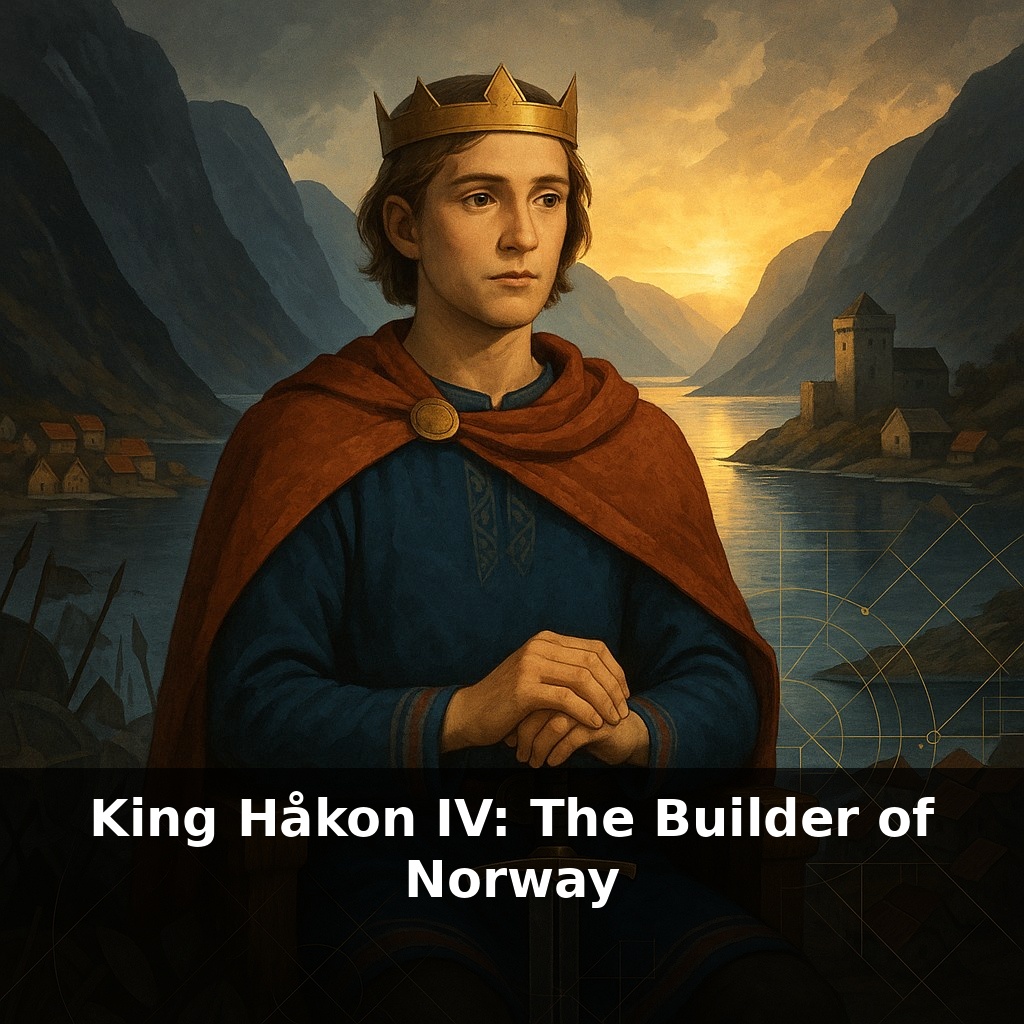
A teenager with no clear claim to the throne ends a century of Norwegian civil war—and most people outside Norway barely know his name. In this episode, you’ll step into a kingdom on the brink and learn how one quiet strategist turns chaos into lasting order.
By the time Håkon IV reached his forties, Norway was no longer just “not at war”—it was quietly turning into a regional power. His reign stretches 46 years, longer than any other medieval Norwegian king, and during that time he did something most rulers never manage: he changed how power worked, not just who held it. Under Håkon, royal income from trade and taxation grew enough to fund stone fortresses instead of wooden strongholds, permanent councils instead of ad‑hoc war meetings, and ships built for commerce as much as for combat. Bergen swelled into a town of several thousand people, drawing merchants from England and the Hanseatic cities. When Håkon hosted a coronation feast for 2,000 guests in his new royal hall, it wasn’t just a party—it was a public demonstration that Norway could now plan, feed, and house large-scale political life.
Håkon’s real leverage came from three choices: where he ruled from, whom he listened to, and what he wrote down. He shifted royal focus toward the coast, spending long stretches in Bergen and along the trade routes instead of deep inland. That put him within days, not weeks, of foreign merchants and envoys. He surrounded himself with a relatively small circle of perhaps a few dozen trusted councillors and royal clerks, rather than hundreds of loose-following warriors. And he began turning customary practice into written rules, instructing local assemblies that royal orders would now come in clear, standardized form.
Håkon’s breakthrough was that he treated peace as a chance to re‑engineer how Norway functioned, not as an excuse to relax. He started with law. Around 1260 he ordered a royal law code to be drafted—a national framework that would eventually become the Landslov of 1274 under his son Magnus VI. Before this, justice varied from valley to valley. Under Håkon’s program, sheriffs (lensmenn) and royal officials were given more standardized rules about fines, inheritance, and local order. That meant a farmer in Trøndelag and a trader in Bergen could increasingly expect similar treatment in court, which in turn made it safer to invest in land, ships, and cargo.
He also rewired Norway’s geography of power. Instead of expanding by constant conquest on the Scandinavian mainland, he focused on securing the North Atlantic. Between 1261 and 1262, Greenland and Iceland formally acknowledged him as king, adding perhaps 60–70,000 people to a core population of roughly 300–400,000 in Norway proper. Håkon didn’t just collect loyalties; he backed them with institutions—sending royal representatives, demanding taxes in stockfish and wool, and integrating local elites into his court network.
Trade policy followed. Håkon negotiated with English and German merchants so that Norwegian exports like dried cod, timber, and furs flowed reliably through ports such as Bergen and Tønsberg. More ships at sea meant more tolls and more legal disputes, so his chancery produced a higher volume of written letters and charters—hundreds survive—that clarify rights over harbors, anchorages, and markets. Each sealed document was both a legal tool and a reminder that authority now travelled on parchment as much as on horseback.
Culturally, he invested in prestige. Håkon’s Hall in Bergen, completed in 1261 and large enough for about 2,000 guests, was matched by a deliberate import of European literary and artistic trends. His court commissioned translations of French romances like the Tristan legend and developed vernacular sagas that portrayed the Norwegian king as a Christian, chivalric ruler on par with his European peers. Those stories trained nobles to think of loyalty and service in more formal, courtly terms—soft power that reinforced the harder structure of law and taxation.
Under Håkon, this new, more predictable order showed up in everyday numbers. A mid‑13th‑century royal letter might specify exactly how many pounds of stockfish a district owed, or how many armed men a ship‑owner had to provide per 20 “løp” of cargo. When Bergen’s population edged into the low thousands, customs rules listed which quays each group of foreign merchants could use and what toll—often a fixed fraction, like 1/20 of a cargo—they had to pay. That clarity cut disputes and sped decisions.
You can see a parallel in how some modern port cities operate. Rotterdam or Singapore publish detailed schedules of harbor dues, container handling fees, and turnaround targets down to the hour. Shipowners respond by routing more traffic there, because they can calculate risk and cost in advance. Håkon’s Norway did a medieval version of this: by turning vague obligations into counted units of fish, wool, and silver, he nudged local chieftains and traders into a system where cooperation paid better than resistance.
Your challenge this week: pick one recurring decision in your life—like managing your calendar or dividing a shared expense—and convert at least one vague expectation into a precise, written rule. For instance, instead of “we’ll split costs fairly,” define “we’ll each pay 50% of rent, utilities, and groceries, rounded to the nearest 10 units of currency, settled by the 3rd of each month.” Or replace “I’ll work on my project regularly” with “I’ll spend 25 focused minutes on it every weekday at 8:00 p.m., tracked on a simple checklist.” At week’s end, ask: did that numeric clarity reduce friction, reminders, or debates? If it did, you’ve just reproduced—on a tiny, personal scale—the same shift from custom to codified rule that helped Håkon’s Norway become more governable and more prosperous.
Håkon’s legacy now quietly shapes digital policy labs and museum tech teams. When Norway funds projects like scanning 50,000+ saga pages or building VR tours of Håkon’s Hall, it’s repeating his habit of turning culture into infrastructure. Your challenge this week: look at one “heritage” asset in your own world—a family story, a local archive, even old code—and ask, “How could this be structured so 10× more people can use it, not just admire it?”
Håkon shows that durable change is rarely flashy. He spent 4+ decades upgrading routines: more written decisions, clearer levies, more predictable courts. You can copy that at small scale. Pick 1 process you touch weekly—team standups, bug triage, budgeting—and tighten it by 10%: 1 clearer deadline, 1 cleaner handoff, 1 metric tracked. Then keep it.
Here’s your challenge this week: Pick one “Håkon-style” state-building project for your own life and execute a visible first step within 24 hours—either (a) host a small “ting” by gathering 2–3 people to make a shared decision (like a family norm, team rule, or club goal), or (b) design a personal “law code” of 5 clear rules you’ll live by for the next 30 days, inspired by Håkon’s focus on legal reform and stability. Name your project after a real Håkon initiative (e.g., “Nidaros Charter,” “Ting Reform,” or “Royal Court Plan”) and write that title somewhere public in your space so others can see it. Before the week ends, report back to at least one person what happened—just like Håkon had to show results to nobles and the Church to keep their support.