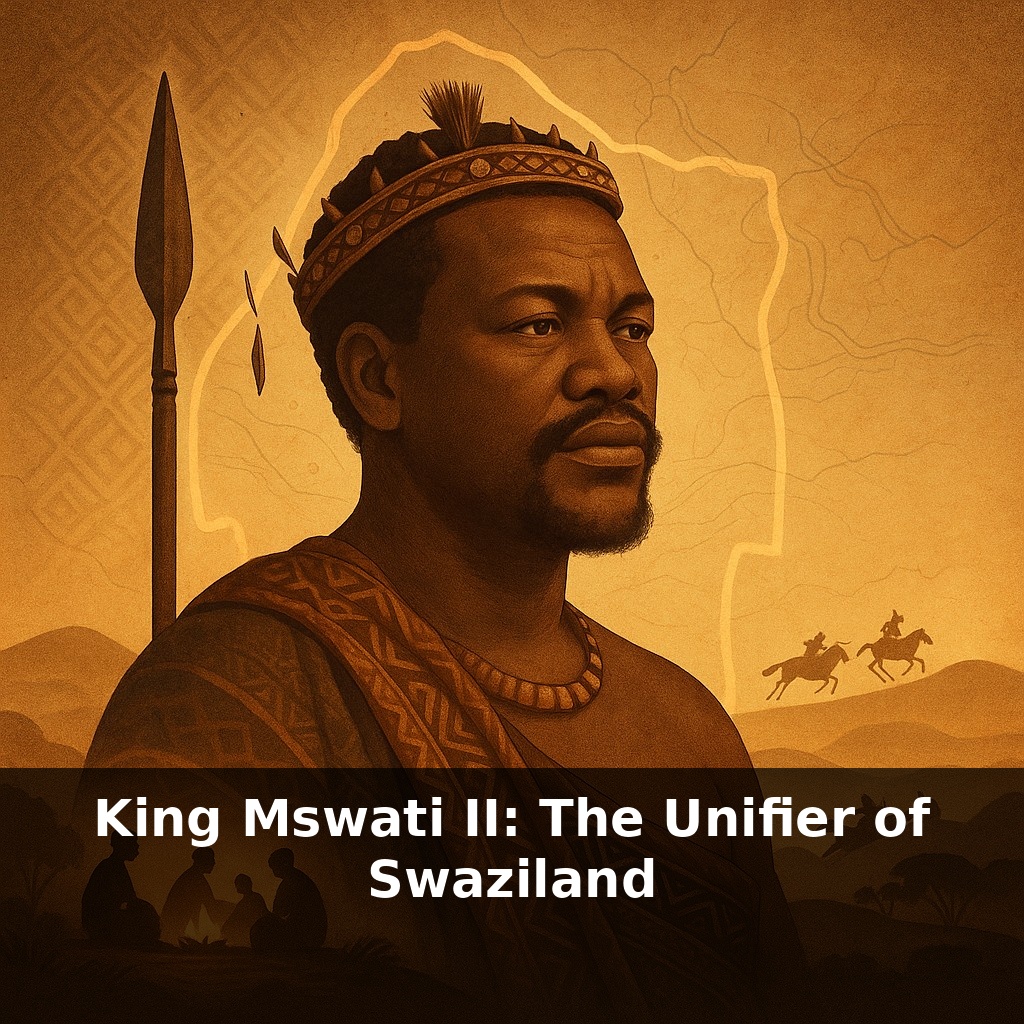
A 19th‑century king draws the borders of a country that still exist today—without railways, radios, or written maps. Riders race between distant valleys, clan elders argue by firelight, and a quiet question hangs in the air: how do you unite people who refuse to be ruled?
At the centre of this unfolding story stands Mswati II himself, a young king inheriting not a neat throne, but a tangle of rival ambitions. His world is crowded: Zulu power to the south, Pedi chiefs to the north, Boer settlers pushing from the west, and over forty proud clans watching closely to see whether this Dlamini ruler can actually protect their cattle, land and honour. Each has its own history of feuds and favours, and none intends to kneel lightly. Mswati’s task is less about grand speeches and more about reading the mood in distant homesteads, timing raids so they signal strength without triggering disaster, and turning would‑be enemies into in‑laws. Think of a thunderstorm hovering on the horizon: his decisions determine whether it breaks as a cleansing rain that nourishes the soil, or as a flood that washes his fragile authority away.
To understand how he manages this, shift closer to daily life in his domain. The heartbeat of politics is not in royal declarations, but in beer‑sharing at seasonal gatherings, in disputes over grazing paths, in whispered news carried by traders who cross rivers long before soldiers do. Age‑sets advance through initiation schools, forging bonds that knit distant homesteads into loose networks of obligation. Rainfalls and droughts quietly redraw local priorities: a failed harvest can matter more to a chief than any distant battle. In this world, a missed condolence visit can undo months of careful negotiation.
Power in this landscape moves along three main paths: regiments, marriages, and ritual. Follow the first path and you find the amabutho, the age‑based regiments Mswati II shapes into something more than temporary war bands. Young men drawn from distant homesteads train and live together for seasons at a time, drilled not just to fight, but to move in coordinated columns, carry messages, escort envoys, and serve at royal homesteads. A regiment that spends one year raiding cattle across a ridge might spend the next patrolling a frontier or helping enforce a disputed succession in a client chiefdom. Warfare, in his hands, becomes a flexible political tool: a sharp raid against a wavering neighbour today, a carefully restrained show of force to reassure a nervous ally tomorrow.
The second path runs through marriage huts rather than battlefields. Mswati’s household expands into a living map of his realm, each senior wife anchoring an alliance with a powerful lineage. A chief whose daughter enters the royal homestead gains more than prestige; he gains regular access to the king’s ear and a stake in the survival of the wider system. When quarrels flare between clans, they can sometimes be defused not by threats, but by summoning “our shared grandchildren” as a reminder that any blood spilled will circle back through intertwined families. Over time, this web of kinship helps stabilise areas that soldiers alone could never fully control.
The third path, ritual, shapes how people imagine authority itself. At Zombodze, seasonal ceremonies tie harvests, rainmaking, and ancestral veneration to the king’s presence. Regional leaders bring offerings that acknowledge not only political subordination but shared dependence on the same ancestral guardians. In return, they expect the king to mediate disputes that cross local boundaries, to redistribute some captured cattle, and to sponsor relief in hard years. When rumours spread of bad omens or offended spirits, Mswati responds with visible rituals that reassure worried communities he is tending to dangers they cannot see.
None of these paths works in isolation. A hard‑fought victory means little if offended in‑laws shelter rebels; a prestigious marriage can fail if not backed by credible force. Mswati’s skill lies in adjusting their balance, again and again, as winds shift across his highland kingdom.
Listen to how his choices play out on the ground. A northern chief hears that one regiment has been ordered not to attack a tempting herd just across the river. That restraint signals more than mercy: it hints that Mswati is holding that force in reserve for a different frontier, and that the chief’s loyalty is being quietly tested. Far away, a junior wife from a once‑minor clan discovers her brothers are now treated as honoured messengers, because any insult to them could ripple awkwardly into the royal household. Even traders adjust their routes when royal envoys begin visiting a new hillside market; where messengers go, protection tends to follow. It’s like watching a careful coach reshuffle players mid‑match—not chasing every ball, but positioning key runners where the game will be decided ten minutes from now. In archives and oral histories, these small moves surface as brief notes: a redirected raid here, a bride sent there, a ritual postponed until the right elders arrive. Together, they reveal strategy in fragments.
Today, his methods echo in boardrooms and peace talks. Leaders facing factional parties or fragile coalitions can study how he layered incentives: status, access, and protection braided together. Think of a regional trade bloc where states trade visa waivers for shared disaster-response teams and cultural festivals; loyalty is reinforced in calm years, not only during crises. The risk, as then, is that overcentralisation can silence local voices while claiming to protect them.
His story also nudges us to ask whose voices are missing from the drumbeat of state-building—the farmers shifting planting dates after raids, women brokering quiet truces, scouts mapping passes like urban cyclists finding backstreets. Your challenge this week: sketch your city or workplace as a network of hidden negotiators, then ask who actually holds it together.