The Birth of Morality: What Makes Us Good?
📝 Transcript
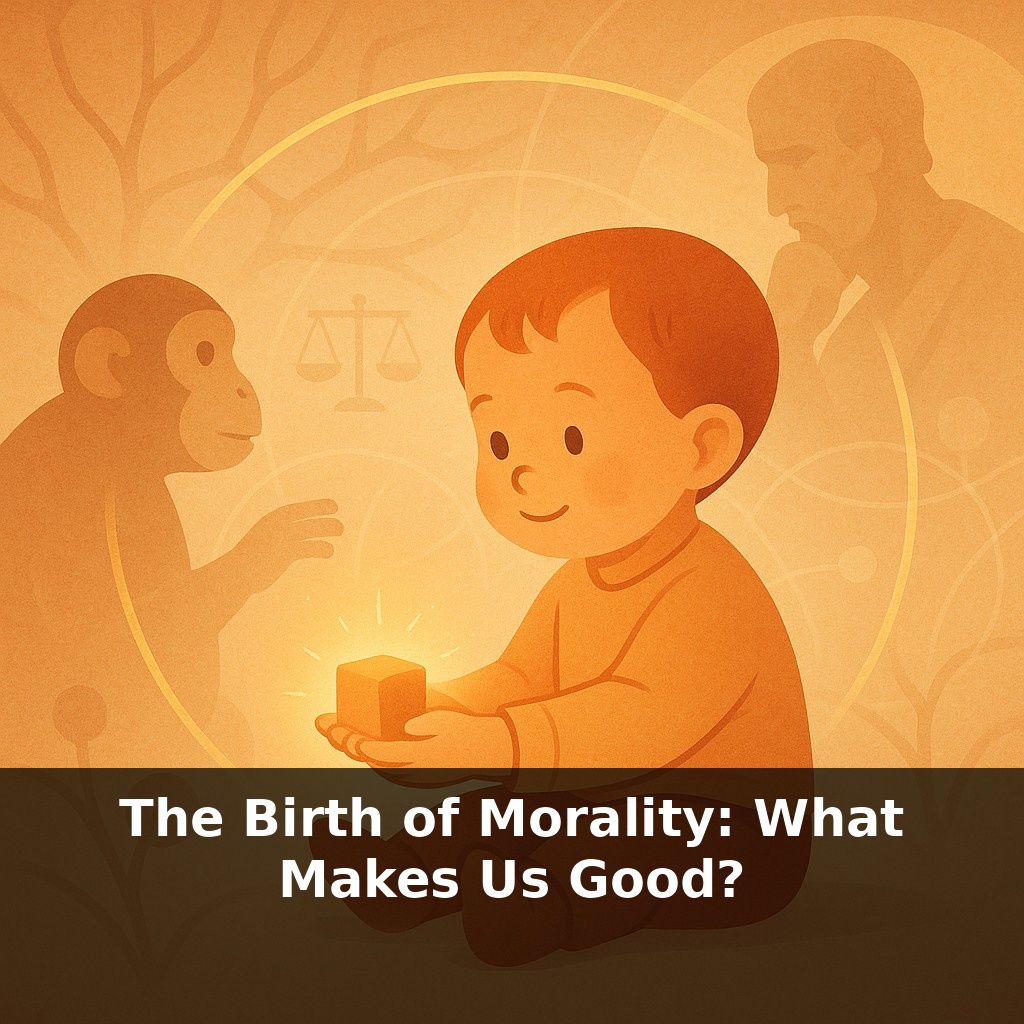
“About half of people worldwide say you don’t need religion to know right from wrong. Now picture a toddler sharing a toy, a monkey throwing away an unfair reward, and a philosopher arguing about justice. Somewhere between those three, our sense of ‘good’ is quietly being born.”
Morality doesn’t just switch on one day, fully formed. It grows in layers. Long before we argue about ethics in classrooms or courts, our bodies and brains are already running quiet background programs: flinching at a cry, softening at a smile, tensing when someone cuts the line. These reactions aren’t random—they’re traces of older survival strategies for living in groups, upgraded over thousands of years. Then culture arrives and starts editing: families reward some impulses, religions redirect others, laws punish a few outright. Over time, these scattered reactions, rules, and habits start to feel like a single “voice of conscience.” In this episode, we’ll pull those layers apart—biological reflexes, psychological motives, and philosophical rules—and ask not just where they came from, but why they so often disagree inside the very same person.
Some clues hide in places we rarely connect: a hormone puffed into someone’s nose that suddenly makes them more generous in a money game; twins raised apart who still show similar levels of kindness; a viral video of a capuchin monkey angrily rejecting a worse snack than its neighbor. At the same time, global surveys show most people now think you can reach solid ethical ground without any sacred text. Biology tweaks our impulses, culture edits our habits, and reflection keeps rewriting our reasons. To see how they interlock, we need to zoom in on each layer without pretending any one is in charge.
Start with the oldest layer: our bodies quietly pushing us toward life in groups. Primates that groomed each other, defended allies, and shared food were more likely to survive than loners. Over many generations, traits that nudged cooperation forward—sensitivity to others’ distress, discomfort at being excluded, pleasure in being approved—tended to stick. That doesn’t mean anyone “aimed at” goodness; it means that, in social species, individuals who could anticipate partners’ reactions had an edge.
Modern studies trace this edge in surprising ways. Twin research, for instance, suggests that some people are simply more inclined toward helping and comforting than others, even when raised in different homes. Certain temperaments show up early: some kids bristle at rule-breaking on the playground, others glide past it. Under the skin, brain circuits for reward and threat light up not only when things happen to us, but when we watch them happen to someone else. That overlap helps make another’s pain feel uncomfortably close to home.
But these inherited tendencies are flexible, not fate. Training, trauma, and culture can amplify or muffle them. A child praised for standing up to a bully may come to feel a rush of pride at defending the weak; a child punished for questioning authority may learn to silence the same impulse. In adulthood, a workplace that celebrates cutthroat competition can tilt those circuits one way, a community that honors care work another.
Then there is the reflective layer, where we start asking whether our gut reactions are actually defensible. Philosophers do this in public, but ordinary people do it around dinner tables and in late-night group chats: arguing over whistleblowers, debating how much privacy we owe our partners, struggling with how honest to be on a job application. Here, we test our reactions against principles like consistency (“Would I accept this if roles were reversed?”) and scope (“Does this still seem right if I apply it to strangers, not just friends?”).
Sometimes those checks push back hard on what feels natural. We may instinctively favor our in‑group, yet endorse rules that protect outsiders. We may crave revenge, yet defend fair trials even for people we despise. The friction between impulse, habit, and reflection isn’t a bug in the system; it’s the terrain on which our idea of being “good” keeps evolving.
A tech company deciding how to handle user data shows these layers colliding in real time. Engineers design features that quietly track behavior because it helps the product “work better.” Marketing teams see patterns they can monetize. Then someone raises a hand: “Would I be okay if another company did this to me?” Legal quotes regulations; PR imagines a headline about a leak. Eventually a policy emerges, not from any single impulse, but from trade‑offs between profit, empathy, fear, and ideals of fairness.
You can watch a smaller version of this inside a soccer team. A striker feels the urge to shoot for glory, but also sees a teammate open for an easy tap‑in. The crowd’s expectations, the coach’s values, and the player’s own standards of sportsmanship all weigh in. A split‑second decision—pass or shoot—carries traces of early training, locker‑room norms, and private reflection about what kind of teammate they want to be.
Laws, apps, and even games are slowly becoming testbeds for our best guesses about being “good.” When cities design welfare systems, they’re not just moving money; they’re betting on what people will actually do under pressure. AI adds another twist: should we train machines to mirror our average behavior, or our aspirations? Like a multiplayer game that patches its rules after each season, future societies may keep updating norms as new data, tools, and voices reveal where our current “best effort” still falls short.
Maybe “being good” isn’t a destination but an ongoing redesign. New dilemmas—deepfakes, climate tipping points, gene editing—force us to beta‑test our values in unfamiliar terrain. Like updating a city’s transit map after new lines are built, we’ll keep redrawing our routes between self‑interest and concern for others, learning where old paths quietly fail.
Try this experiment: For three days, secretly flip a coin each morning to decide whether you’ll act from “fairness” (tails) or “loyalty” (heads) in one specific situation that day—like splitting a dessert with a friend, deciding who does an annoying task at work, or choosing whose idea to support in a group. If it’s fairness, you deliberately split benefits or burdens as evenly as possible; if it’s loyalty, you deliberately favor “your people” (a friend, colleague, or family member) even when it slightly disadvantages someone else. Each evening, quickly rate (1–5) how good you feel about yourself, how conflicted you feel, and how others reacted in that situation. After three days, compare which moral lens (fairness vs. loyalty) left you feeling more grounded, more guilty, or more connected—and notice whether your “gut” morality matched the coin flip or resisted it.
From this course
Values Unveiled: What Shapes Our Moral Compass?
5 episodesUnlock all episodes
Full access to 5 episodes and everything on OwlUp.
Subscribe — $1.99/monthLess than a coffee ☕ · Cancel anytime