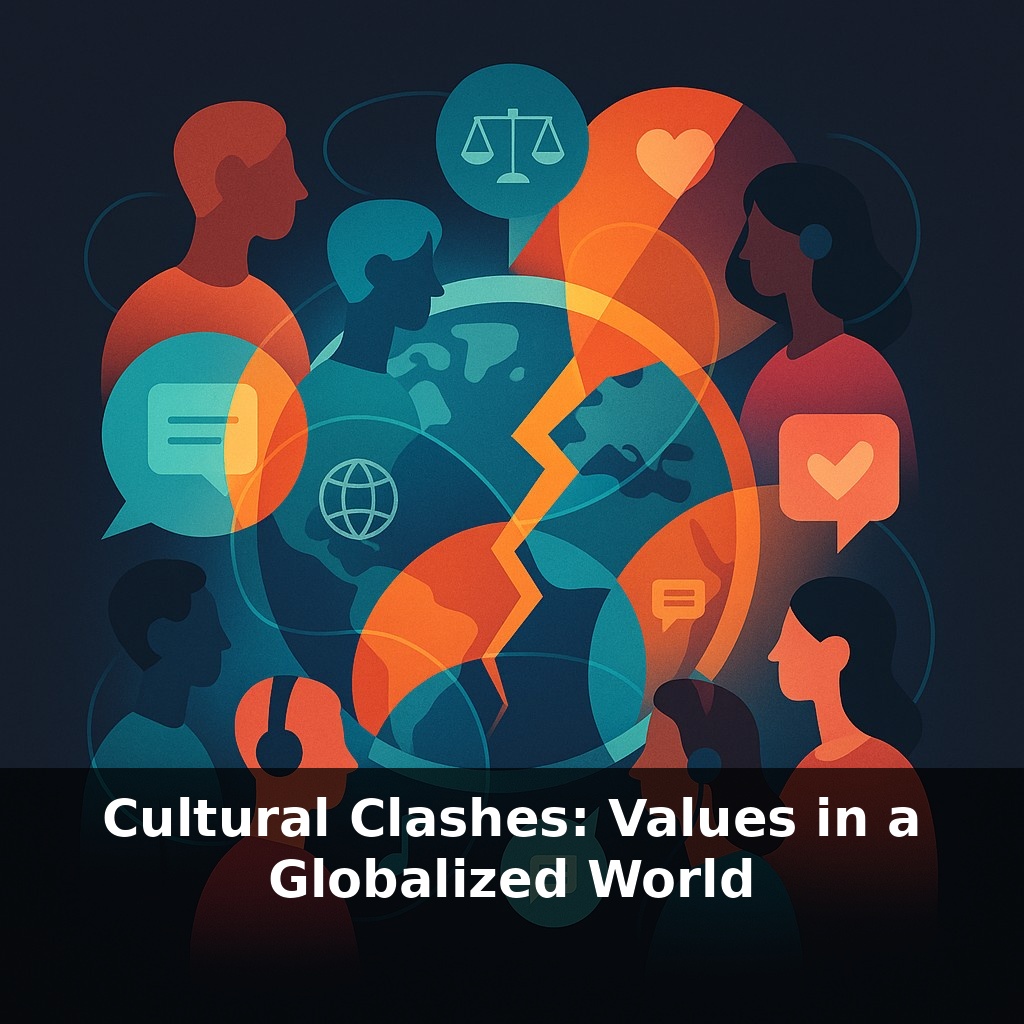
Right now, hundreds of millions of people live outside the country where they were born—yet many still stream the same songs, follow the same influencers, and vote for wildly different values. How do we share a culture without agreeing on what “good” even means?
A strange thing is happening in our global moment: people are arguing more fiercely than ever about values, while quietly borrowing from one another’s ways of living. A teenager in Lagos joins a K‑pop fandom; a CEO in Berlin adds “mindfulness” sessions inspired by Zen; a reality show in Mumbai copies a US format but edits out the kissing scenes. These aren’t just lifestyle quirks—they’re tiny pressure points where different moral priorities collide and sometimes fuse. Some clashes are loud and public, like debates over dress codes, speech laws, or school curricula. Others are subtle: a translation choice, an office rule, a product label. Step back, and you start to see a pattern: the struggle isn’t only over *which* values win, but over *who* gets to decide what counts as “normal” in the first place.
Zoom in, and these tensions look less like a clean clash and more like overlapping negotiations. A government weighs religious lobbying against trade deals when drafting a media law. A streaming platform quietly edits posters and episode orders by country, the way a café offers different “specials” in different neighborhoods. Migrants send remittances home while bringing back new habits, blurring lines between “foreign” and “local.” Power, of course, is uneven: a viral campaign from a wealthy country can reshape dress codes abroad faster than local protests can change a single workplace rule.
Step into a migrant-run factory on the outskirts of a booming city and you can watch global values collide in real time. The boss advertises “family-like” loyalty, then threatens anyone who refuses unpaid overtime. Posters on the wall praise “empowerment,” but passports are locked in a drawer. This is where high-minded talk about diversity and human rights meets the statistic that 27.6 million people are trapped in forced labor. Whose priorities shape what actually happens on the shop floor: the multinational client, the local recruiter, the religious leader, the trade lawyer, or the exhausted worker?
Look at three forces that keep reshaping these clashes:
First, **who holds leverage**. A fashion brand facing a boycott over sweatshop conditions may suddenly “discover” ethics; a domestic worker on a temporary visa has almost none of that bargaining power. When one side controls money, media, or migration rules, their story of what’s acceptable often becomes the default—until a scandal or movement exposes the gap.
Second, **how stories travel**. A single video of a protest in one city can redefine what counts as abuse or bravery in another. World Values Survey data on rising acceptance of homosexuality shows how repeated exposure—through TV, tourism, or a friend’s coming‑out—can shift what people call “justifiable,” without guaranteeing that courts or parliaments follow.
Third, **how institutions translate conflict into rules**. Courts decide whether a religious dress ban protects neutrality or discriminates. Trade agreements quietly encode labor standards—or quietly ignore them. A social media firm tweaks an algorithm, amplifying some moral outrage while burying others. These aren’t neutral technicalities; they’re moral choices with user interfaces.
Think of value systems like operating systems receiving foreign code: some apps are rewritten to run smoothly, some crash the whole device, some get sandboxed so they can’t do much harm. The outcome isn’t predetermined. In Indonesia, many call Western pop culture harmful while eagerly consuming it; in over 70 countries, same‑sex relations remain crimes even as rainbow logos appear in global ads. Between backlash and celebration lies a messy middle zone where people test, patch, and sometimes quietly uninstall each other’s moral software.
Your challenge this week: trace one concrete “value journey” from start to finish. Pick a specific issue that crosses borders—maybe a clothing item you own, a song you stream, or a workplace policy you follow. Then:
1. Identify at least three different actors involved across countries (for example: designer, regulator, activist, buyer, streaming service, religious authority, union, influencer). 2. For each actor, write a one-sentence guess about what *they* would say the “right” thing is in this case. 3. Look for where these mini‑moralities clash or quietly align. Which actor actually has the power to decide what happens? Which one absorbs the cost?
By the end of the week, you won’t just see “globalization”; you’ll see a moving map of competing moral projects—and your own place inside it.
Consider three quick scenes. First: a gaming studio in Seoul designs a battle royale title. When it launches in Germany, blood is recolored and loot boxes get age-gates; in Brazil, local streamers insert jokes about politics; in Saudi Arabia, certain outfits never appear. Same game file, different moral edits—yet players still meet on the same servers. Second: an eco‑label on your sneakers. The brand touts recycled plastic; a lab in another country certifies “low emissions”; a riverbank community near the dye house lives with murky water. The shoe becomes a traveling compromise between marketing claims, regulations, and quiet harms. Third: an international school board drafts a “global citizenship” curriculum. In one city, parents demand more emphasis on national history; elsewhere, students push to add LGBTQ+ authors. The syllabus turns into a negotiated blueprint, more like a constantly renovated building than a finished temple.
A passport policy at a border, a dress code in a classroom, a filter in a recommendation engine—these will quietly decide which clashes cool into compromise and which ignite. As AI tools scan speech and images, they’ll be asked to act like referees in disputes they barely grasp. Think less about a single “global ethic” and more about overlapping rulebooks, like sports played on the same field. The real question is who gets to write the updates, and who just has to play along.
Global clashes aren’t just “out there” in headlines; they’re more like overlapping playlists on your phone, auto‑shuffling with every notification, purchase, and click. Each small choice joins a much larger remix. The open question is whether we learn to DJ together—sharing the queue—or let the loudest speaker in the room drown everyone else out.
Try this experiment: For the next 7 days, pick one daily interaction (at work, online, or in your neighborhood) and deliberately respond using the *other* cultural value from the episode’s examples—if you’re usually individualist, pause and choose the “collective harmony” option; if you’re usually direct, choose the “high-context/indirect” option described in the show. Before the interaction, briefly predict how you think the other person will react; after it, compare what actually happened to your prediction and note one surprise. At the end of the week, choose the one value-shift that led to the most unexpectedly positive outcome and commit to using it in one specific recurring situation (team meetings, family dinners, group chats) for the next month.