“Future people don’t vote, don’t tweet, and don’t sue—but they’re the ones who’ll live with our decisions.”
Right now, in labs and data centers, choices are being coded into AI and gene tools that could steer not just your life, but the lives of billions yet to be born.
In 2016, there were only a handful of public guidelines about AI ethics. By 2022, there were more than 160. That’s not a niche debate—that’s a scramble to rewrite the rulebook while the game is already in play.
At the same time, doctors are testing ways to rewrite human genomes, engineers are designing brain-computer interfaces, and policymakers are quietly weighing whether we should cool the planet with reflective particles in the sky. None of these choices fit neatly into old moral categories of “individual vs. society” or “freedom vs. security.”
Instead, a new cluster of values is taking shape: who gets included in the training data—and who gets erased; whose bodies and brains remain truly theirs in a world of constant sensing; and how much weight we grant to people who don’t yet exist but will live inside the systems we’re building now.
Ethical debates used to revolve around familiar battlegrounds: speech, sex, war, work. Today, they’re creeping into thermostat settings, hiring algorithms, personalized medicine, and proposals for off‑world colonies. That’s because our tools now operate at three awkward scales at once: inside our cells, across global networks, and over centuries. As these layers stack, old value systems start to clash—religious duties vs. data rights, national interests vs. planetary limits, personal freedom vs. collective survival—forcing us to ask not just “What is right?” but “Who gets to decide, and for how long?”
In less than a decade, we went from almost no public conversation about neuro‑rights to the OECD noting that fewer than 10 countries clearly protect brain‑data privacy. That gap—between what’s technically possible and what’s legally or morally articulated—is where “future ethics” is starting to take shape.
Instead of asking only, “Is this allowed?” more people are asking, “Who could be harmed by this in 30 years—and how would we even know?” That’s why you see new experiments in anticipatory ethics: citizen assemblies that deliberate on climate interventions before deployment; “red‑team” exercises where researchers are paid to break AI systems to surface hidden risks; and regulatory sandboxes where companies can test high‑risk tools under close oversight rather than in the wild. These aren’t perfect, but they show ethics trying to move in lockstep with innovation instead of limping behind it.
Inclusivity is shifting from a moral slogan to an engineering constraint. When facial recognition fails more often on darker‑skinned faces, or loan models quietly penalize people from certain postcodes, the fix is not just “cleaner data.” It’s choosing which errors we are willing to tolerate and which groups we refuse to sacrifice to optimize profits or efficiency. Bias cannot be deleted like a file; it has to be negotiated, monitored, and sometimes deliberately overruled.
Long‑termism pushes this even further. If the Oxford Global Priorities Institute is even directionally right that preventing extinction could affect tens of billions of lives, then actions that slightly reduce existential risk—from better pandemic monitoring to safer nuclear policies—may outweigh many short‑term wins. The hard part: long‑termism can be hijacked to justify present harms “for the greater future good,” so future ethics needs strong guardrails around who speaks for tomorrow.
Ecological stewardship is also mutating. It’s not just about recycling or conservation anymore, but about whether we treat the atmosphere and biosphere as infrastructure we’re allowed to re‑engineer. Geoengineering proposals sit on this fault line: they might reduce global temperatures, yet they can’t repair oceans acidified by CO₂ or restore lost species, and a sudden halt could unleash abrupt warming. So emerging frameworks emphasize reversibility, global consent, and the humility to treat some options as last‑ditch backups, not default solutions.
Threaded through all this is cognitive and bodily autonomy. Health apps, wearables, and neural sensors can blur the line between support and subtle coercion—where “nudges” toward productivity or calm become hard to refuse because employers, insurers, or platforms implicitly expect compliance. The ethical question is no longer just whether data are “consented to” at a single click, but whether people can realistically say no without losing access, income, or community.
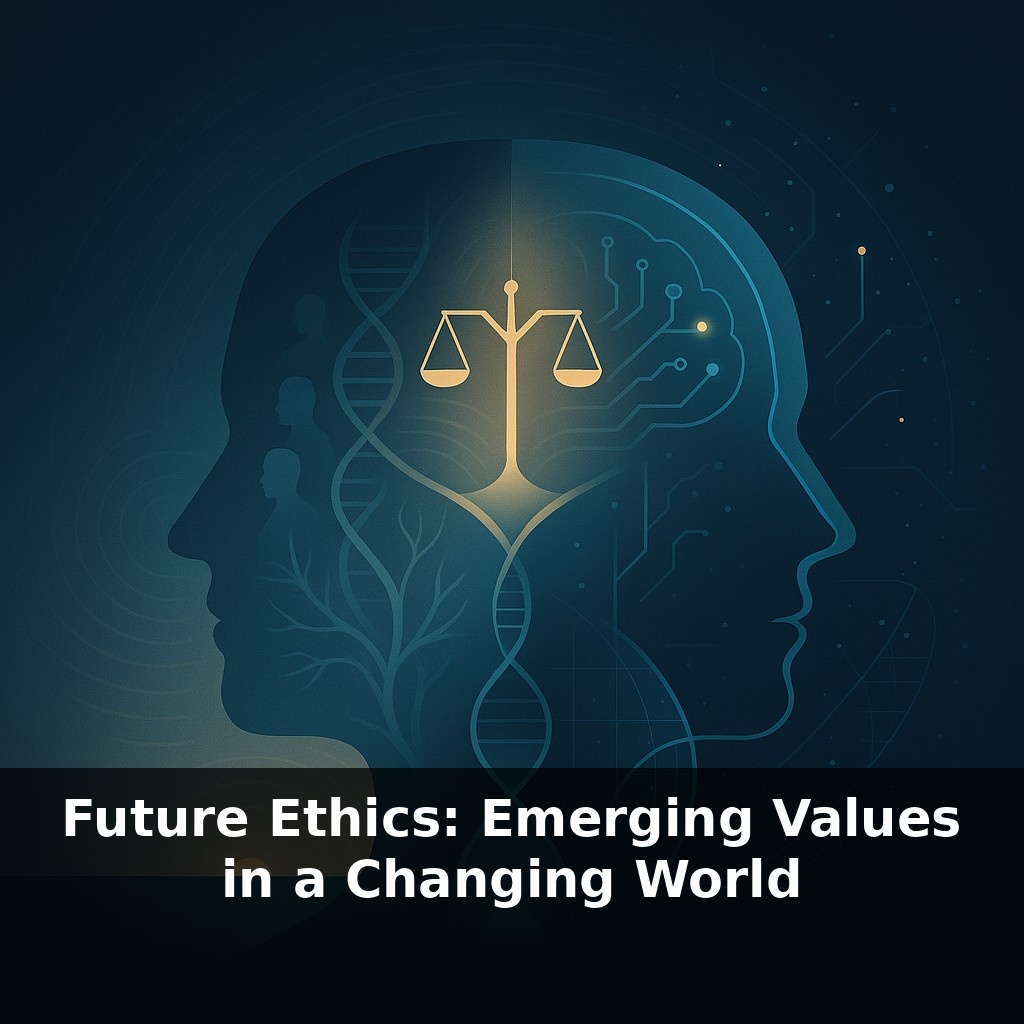
Future ethics, then, is less a fixed code and more an evolving practice that must stay as networked, global, and fast‑learning as the systems it tries to guide—open to revision, grounded in lived experience, and alert to those who are easiest to ignore: marginalized groups today and the silent majority of tomorrow.
“Future ethics” already shows up in places that look mundane. When Spain tested a citizens’ assembly on climate, the questions weren’t abstract; participants debated who should control potential climate-cooling tech and how to protect regions that never caused most emissions. In hospitals, some review boards now include patient advocates and disability groups to flag how “personalized” treatments could lock people into data profiles they can’t escape.
Sports offers a concrete parallel: in Formula 1, rules evolve as cars get faster, not years later. Stewards watch live telemetry, tweak regulations mid‑season, and sometimes ban a design that technically fits the rulebook but clearly breaks its spirit. Future ethics needs similar “race stewards” for AI labs, biotech startups, and space agencies—people empowered to pause, audit, or reroute projects in real time.
This also means building feedback channels where gig workers, small communities, and users can contest how large systems classify or nudge them, instead of relying only on top‑down expert panels.
Future ethics could reshape everyday expectations: product labels might list not just ingredients but planetary and social impact scores. Company boards may reserve seats for representatives of ecosystems or distant communities, the way cities now reserve bike lanes. Court cases could hinge on whether an algorithm showed “due care” for those least visible. And personal “moral dashboards” might help people track how their lifestyle nudges wider systems, like fitness apps already do for health.
Instead of asking ethics to deliver final answers, we may treat it as a shared lab notebook: public, editable, always dated. New entries could log unexpected side‑effects, dissenting voices, and local experiments—from city climate trials to school data charters—so that “good” stops being a static label and becomes a collective, evolving research project.
Here’s your challenge this week: Pick one everyday technology you use—like your favorite social app, smart speaker, or AI tool—and actually read its latest terms of service and privacy settings, then change at least three defaults so they better match your values (for example, data sharing, personalization, or facial recognition). Next, have a 15-minute “future ethics” chat with one friend or colleague where you explain one hidden trade-off you discovered and how you changed your settings because of it. Before the week ends, email or DM the company one concrete ethical improvement you want to see (e.g., clearer consent prompts, limits on biometric data, or an option to completely opt out of tracking) and save a screenshot of your message as your receipt.