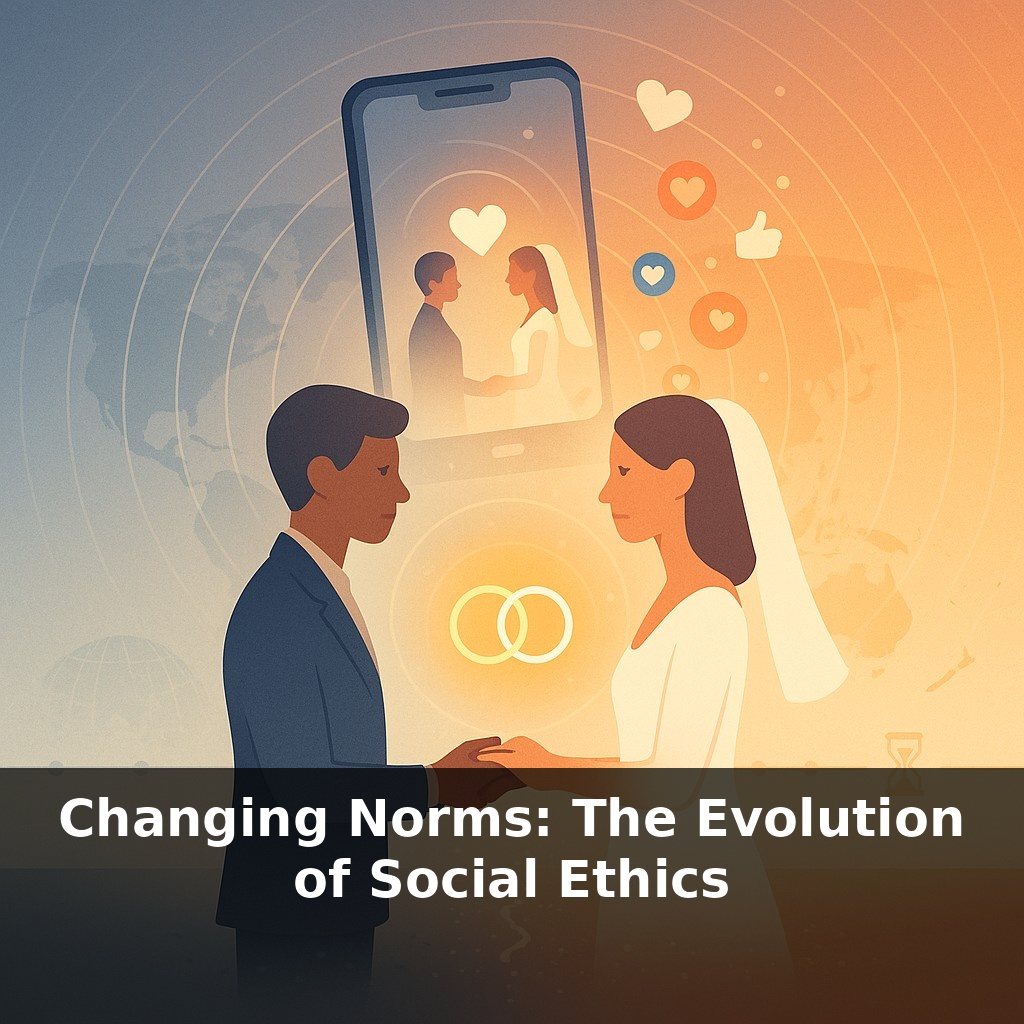
A wedding that was illegal a generation ago is now livestreamed and heart-reacted by relatives worldwide. In one lifetime, “unthinkable” became “of course.” How does that happen? Today, we step right into the moment where a fringe idea quietly starts to feel normal.
Interracial marriage took 19 years to move from first legal state to nationwide recognition in the U.S.; same‑sex marriage did it in 11. Norms aren’t just changing—they’re changing faster. That acceleration isn’t random. It tracks with shifts in who talks to whom, who studies what, and who owns the microphones of culture.
Anthropologists point out that every society quietly runs a constant experiment: “Given our economy, our technologies, our mix of generations and cultures—what rules let us live together without falling apart?” Sociologists then watch which answers spread. Law, schools, streaming platforms, even meme pages act like amplifiers, turning local experiments into global conversations.
So when a new moral claim surfaces—about gender, data privacy, or climate justice—it enters this sprawling, wired-up lab, competing to redefine what counts as “obvious.”
Watch how quickly certain words go from niche to everywhere. “Climate justice” barely appeared in books before 2000; by 2020 it had surged over 1,000 percent. That linguistic jump signals something deeper: people are re‑sorting what counts as fair, who counts as harmed, and who owes what to whom. Demographers note that younger, more educated, more urban populations tend to back these shifts, and digital platforms let them coordinate in real time. As college attendance rises and timelines overlap, yesterday’s argument thread can become tomorrow’s policy debate, then next year’s default setting.
Open a newspaper from 1990 and one from today, and you’re not just seeing different headlines—you’re seeing different answers to the question, “What do we owe each other?” Those answers are built, contested, and rebuilt through a messy dance between ideas, incentives, and institutions.
Anthropologists studying small-scale societies notice something striking: moral norms tend to crystallize around recurring problems. Who gets scarce resources? Who cares for children and elders? How do we handle outsiders? When new conditions emerge—automation displacing workers, data brokers tracking our clicks—old rules no longer quite fit. That mismatch creates what sociologists call “moral strain”: widespread discomfort that “the way we do things” is out of sync with lived reality.
Enter norm entrepreneurs. These are activists, lawyers, artists, sometimes CEOs, who spot the strain and propose a different “obvious.” Environmental justice groups link air pollution to race and income; tech workers walk out over AI uses they find disturbing; disability advocates reframe access not as charity but as a right. Philanthropic foundations, think tanks, and NGOs often act as early funders and translators, turning raw outrage into white papers, model laws, and shareable narratives.
Law and markets then act as force multipliers. Anti-harassment policies, for instance, didn’t appear from nowhere; they followed decades of organizing, lawsuits, and scholarship that redefined certain behaviors as unacceptable rather than inevitable. Once corporations realized that failing to adapt meant lawsuits, brand damage, or talent loss, many became surprisingly quick converts.
One helpful way to see this: social norms resemble software updates to a shared operating system. Early “beta versions” appear in subcultures, pilot programs, or local ordinances. Courts debug the first test cases; journalists and influencers review the update in public. If enough people accept the patch—switching pronouns, adjusting hiring practices, rethinking family roles—the update installs as common sense.
But there’s no guarantee the new code is cleaner or kinder. Backlashes, moral panics, and nostalgic appeals can roll norms back—or fork them into rival versions that compete for users.
When you look closely, “norm cascades” rarely start in parliaments. They often begin in tiny, unfunded corners of culture: a university debate club refusing fossil‑fuel sponsorships, a fan community boycotting a show over harmful stereotypes, a neighborhood group insisting police wear cameras. Those choices look trivial in isolation, but they function like small switches in a much larger circuit. Flip enough of them, in enough places, and the whole system lights up differently.
The numbers bear out how quickly those circuits can rewire. Since 1990, nearly a hundred countries have added LGBTQ+ protections, often after court cases brought by just a handful of people willing to be named in public documents. Robert Putnam’s work hints at another quiet driver: campuses where students from different backgrounds argue late into the night, then carry their revised intuitions into voting booths, HR offices, and parenting styles.
Your challenge this week: treat yourself as a live data point in norm change. For seven days, notice one concrete moment each day when you self‑censor or adjust what you say because “that’s just how things are done here”—at work, online, with family, anywhere. Don’t judge it; just jot down the situation and what you didn’t say or do. At the end of the week, look across the seven moments and ask: whose approval or disapproval was silently steering me? That small audit is a first step toward seeing norms not as air you breathe, but as rules you participate in updating.
Ethical “updates” won’t arrive as a single download; they’ll show up as small prompts in everyday systems. A hiring app might flag biased language, or a city dashboard might highlight which neighborhoods lose out in heatwaves. As AI standards, climate migration, and Gen Z’s expectations collide, the real test is meta‑ethical: can we design courts, schools, and codebases that not only apply today’s rules, but are transparent about how—and why—those rules will change?
Norm shifts aren’t just headlines; they’re choices in group chats, hiring meetings, and product roadmaps. Each time you challenge a “we’ve always done it this way,” you’re nudging the boundary of the permissible, like moving a three‑point line in basketball. The deeper question isn’t just “What’s normal now?” but “Who gets to move that line next—and how?”
To go deeper, here are 3 next steps: 1) Pick one historic social norm shift mentioned in the episode (e.g., attitudes toward marriage equality or civil rights) and read the matching chapter in Jonathan Haidt’s *The Righteous Mind*, then highlight 3 passages that explain *why* moral intuitions shifted over time. 2) Use Google Scholar to pull up one recent paper on algorithmic bias or digital surveillance ethics, and run it through the free tool Elicit.org to quickly map its main arguments and how they connect to the concerns about tech-driven norms discussed in the episode. 3) Watch the first lecture of Michael Sandel’s *Justice* course (freely available on YouTube), then share one concrete policy question from the episode (like data privacy, climate responsibility, or workplace inclusion) in an online forum or group chat and ask others how Sandel’s frameworks might change their view.