Viewers decide if you’re competent in less than a second—long before you finish your first sentence. You hit “record,” clear your throat, and start talking… but their minds are already made up. So the real question is: what are you silently telling them in that first heartbeat?
Here’s the twist: most people try to “fix” their on‑camera presence by obsessing over the script, when the real leaks are happening in how they sit, breathe, and look at the lens. The camera acts like a magnifying glass: tiny hesitations in your eyes, a slight collapse in your shoulders, or a rushed sentence gets amplified into “not confident,” even if your ideas are brilliant. On the flip side, small, controllable tweaks—like lifting your eyeline two centimeters, slowing your pace by a notch, or raising your mic gain slightly—can make you feel instantly more credible and relaxed to viewers. We’re going to treat your video setup like a living experiment: adjust one variable at a time, test it on camera, and notice how differently people respond, even when your words stay exactly the same.
On top of that, the camera doesn’t just show you; it also shapes you. Once the red light is on, most people unconsciously tighten their jaw, lift their shoulders, and speed up by 20–30 words per minute. That’s why you can sound clear in conversation, then watch the recording and wonder who this tense, louder, slightly robotic version of you is. The goal isn’t to fake a “TV voice,” but to create a setup and routine that pulls you toward your best habits automatically—like a well‑organized kitchen that makes cooking calmly almost inevitable, even on a busy weeknight.
Think of your on‑camera presence as three separate “dials” you can tune: how you look in the frame, how your body moves, and how your voice behaves once the red light turns on. Most people try to twist all three at once and end up with chaos. Instead, isolate them.
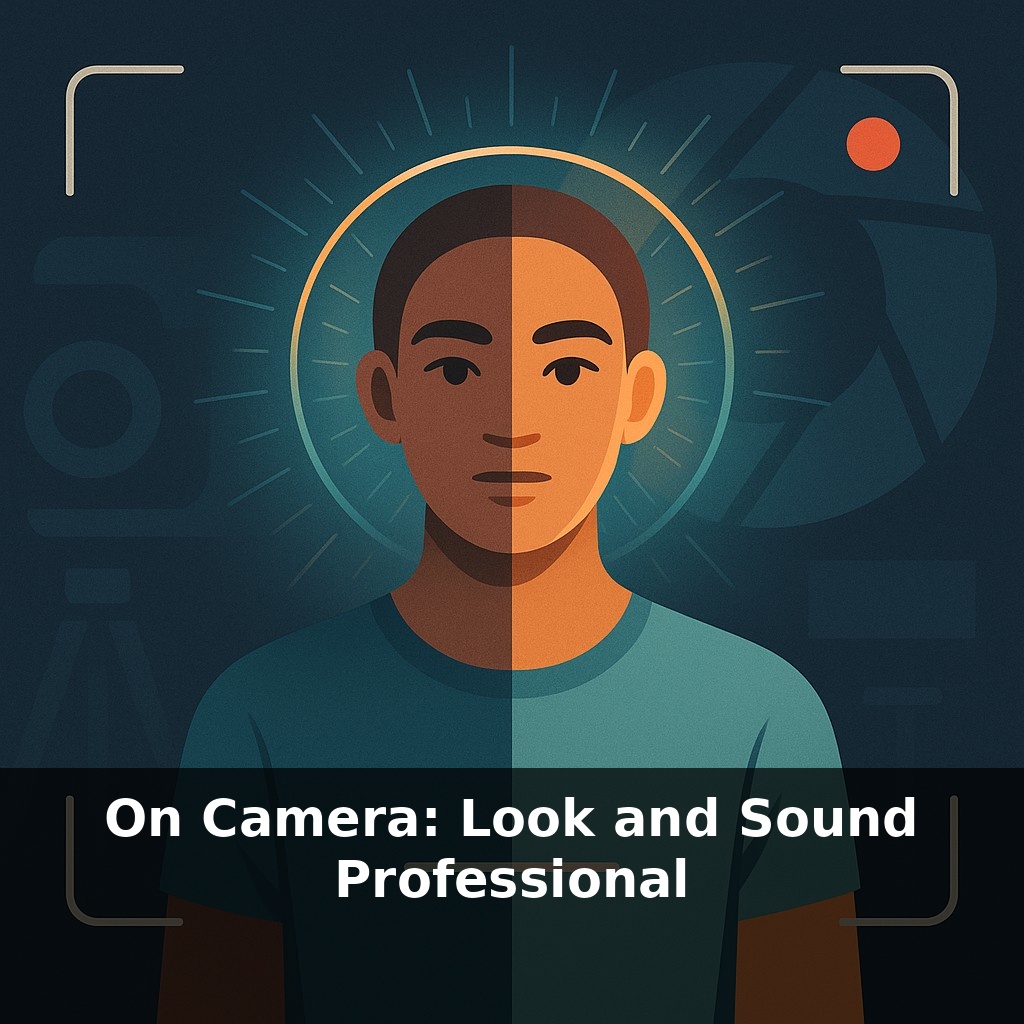
Start with the frame. A simple test: record a 10‑second silent clip, no talking. Check three things only: 1) Is the camera at eye level or slightly above? If it’s below, your jaw and nostrils dominate the frame. 2) How much headroom is above you? Aim for just a few centimeters, not a giant empty space. 3) Are you centered or slightly off‑center with “looking room” into the empty side? That tiny shift makes you feel more like a person in a conversation than a passport photo.
Next, body language—but keep it ridiculously small. Instead of “use your hands more,” set one micro‑rule: keep your elbows lightly touching your ribs, and let your hands move in a small “pizza box” in front of your chest. That prevents flailing while still giving you natural emphasis. Then add one anchor: plant both feet flat on the floor. A stable base calms the rest of your body more than you’d expect.
Now the voice dial. Don’t chase a “radio voice.” Target consistency and clarity. Run a 30‑second test where you intentionally: • Start at a whisper and smoothly rise to just above normal speaking volume, then back down. • Read the same sentence three ways: neutral, slightly faster, slightly slower. Playback and mark where you sounded most like yourself yet easiest to follow. That’s your benchmark, not the version where you sounded “fancy.”
Lighting and wardrobe are support systems, not decoration. With light, your only job is to avoid harsh contrast: face brighter than the background, but not blinding; shadows soft, not streaky. With clothes, avoid tiny stripes, noisy logos, and colors that match your wall. Pick one solid color that lets your face be the brightest, most detailed part of the frame. Like a well‑plated dish, the viewer’s eye should go straight to the “main ingredient”: you.
Think of this part as stress‑testing your setup in “real life” scenarios instead of treating it like a perfectly staged studio. Record three tiny clips—30 seconds each—with different constraints, like a scientist changing one variable at a time.
Clip one: “Bad Wi‑Fi mode.” Pretend you’re on a glitchy call and have to land each idea in short, clear bursts. Notice how your phrasing tightens and your pausing becomes more deliberate. That same phrasing works brilliantly in normal videos.
Clip two: “Late‑night scroll stopper.” Talk as if someone finds you at 1 a.m., half‑distracted. Your mission: make the first sentence so concrete and specific that they can’t swipe away. Watch back and underline the words that feel most vivid; use more of those in future openings.
Clip three: “Explainer to a 12‑year‑old.” Take a complex point from your topic and simplify it without dumbing it down. You’ll catch jargon, tangled sentences, and spots where your tone accidentally turns stiff.
Future tools will also “listen” to you differently. AI editors are already auto‑cutting based on energy spikes in your waveform, not just your words, so intentional shifts in pacing and tone become editing cues as much as performance choices. Expect platforms to surface creators whose vocal and visual patterns are easy for algorithms to segment, caption, and remix. Training those habits now is like future‑proofing your clips for a world where machines are your first audience.
Treat every recording as a mini–field study: tweak one variable, ship it, and watch how people actually respond in comments, retention graphs, and DMs. Patterns will surface, just like tasting a sauce after each ingredient. Over time, those tiny, boring adjustments stack into a signature style that feels natural to you and unmistakable to your audience.
Start with this tiny habit: When you open Zoom or your camera app, tilt your laptop screen slowly forward and back until your eyes are about one-third from the top of the frame, then stop. Don’t fix anything else yet—no lights, no background—just that one adjustment. Do this every single time before you hit “Join” so your face is always framed at a professional, eye-level angle. Over time, you’ll automatically start noticing and correcting your on-camera setup without it feeling like extra work.