A war that lasted longer than the United States has existed began with a royal paperwork dispute. A French king died, a cousin claimed the crown, and suddenly merchants in London, peasants in Burgundy, and archers in Wales all had skin in the game—and everything changed.
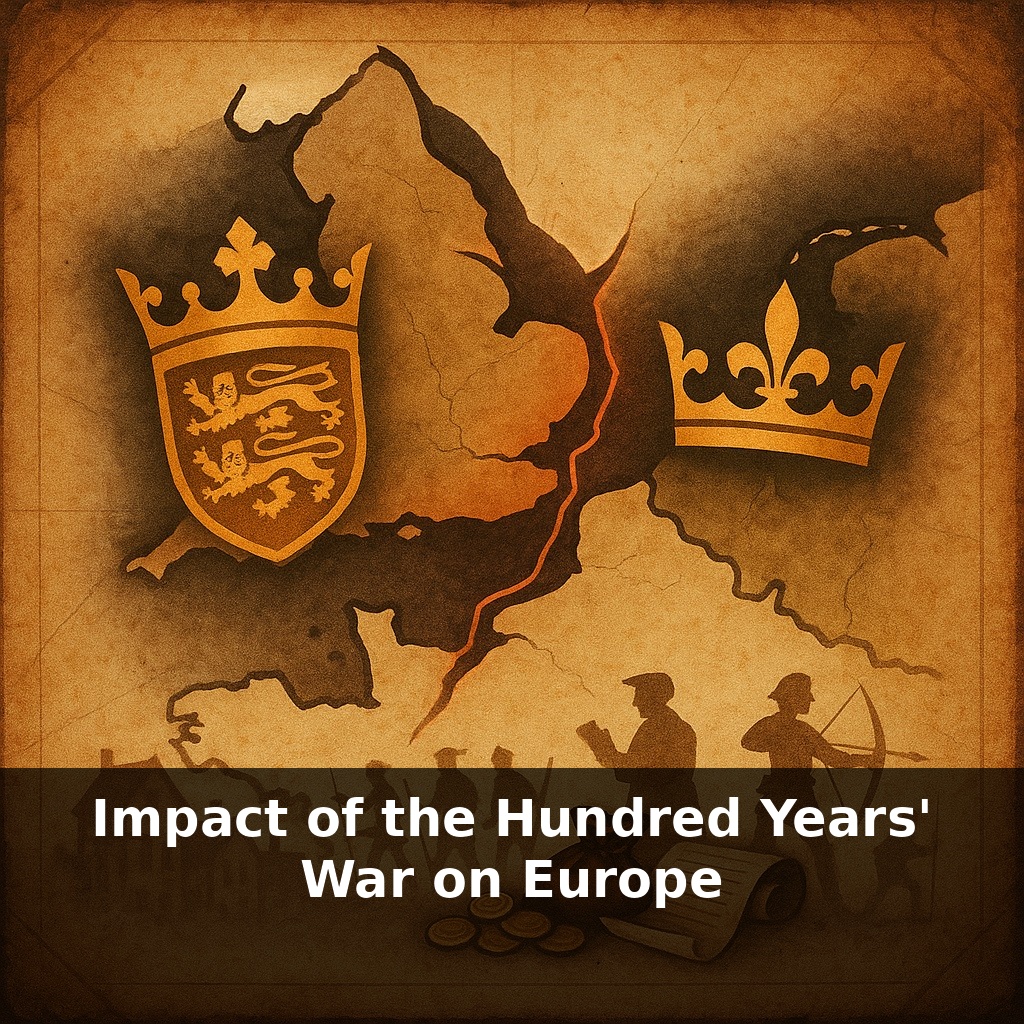
By the mid-1300s, that royal dispute had swollen into something far stranger than a simple contest between kings. Tax collectors began knocking on doors more often; wool traders watched prices seesaw with every campaign; village churches rang their bells not just for saints’ days, but for new levies and bad news. The conflict seeped into daily life the way damp creeps through a stone wall—slowly at first, then all at once, reshaping what seemed solid. Local grudges were suddenly recast as questions of “loyalty” to a distant crown. Borders that had once felt porous—regions where people shared language, wine, and marriage ties across the Channel—started to harden. As the fighting dragged on, the war stopped being only about who sat on a throne, and became a laboratory where Europe tested new ways to fight, to tax, and to imagine belonging.
By the time banners clashed at Crécy and Poitiers, the struggle had become a slow-motion earthquake under Europe’s social order. Old certainties—who could bear arms, who could command men, who could demand obedience—started to crack. New weapons, from the English longbow to crude but frightening cannon, meant that years of aristocratic training on horseback could be undone in minutes by disciplined commoners on foot. Parliaments and estates-general were summoned again and again to fund campaigns, and each summons was a small rehearsal in asking, “What do we get in return?”
If you trace the arc from Crécy to Castillon, what stands out isn’t just who wins which battle, but who gets empowered between them. Early on, armored nobles still expect war to confirm their status. They charge, literally, into the story assuming their courage on horseback is what matters. But when ranks of longbowmen drop them at a distance, and when gunpowder begins tearing holes in stone walls once thought unassailable, the logic of privilege on the battlefield starts to fray.
Rulers notice. If disciplined commoners with bows or pikes can outperform glittering cavalry, then kings can build something new: standing armies loyal to the crown rather than temporary feudal hosts loyal to individual lords. Think of it like shifting from a loose jam session of local bands to a permanent orchestra with a central conductor; once that ensemble exists, it’s hard to return to the old, improvised arrangement. Paying for that orchestra, though, forces monarchs back to assemblies, city councils, and provincial elites again and again.
Those meetings leave political fingerprints. In England, the need to grant new taxes helps Parliament entrench the idea that extraordinary funding requires some form of consent. In France, repeated crises push the crown toward more direct taxation and administrative reach, gradually bypassing some traditional intermediaries. Neither transformation is neat or linear, but both loosen the old knot tying landholding automatically to power.
Meanwhile, devastation on the ground—especially in regions repeatedly campaigned over—pushes communities to look upward and outward for protection. When raiding parties don’t care about your local customs but do care which banner you live under, that banner starts to matter more. Language, law, and shared enemies begin to feel like part of the same package. This is not yet nationalism in the modern sense, but the vocabulary of belonging shifts: fewer references to a mosaic of overlapping lordships, more to “the realm” and “the kingdom” as meaningful units.
Even culture absorbs the shock. Chronicles, songs, and sermons recast victories and defeats as stories about a people, not just a dynasty. Over time, the war becomes less a long feud between families and more a crucible in which new political and social identities are tempered—imperfect, unfinished, but recognizably different from what went in.
On the ground, you can see the shift in small, concrete moments. A village that once answered only to a local lord now finds royal officers arriving with standardized weights, coinage, and written orders. In some regions of France, towns devastated by chevauchées negotiate directly with the crown for the right to wall themselves, effectively trading cash for a tighter link to royal authority. English coastal communities watch Calais become less a battlefield trophy and more a commercial hinge, tying their livelihoods to distant diplomatic choices. Laws start to mark sharper boundaries: rules about who may trade where, or which courts hear which disputes, make “inside” and “outside” the realm feel more real. Chroniclers who once traced noble genealogies begin to write about “the English” or “the French” as collective actors on the page. Over decades, these scattered experiences accumulate like sediment in a riverbed, silently redirecting the larger political current toward more centralized, territorial states.
The war’s deeper lesson is about systems under pressure. When campaigns dragged on, rulers had to improvise—new levies, new offices, new promises—that outlived the battles. Institutions today face similar stress-tests: pandemics, cyberattacks, climate shocks. Each crisis invites shortcuts that can quietly harden into routine. Like a river redirected by one landslide, a single “temporary” emergency measure can carve a lasting channel for power, accountability, or exclusion long after the danger fades.
In the end, the war’s legacy is less a line of dates than a shift in how power, space, and belonging fit together. Borders that once felt like chalk marks became more like stone walls; accents turned into political signals. When pressure mounts in our own world, watching which “temporary” fixes start to feel permanent is the closest we come to reading history in real time.
Try this experiment: For one day, run a “mini Hundred Years’ War economy” in your home by tracking how conflict reshapes resources. Pick two “rival powers” in your budget (for example, food vs. entertainment), then reallocate a fixed amount of money from one to the other every time you encounter “conflict” (news about war, political tension, or workplace drama). At the end of the day, look at how your spending map has shifted and compare it to what happened in late-medieval France and England—how war taxes, pillaging, and shifting alliances distorted trade, agriculture, and urban life. Then decide what “peace treaty” (a new rule for your real budget or time use) would stabilize your small system the way strong monarchies eventually did for European states.