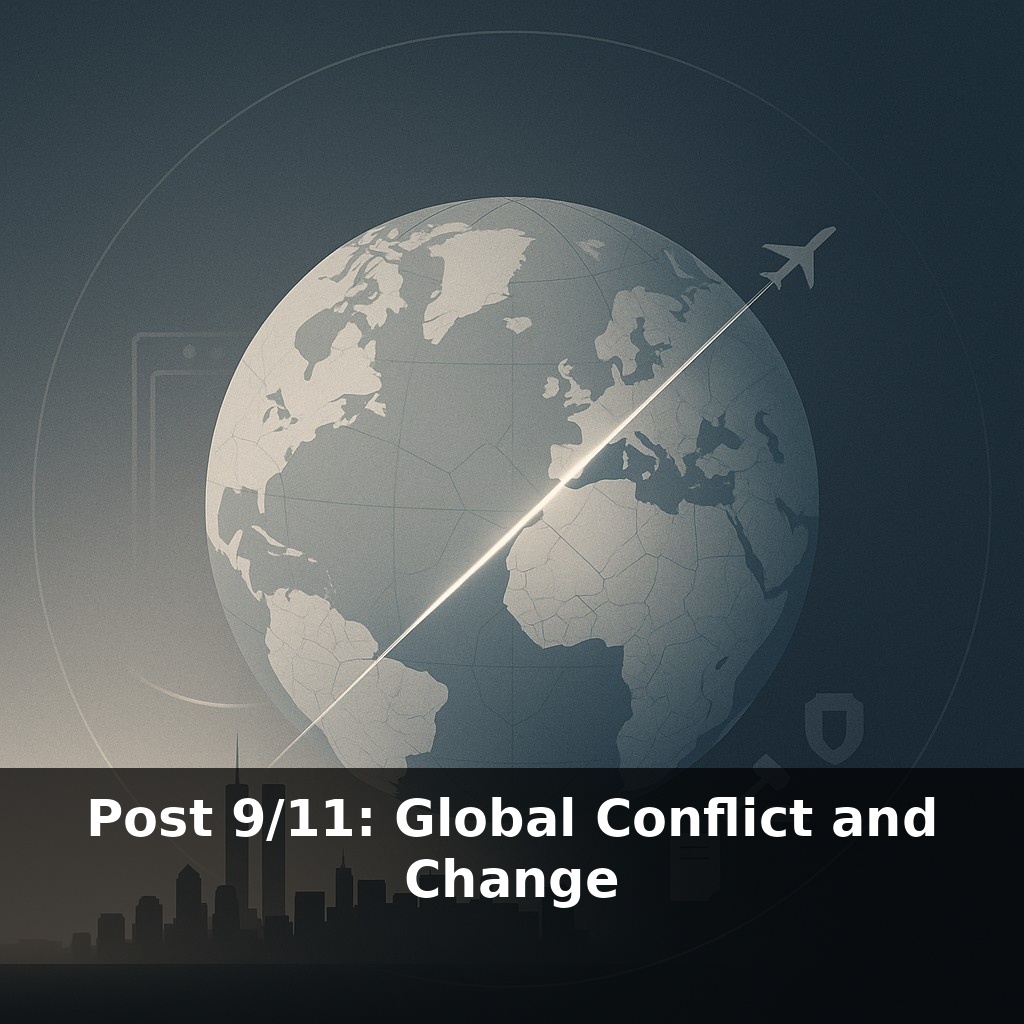
On a quiet Tuesday, nearly every airport security rule you know today did not exist. By the next year, nations were rewriting laws, redrawing maps, and rethinking freedom itself. In this episode, we step into that pivot point and ask: what changed—and what never went back?
Nineteen men with box cutters did not just strike New York and Washington—they cracked open the operating system of global politics. In the months after 9/11, leaders weren’t only asking how to stop the next attack; they were quietly deciding which risks a society should live with, and which freedoms it could live without. Intelligence budgets swelled. Secret black sites appeared on maps the public never saw. Parliaments rushed through counter-terror laws so fast that some lawmakers later admitted they hadn’t fully read them. And as states armed themselves against a shadowy enemy, something subtler shifted too: neighbors eyed each other differently, news anchors learned new words, and entire communities found themselves treated less like citizens and more like suspects.
Armies moved first, but the deeper shift unfolded in quieter places: server farms, visa offices, banking systems. Terrorism stopped being just a security issue and became a lens for almost every policy choice. The U.S. poured trillions into wars and homeland security, while other governments rewired their police and intelligence agencies, often with little public debate. The battlefield stretched from Kabul to cable traffic, from Waziristan to WhatsApp. Like a river suddenly dammed, political energy was forced into new channels—some protective, some corrosive, all hard to reverse.
In public, the post‑9/11 story sounded simple: hunt the terrorists, secure the homeland. Underneath, three quieter revolutions unfolded.
First, the map of power inside states shifted. Interior and justice ministries, once bureaucratic backwaters, became star players. Police units morphed into “counter‑terrorism task forces” with access to tools that had previously been reserved for wartime espionage. Financial watchdogs began tracing tiny wire transfers with the same intensity once reserved for missiles. Banks were pushed to flag “suspicious” customers, giving private companies a role in security decisions that used to sit firmly with governments.
Second, the category of “enemy” blurred. Traditional wars pit one state against another; after 9/11, the main adversaries were networks that crossed borders and passports. Washington struck in Afghanistan, but also in Yemen’s deserts, Pakistan’s tribal areas, Somalia’s coastline, using drones, special forces, and local partners. European capitals quietly expanded their own reach, from North Africa to the Sahel, justifying airstrikes and training missions as pre‑emptive self‑defence. This created a grey zone where citizens could be surveilled like foreign threats and foreign suspects could be targeted as if they were on a battlefield, even when no formal war was declared.
Third, societies absorbed the shock unevenly. In many Western cities, Muslim communities found everyday life subtly rerouted: extra questions at borders, informal blacklists at airports, police visits after a neighbour’s complaint. At the same time, victims of attacks in places like Baghdad, Kabul, or Mogadishu often struggled to get even a passing mention on global news. The hierarchy of whose fear counted most became a geopolitical fact.
Over time, the focus of concern shifted again. As jihadist attacks in Western countries fell after 2017, far‑right extremists and “lone actor” shooters exploited the same online spaces and grievances. Intelligence services built to track foreign plots were now asked to watch domestic message boards. Laws drafted for one threat proved elastic enough to stretch over others, raising an awkward question: when emergency tools become permanent, who decides when the emergency is over—and how?
In practice, this new security mindset reached into places that felt far from battlefields. University researchers found grants suddenly tied to “counter‑radicalization.” Humanitarian NGOs delivering food in conflict zones were asked to prove they weren’t “materially supporting” the wrong armed group; some pulled out rather than risk prosecution. Tech firms that once sold themselves as neutral platforms faced quiet visits from officials asking for back doors, data sharing, or faster content takedowns. Even pop culture shifted: TV dramas recast intelligence agents as main characters, normalizing the idea that much of public life happens behind one‑way glass.
Think of it like a city that upgrades its flood defenses after a catastrophic storm. Higher sea walls and new drainage protect homes, but they also reshape where people build, how they move, and which neighborhoods get investment. Long after the clouds pass, the skyline still reflects decisions made in a moment of fear—and it’s hard to tell which structures are safeguards, and which have simply become part of the scenery.
Security thinking now bleeds into issues that once felt separate: migration, public health, even online schooling. Risk models built for terrorists are quietly repurposed to flag “unusual” patterns in welfare claims or student behavior, like metal detectors moved from airports to library doors. As climate shocks, cyberattacks, and pandemics stack up, leaders may be tempted to treat every crisis as a security problem—normalizing emergency reflexes as a default way of governing.
The next phase may depend less on weapons than on memory. Societies can treat the last two decades like a groove worn into vinyl—easy to replay, hard to escape—or like a draft score, marked up and revised. As new threats crowd the stage, the open question is whether security remains the drumbeat, or becomes just one instrument in a wider civic orchestra.
Start with this tiny habit: When you hear or read a news story about terrorism, war, or “security threats,” pause and spend 30 seconds googling one concrete fact about the country mentioned (like its capital, population, or official language). When you open YouTube or a podcast app, once a week swap just the first recommended video with a 5-minute clip from someone in a post‑9/11 conflict zone (a veteran, Afghan journalist, Iraqi civilian, etc.). When you pass a public memorial, flag, or 9/11 reference in your day, whisper one question to yourself: “Who else was affected by this that I never hear about?” and mentally name at least one group (e.g., Muslim Americans, Afghan civilians, first responders).