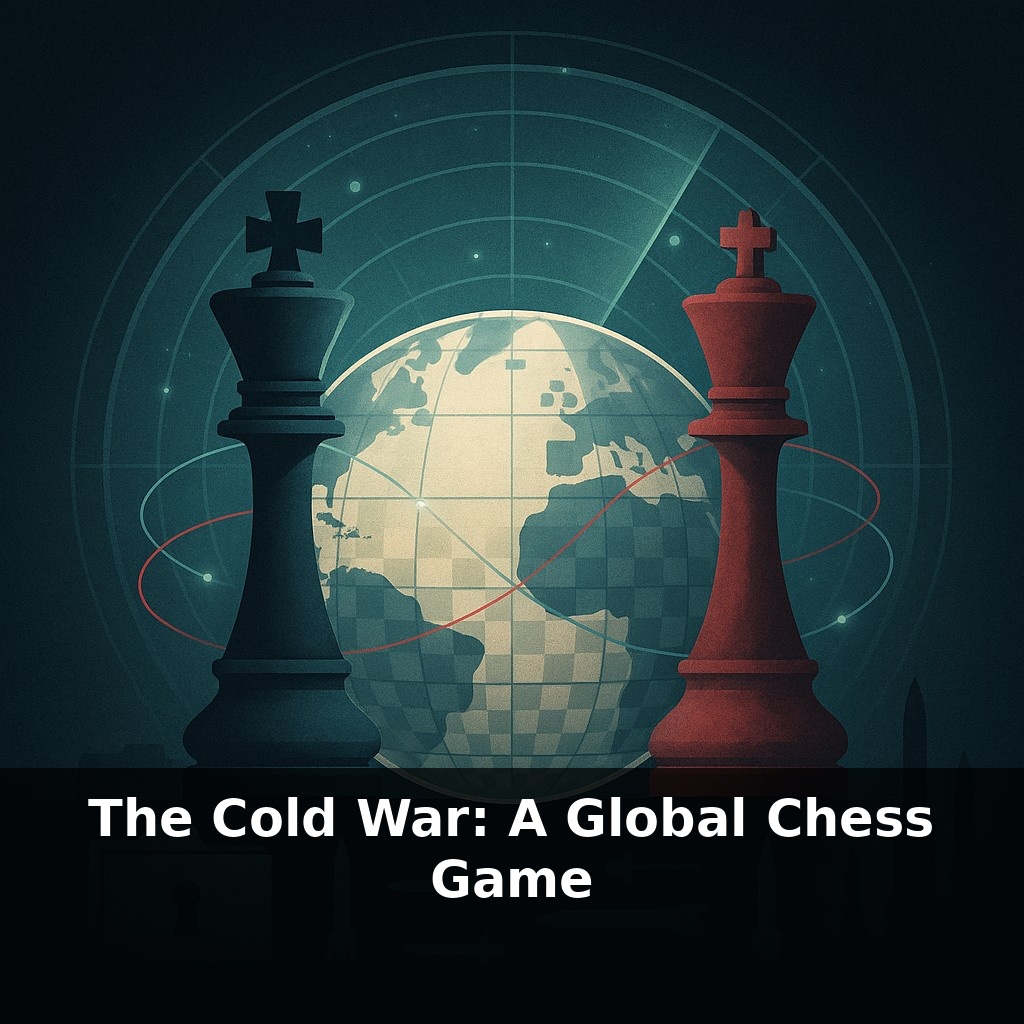
In the summer of 1962, a single misunderstood radar signal could have ended human civilization. No bombs fell, no declarations were made, yet generals, spies, and scientists on opposite sides quietly moved their pieces in a global game where one mistake meant no second chances.
Instead of swords and spears, the age of this standoff was measured in launch codes, factory output, and secret files locked in windowless rooms. From 1947 onward, Washington and Moscow treated every election abroad, every trade deal, even every Olympic medal as a small shift in the balance of power. A student protest in Prague, a coup in Tehran, a crop failure in China—each event could tilt the board, sometimes in ways neither side intended. The Cold War seeped into school drills, movie scripts, and kitchen appliances, turning daily life into a quiet referendum on whose system worked better. Like a long, unsettled storm front that never quite breaks into open downpour, this conflict hovered over decades, reshaping borders, budgets, and beliefs while most people tried simply to get on with their lives.
While leaders watched maps and missile charts, the real contest spread sideways into classrooms, factories, and even living rooms. A teenager in Delhi choosing which language to study, a farmer in Ghana deciding what fertilizer to buy, a musician in Santiago picking which records to cover—each choice nudged influence one way or another. Development loans, radio broadcasts, and student scholarships became subtle tools of persuasion. Culture and cash flowed like competing currents in the same river, pulling newly independent nations toward one shore or the other, even as many tried to steer straight down the middle.
Military strategy during this era twisted into something paradoxical: the path to survival ran through the threat of absolute ruin. Generals and physicists on both sides built vast arsenals of nuclear weapons not because they intended to use them, but because they needed the other side to believe they might. By the mid‑1980s, those stockpiles had swollen to roughly 70,300 warheads—enough to obliterate cities many times over. The logic was brutally simple: if any strike would trigger retaliation so overwhelming that no government could claim victory, then starting a war became irrational.
This logic hardened into doctrine. War plans that once focused on tanks crossing borders now revolved around flight times of missiles and the hardness of underground bunkers. Submarines slipped beneath polar ice, bombers circled near enemy airspace, and early‑warning systems watched the sky for hints of a launch. The margin for error shrank to minutes. Several times, technical glitches or misread data pushed commanders to the edge of ordering a response; in 1983, a Soviet officer named Stanislav Petrov chose to trust his instincts over his computers when they reported incoming American missiles, and his hesitation prevented a possible spiral toward disaster.
Yet the same rivalry that narrowed humanity’s margin for error also widened its technological horizons. To prove whose system could best harness science, both superpowers poured money into rockets, satellites, and the electronics to guide them. The race to orbit and then to the Moon demanded lighter, faster, more reliable circuits. Out of this pressure cooker came integrated circuits compact enough to sit on a single chip, the ancestors of the processors in today’s phones and laptops. Computing power that had once filled rooms slowly migrated onto desks, then into briefcases, then pockets.
This pattern—threat and innovation tightly interwoven—shaped the broader contest. Defense labs doubled as research hubs; weather prediction, global telecommunications, and satellite navigation all rode on technologies originally built to track missiles or spy from orbit. Like a dense forest after a lightning‑sparked fire, the landscape of science and security grew back altered: charred in places, but also studded with new growth that would outlast the original blaze.
In this strange era, a pop song or a new factory could carry weight far beyond its surface. When a jazz band from the United States toured Eastern Europe, the notes on stage doubled as a message about freedom of expression; when Soviet ballet companies dazzled audiences in Paris or New York, every perfect landing hinted that discipline and planning could produce beauty as well as power. Consumer goods turned into quiet ambassadors. A refrigerator in Lagos or a tractor in Vietnam might come stamped with Cyrillic letters or an American brand, each promising a particular future of comfort or productivity. Even sports records became loaded symbols: every sprint time or weightlifting medal whispered that one training system—and by extension, one political system—could shape stronger bodies. The contest seeped into textbooks, movie posters, and scientific conferences, so that a scholarship to study abroad or a television series acquired meanings that stretched far past classrooms and living rooms. Choices that seemed personal were gently pulled by distant hands.
Nuclear strategy’s legacy now hides in plain sight: satellite networks, encrypted finance, even disaster planning trace back to those decades of rehearsal for catastrophe. As archives open, younger leaders confront how quickly routine alerts once brushed against irreversable choices. Today’s rivalries—over data cables, orbital drones, and bio‑labs—echo old patterns, yet the stakes sprawl wider, like storm fronts merging into a single, unpredictable weather system.
Today’s flashpoints—cyber intrusions, satellite jamming, AI‑guided weapons—carry quieter signals but similar risks. Deterrence now spreads across code, clouds, and cables, more like shifting winds than fixed battle lines. Your challenge this week: trace one headline back through its alliances and technologies until you see the hidden map of pressures beneath it.