The Beatles' Hidden Messages
📝 Transcript
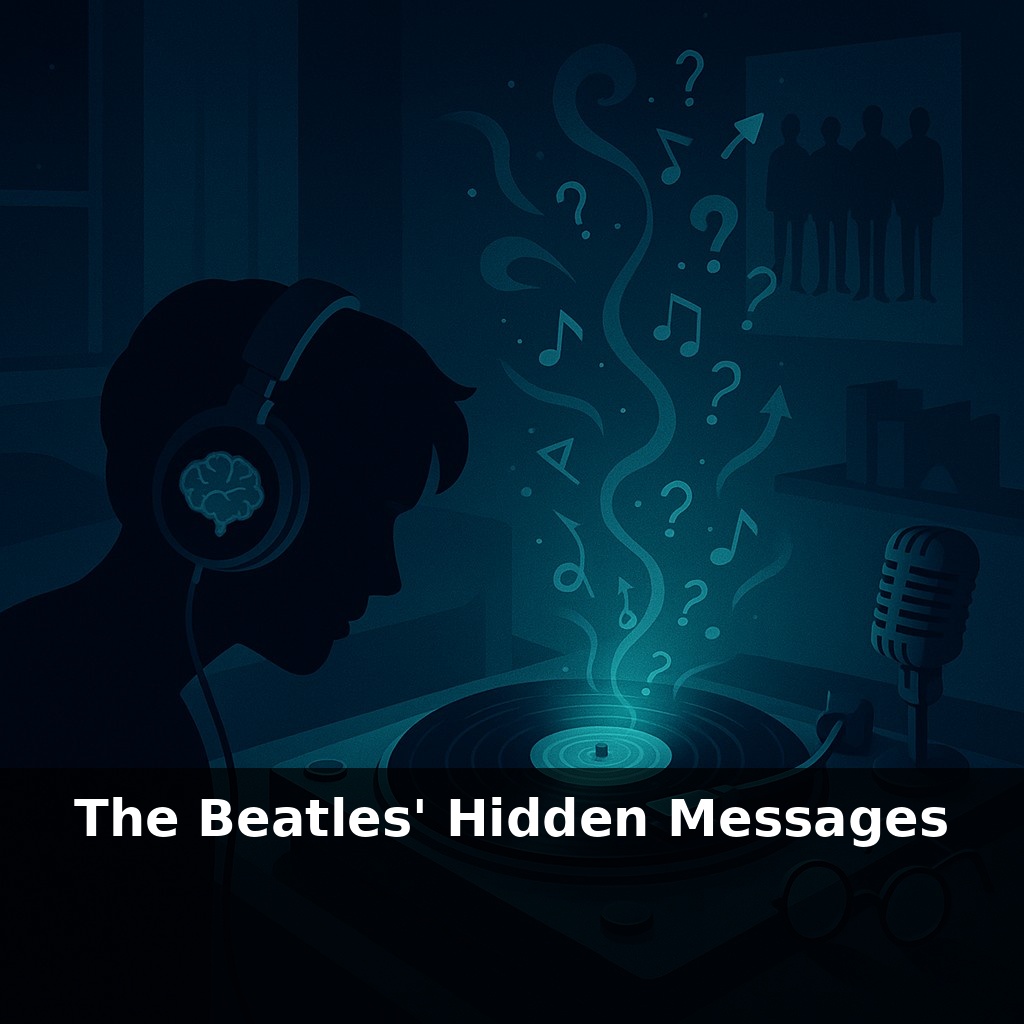
John Lennon once said the Beatles put “as much as we could cram” into their records. In the dead of night, a fan sits in a dark dorm room, spinning a vinyl backward, swearing they hear “turn me on, dead man.” Is it a real message—or proof our brains hate leaving silence unexplained?
Lennon also joked that some “hidden messages” were really just “gobbledygook” fans insisted on decoding. Yet the Beatles weren’t innocent bystanders. They were pushing studio technology so far beyond its original purpose that weird artefacts, half-heard words, and chopped-up tape became part of the songwriting toolkit. The studio stopped being a neutral recorder and turned into a mischievous band member—splicing, echoing, and warping sounds into something nobody had a name for yet. Producer George Martin and engineer Geoff Emerick treated faders and tape reels like levers in a mad inventor’s lab, running vocals through rotating speakers, slowing pianos until they sounded like cellos, and bouncing tracks so many times that ghosts of earlier takes bled through. Out of that chaos came the perfect breeding ground for myths: a few intentional tricks buried in a jungle of glorious accidents.
And once the myths took hold, the records stopped being just music and turned into puzzles. Fans treated every murmur, chair squeak, and count‑in like a hidden clue from a secret society. The band didn’t exactly discourage it: they slipped in fragments of chatter, strange laughs, fragments of other songs, even fake endings that snapped back to life. You weren’t just listening; you were decoding. That shift—songs as interactive mysteries—helped blur the line between artist and audience. The Beatles built the house, but listeners started hunting for trapdoors, convinced each creak in the floorboards meant something profound.
Some of the clearest “hidden messages” weren’t mystical at all; they were practical jokes with very specific punchlines. On “Sgt. Pepper,” the run‑out groove babble and the high‑pitched dog whistle at the end weren’t clues about death—they were a wink to fans and a literal noise only pets would really notice. “I Am the Walrus” stitches in a live BBC radio performance of *King Lear*, not because Shakespeare held a cosmic secret, but because Lennon liked how the random dialogue collided with his nonsense lyrics. These are less like coded prophecies and more like graffiti in the margins: you’re supposed to find them eventually.
Other moments that later fueled conspiracies began as creative shortcuts. Snatches of studio chatter left just loud enough to catch—Paul’s muffled asides, Lennon’s off‑mic jokes—were partly about preserving a human feel on increasingly constructed records. When listeners froze those half‑sentences in place and replayed them obsessively, they turned throwaway remarks into supposed confessions. The more fans hunted, the more each tiny irregularity felt intentional.
Psychologists call this pattern‑hunger: once your brain decides there *must* be a story, it starts connecting dots that were never meant to meet. A blurry shape in the pond becomes a sea monster; a garbled chord change becomes “I buried Paul.” The band watched this happen in real time. By the late ’60s, the more they experimented, the more journalists and fans treated every experiment as evidence of an underlying plot.
Yet the Beatles did occasionally lean into the game. Titles like “Glass Onion” openly tease people for reading too much, while still tossing them references to earlier songs, as if daring, “Go on then, decode *this*.” It’s the same tension you see in modern internet culture: creators bury Easter eggs because it’s fun, then watch as entire subreddits spiral into overanalysis. One deliberate secret invites ten imagined ones.
In that sense, Beatles records started to resemble a sprawling software project: a few carefully planted features, lots of messy legacy code, and users convinced every glitch hides a master plan.
The way Beatles “messages” spread looks a lot like how rumors travel online now. One late‑night DJ in 1969 half‑seriously strings together odd lyrics, a strange album cover pose, and a fragment of mumbled chatter; within weeks, letters flood stations, college kids hold listening parties, and mainstream papers treat the “Paul is dead” theory as a cultural event. Nobody at EMI planned a campaign—yet the network of fans acted as an unpaid marketing department, stress‑testing every scrap of sound for meaning. Charles Manson’s reading of “Helter Skelter” shows the darker edge of this: pull a song out of its context, project your fears onto it, and suddenly an energetic rock track becomes “evidence” of an apocalypse only you can hear. In that sense, each record sleeve and lyric sheet functioned like an open‑source repository: the band pushed out a version, and the world “forked” their intentions into conspiracy, prophecy, or satire, depending on what listeners brought to the music.
Hidden-message culture isn’t going away; it’s mutating. As stems, demos, and AI‑peeled tracks circulate, fans gain forensic access to every cough and count‑in, while artists can plant subtler games—cryptic harmonies, coded release dates, ARG‑style rollouts across platforms. Expect fandoms to treat albums like living puzzles that update over time, more like “seasonal content” in games than fixed artifacts. That raises fresh questions: when does playful decoding tip into harassment, or rewrite an artist’s intent entirely?
The next time you hear a “hidden message,” try treating it less like a courtroom exhibit and more like cloud‑watching: notice what shape *you* give it. Are you hearing fear, hope, mischief? In that gap between what’s pressed into the groove and what your brain paints over it, you’re not just decoding the Beatles—you’re co‑writing the story.
Before next week, try this experiment: Choose one Beatles song mentioned (like ‘Strawberry Fields Forever’ or ‘A Day in the Life’). As you listen, jot down any production choices that catch your ear—like backwards tape or unusual sound effects. Track how these elements alter your interpretation. Then, select a personal communication (email or social post) and playfully embed a hidden message, noting the responses you receive.
From this course

Whispers of Sound: Secrets Behind Famous Tracks
6 episodesUnlock all episodes
Full access to 6 episodes and everything on OwlUp.
Subscribe — $1.99/monthLess than a coffee ☕ · Cancel anytime