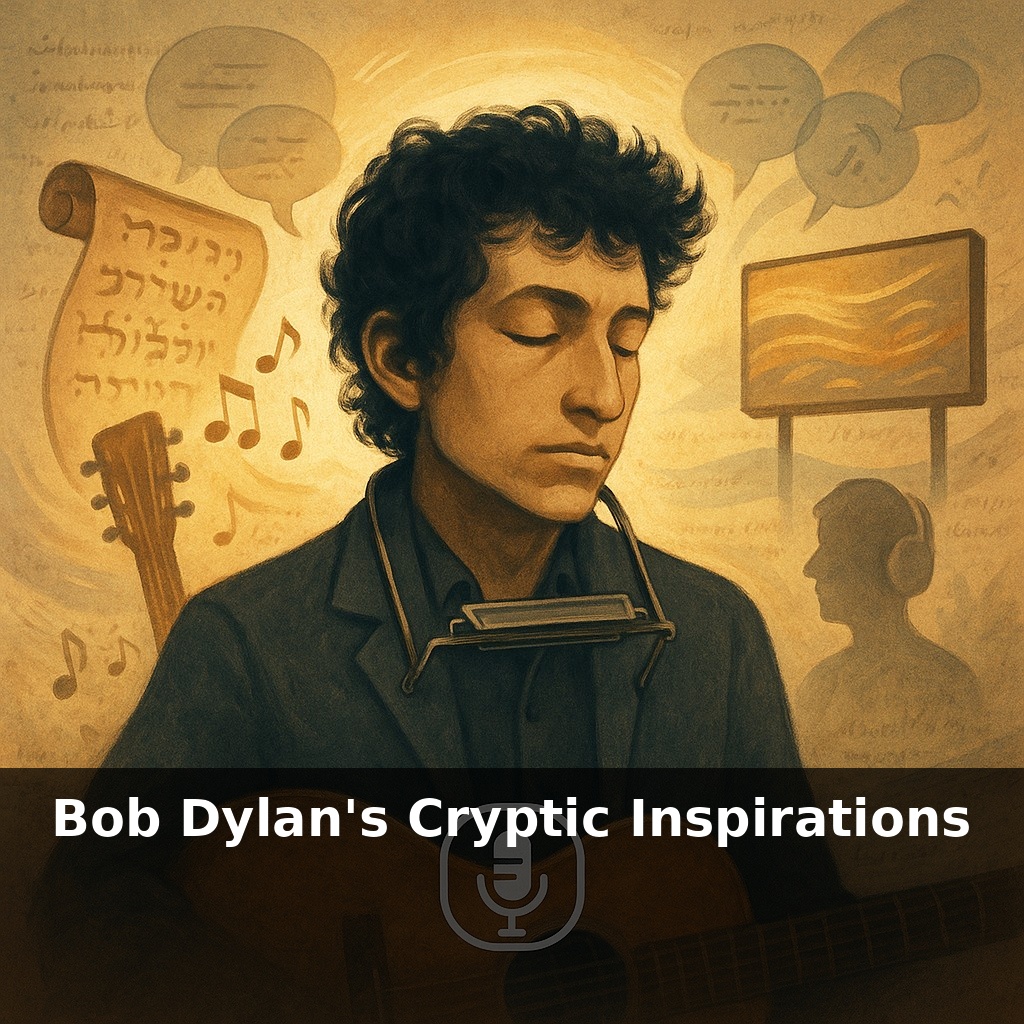
Bob Dylan once lifted lines from a 2,000‑year‑old prophet and from a roadside billboard—and made them rhyme. He writes protest songs that dodge clear opinions, and love songs full of strangers’ voices. So whose feelings are you hearing: his, or secretly, your own?
By the time Dylan hit his stride, he’d already absorbed more voices than most small-town libraries. He raided the Book of Isaiah for thunder, French symbolists for hallucinations, Woody Guthrie for plainspoken grit, and last night’s headlines for urgency. Then he’d drop in a stray phrase from a TV commercial or a campaign slogan, all in the space of a verse. It wasn’t plagiarism; it was closer to architectural salvage—pulling bricks from ruined buildings to construct something that had never stood before. The result: songs that feel weirdly familiar the first time you hear them, like you’re recognizing a dream you can’t place. This dense layering doesn’t make the songs harder to enter; it makes them more porous. Wherever you approach from—scripture, politics, poetry, pop culture—there’s a doorway with your fingerprints already on the knob.
Dylan didn’t stumble into this method; he trained for it like a long‑distance runner. As a teenager in Minnesota, he hoarded sounds: blues 78s, carnival barkers, radio sermons, carnival gossip. Later, in New York, he spent days in libraries and nights in clubs, treating language like a vast used‑parts warehouse. One afternoon it might be Rimbaud’s hallucinations, the next a newspaper’s crime blotter, the next an overheard joke in a coffee shop. He wasn’t chasing “original lines” so much as original collisions—testing which unlikely neighbors sparked when bolted together in a verse.
Dylan’s trick isn’t just where he grabs his lines from; it’s *how* he sets them against each other so they won’t sit still. Listen to “It’s Alright, Ma (I’m Only Bleeding).” In a few breaths, he swings from advertising clichés to apocalyptic dread to deadpan jokes. The references are traceable, but the emotional weather keeps changing faster than you can pin it down. That instability is the point: if a song can tilt under your feet, it can tilt with each new decade too.
Crucially, he rarely lets a borrowed fragment keep its original job. A biblical image of judgment shows up not to preach, but to describe a breakup. A phrase from a political leaflet gets dropped into a scene in a bedroom or a back alley. By forcing phrases to “work overtime” in new contexts, he doubles their charge. One line can feel sacred and petty, tragic and sarcastic, all at once. That ambiguity leaves space for listeners to slip in with their own experiences and seal the circuit.
The notebooks scholars have seen show how deliberate this is. Dylan will scribble a phrase, cross it out, move it three lines down, swap in a different proper name, then circle a single unexpected rhyme like it’s the key to the whole page. He’s not hunting for a tidy message; he’s hunting for friction—spots where two borrowed pieces strike sparks instead of lying there politely.
This is why later songs such as “Jokerman” or “Not Dark Yet” can feel haunted without ever announcing what, exactly, is doing the haunting. You sense scripture in the background, or a half‑remembered headline, but the song never stops to footnote itself. It keeps moving, trusting that your own half‑memories will rush in to complete the picture. The most charged lines often sit right on the edge of sense: you understand them perfectly until you try to paraphrase them.
In that way, Dylan behaves less like a confessional diarist and more like a code designer. He builds lyric “interfaces” that remain compatible with new eras, new crises, new private heartbreaks. A phrase that once brushed against Civil‑Rights news can brush, decades later, against surveillance capitalism or climate anxiety without needing to change a syllable.
Dylan’s drafts often look less like poems than like messy circuit boards. You’ll see a line clearly traced to Isaiah wired beside a scrap that sounds ripped from a diner argument, both feeding voltage into a single chorus. Scholars studying his archive in Tulsa describe pages where whole verses are built around one “wrong” word—a verb that doesn’t quite fit the idiom, a noun that jars against the scene. Those misfits stay, not as errors, but as switches: they flip the verse from straightforward statement into something twitchier and more alive. Listen to “Visions of Johanna” or “Desolation Row” and you can hear those switches clicking; the song keeps refusing to settle into one stable picture. It’s like a software update that never fully installs, forever asking you to restart your understanding. That’s why new references keep getting discovered in lyrics decades old: the songs were engineered with spare ports, waiting for future meanings to plug in.
Dylan’s collage style may become a test case for how law treats “transformative” AI art. If bots can scan archives the way radar sweeps a coastline, they’ll surface forgotten echoes in his lines—and in everyone else’s. That could push courts to refine what counts as theft versus homage. For young writers, the takeaway isn’t “sample everything,” but “risk rearranging it.” The future audience may value lyrics the way gamers value open worlds: built to be explored, modded, and revisited.
Each time you hit play on Dylan, you’re not just replaying history; you’re stress‑testing how many directions a song can point at once. Your challenge this week: raid three unlikely shelves—news, poetry, overheard talk—and fuse snippets into four lines. Treat it like wiring a custom pedal board and see what new signal you can coax from the noise.