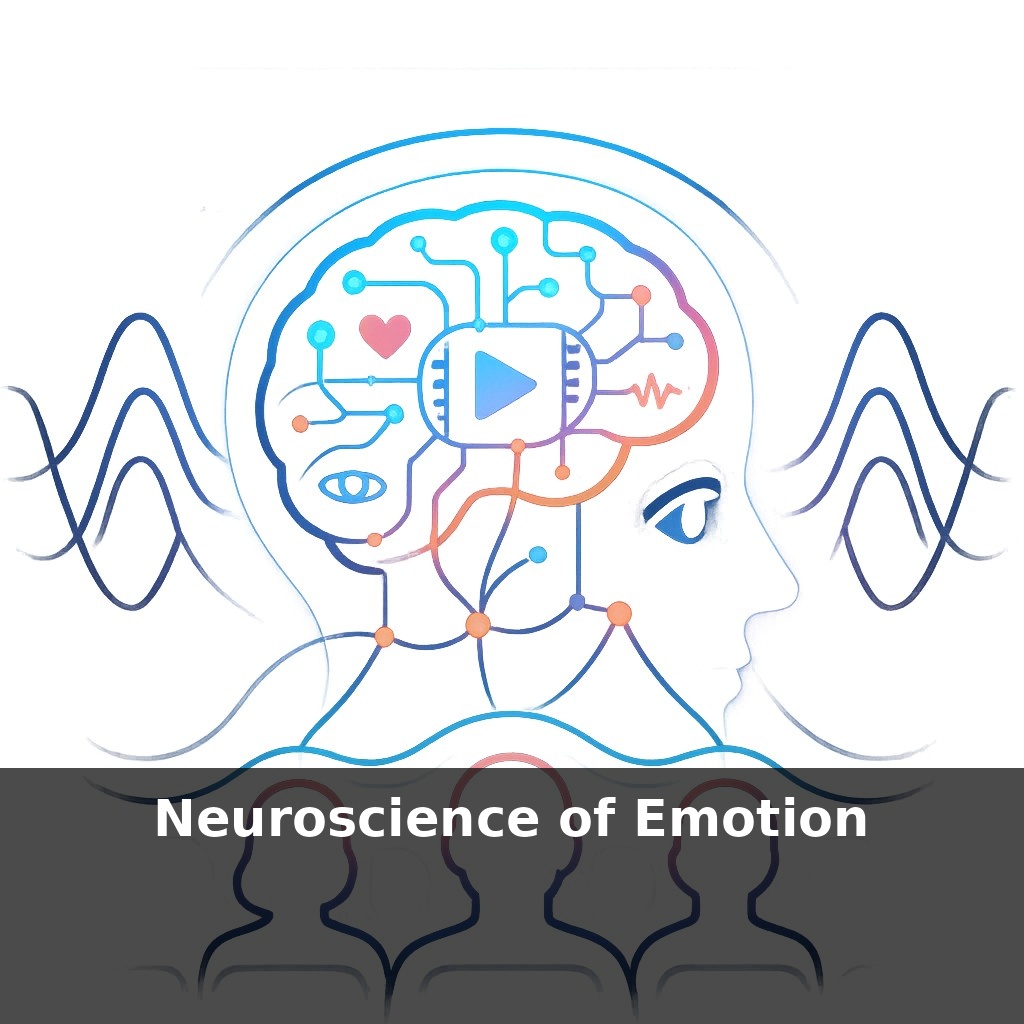
Neuroscience of Emotion
📝 Transcript
A suspense scene can make the brains of a whole cinema audience pulse in sync, almost like a single mind. One person gasps, another grips the armrest, and a third feels their heart race—yet inside, their neural rhythms are lining up, choreographed by the film.
Neuroscientists can now watch this process unfold almost frame by frame. When a character’s face suddenly crumples, activity spikes in regions that read social signals; when the soundtrack swells, areas that track bodily states light up. Visual cuts, sound cues and timing don’t just “feel” effective—they leave a measurable fingerprint across multiple brain systems at once. Directors, often without formal neuroscience training, have learned these levers through trial, error and box-office feedback. Editors talk about “rhythm” and “breath” in a scene, but what they’re really adjusting is how long your brain has to predict, react and recover. Subtle changes—a half-second pause before a line, a delayed music cue, a longer close-up—can shift not only what you feel, but how strongly your brain locks onto everyone else’s in the room.
Neuroimaging adds another twist: different ingredients of a scene tug on different systems at once. A trembling close-up leans on the amygdala and vmPFC to tag a moment as safe, risky or morally charged. A dissonant chord or sudden silence nudges the insula and ACC, shifting how “on edge” your body feels. And when an actor flinches or reaches out, the mirror-neuron network quietly rehearses the same move inside you. It’s less like watching from a distance and more like being drafted into the story’s internal circuitry, whether you want to or not.
Neuroscientists used to study emotion with static photos or single tones in a lab; films changed the game. A movie provides a continuous stream of faces, actions, music and story beats, so researchers can see how the emotional network behaves in something closer to real life. When they slide viewers into an fMRI scanner and play a short film, they don’t just ask “which region lights up?”—they track how the amygdala, vmPFC, insula, ACC and mirror systems rise and fall together over minutes, almost like following the score of an orchestral piece.
One pattern that stands out: your brain treats story as a kind of prediction training. As a plot unfolds, frontal regions constantly guess what comes next, while deeper circuits tag each outcome as better or worse than expected. Surprise, relief and dread show up not as isolated “feelings,” but as shifts in how these guesses are updated. A jump scare that comes too early or too late is less effective partly because it lands outside this window of prediction, giving those circuits less of a jolt.
Studios quietly exploit this. Test audiences might watch three alternate versions of the same sequence while wearing eye-trackers and heart-rate sensors. Editors then line up the physiological traces with the timeline of the scene. A dip in attention when a side character talks? Trim the dialogue. A consistent spike in skin conductance when the villain hesitates before acting? That pause is gold; they may extend it. Over many projects, patterns emerge that feed back into writing and storyboarding long before cameras roll.
There’s a social layer too. When you see someone’s eyes well up on screen, nodes in your mirror system and mentalizing network help you infer their inner state. But context matters: the vmPFC weighs past scenes, moral cues and even your own life history to decide how much to care. That’s why the same on-screen tear can feel manipulative in one movie and devastating in another; the surface expression is similar, but the meaning that your control systems construct around it is not.
Your challenge this week: pick one emotional scene from a favorite film and watch it twice—first with sound, then muted. Notice which moments still “land” without audio and which suddenly feel flat. You’re reverse-engineering which parts of your emotional circuitry each layer of the craft is actually targeting.
When editors at Pixar tweak a storyboard, they’re not just polishing jokes; they’re shaping how your prediction systems will rise and fall over 90 minutes. Their internal data show that a classic Hero’s Journey—early struggle, mid-crisis, hard-won resolution—maps onto stronger audience satisfaction, which quietly means a smoother trajectory in those frontal regions that keep betting on what happens next. Horror teams do something similar with physiology instead of story beats. At the University of Turku, jump scares that pushed heart rates up by 14–25 bpm weren’t just “scarier”—they tended to cluster where earlier scenes had already trained viewers to expect, then delay, the threat. Studios with access to skin-conductance readouts go even further: Warner Bros. analysts found that moments nudging arousal above a 0.05 μS threshold were nearly three times likelier to survive into the final cut. It’s like revising a musical score by replaying the concert and amplifying the passages where the audience collectively leans forward in their seats.
Studios are already testing emotion-aware trailers that reshuffle in real time based on viewer engagement, hinting at films that “listen back” to us. At home, your watch or VR headset could nudge streaming platforms toward scenes that gently stretch your comfort zone, like a trainer adjusting the weight on a barbell. Therapists might one day assemble micro-playlists of clips tuned to specific fears or biases, turning movie nights into targeted emotional workouts rather than passive escapes.
As these tools mature, emotional design in film could become less about “pushing buttons” and more like crafting a tailored playlist for your nervous system. The open question is how much of that tuning you’ll control. Will you choose settings—comforting, challenging, cathartic—or will recommendation engines quietly steer the slider for you?
Before next week, ask yourself: - “When I feel a strong emotion (like irritation in traffic or anxiety before a meeting), what’s the *first* physical signal my body gives me—tight chest, faster breathing, jaw clenching—and can I pause for 30 seconds to just notice that signal without trying to fix it?” - “In one emotionally charged moment today, what changes if I silently label my state with specific ‘neuroscience words’—like ‘my amygdala is on alert’ or ‘my prefrontal cortex is trying to come back online’—instead of just saying ‘I’m stressed’?” - “If I deliberately do one nervous system ‘downshift’ (for example, a slow exhale that’s longer than my inhale or briefly stretching my neck and shoulders), how does that change the intensity or duration of the emotion I’m feeling in that moment?”
From this course
Why Movies Make You Cry
6 episodesUnlock all episodes
Full access to 6 episodes and everything on OwlUp.
Subscribe — $1.99/monthLess than a coffee ☕ · Cancel anytime

