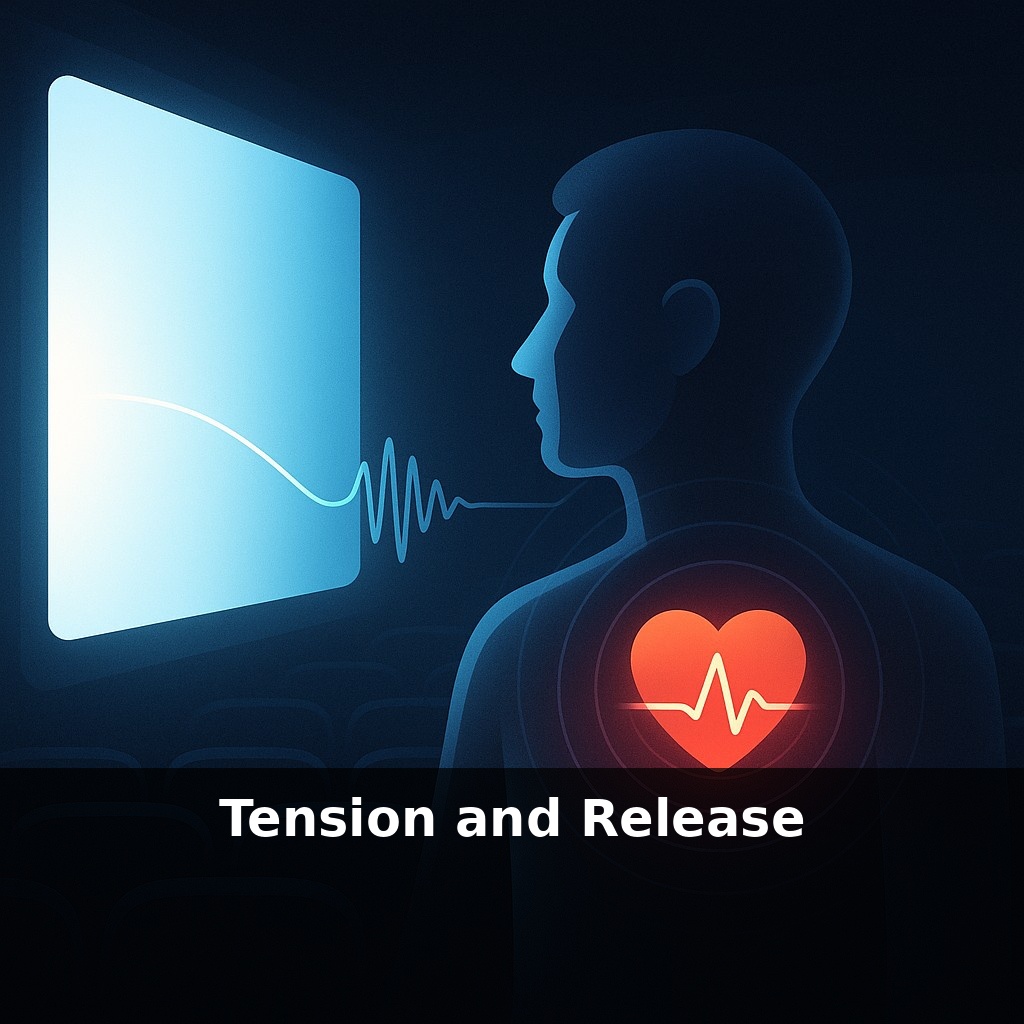
A horror film can raise your heart rate almost as much as light exercise—without you moving a muscle. You’re in the theater: the room is quiet, no jump scare yet, but your chest is tight. Why? In this episode, we’ll explore how movies create that invisible “stretch” before the emotional snap.
A 2019 University of Westminster study found that during high‑tension scenes, viewers’ heart rates jumped by 25–35%—as if they’d briefly started exercising in their seats. That spike isn’t accidental; it’s engineered. Filmmakers treat uncertainty, timing, and sound almost like dials on a control panel, nudging your body into alert mode long before anything “scary” actually happens. Notice how a hallway shot lingers a beat too long, how dialogue suddenly slows, or how background noise thins out to near‑silence: these are tiny, precise choices designed to stretch you toward a breaking point. Then, with a cut, a reveal, or even a joke, they let you drop. Across a whole film, these micro‑stretches stack into a larger emotional arc, steering you toward one big moment that feels strangely satisfying—because your brain has been primed for release all along.
Filmmakers don’t just want you scared or thrilled; they want you *stretched* in very specific directions. That’s where stakes, pacing, and structure come in. Stakes answer, “What do we stand to lose right now?” In *Get Out*, every polite conversation quietly risks the protagonist’s safety and identity, not just his comfort. Pacing decides how long we’re forced to sit with that risk. Even the order of scenes matters: jump too fast between danger and safety and tension feels cheap; linger too long and it goes flat. The best films shape these rises and dips into a rhythm your body starts to anticipate—without ever quite guessing the beat.
Tension doesn’t come from *one* thing on screen; it comes from a stack of small, carefully timed pressures. Start with *who* we’re aligned with. When a director holds on a character’s face a little longer than feels comfortable, lets us hear their breathing, or isolates them in the frame, we’re being nudged to fuse our emotional state to theirs. From that point on, every delay, interruption, or obstacle lands directly in our nervous system.
Uncertainty gets sharpened by how information is rationed. Hitchcock’s famous “bomb under the table” idea isn’t just about danger; it’s about *who knows what, when*. If we know more than the character, we feel dread. If we know less, we feel confusion. Great thrillers toggle between these positions moment to moment, constantly adjusting how “in the know” we feel so our attention never fully relaxes.
Pacing, on the page and in the edit, controls how long those adjustments last. *Get Out* keeps its scene lengths short through the middle of the film, constantly refreshing the question, “Is this safe or not?” Then, as it approaches the 95‑minute mark, those rhythms shift: scenes stretch, confrontations finally collide, and the film starts cashing out all the little tensions it’s been banking. That contrast between tight buildup and more expansive payoff is what makes the release feel earned instead of arbitrary.
Sound and silence are the glue holding these moves together. A long, steady note that *doesn’t* resolve, footsteps with no visible source, or even the sudden *absence* of ambient noise can all raise arousal without anything overtly scary happening. Editors often cut *into* a sound—like a door slam or a phone ring—to mark a shift from stretch to snap, telling your body, “Now you can react.”
Across a whole movie, these choices form layers: tiny questions inside bigger questions, each with its own rise and fall. A minor conflict in a scene builds a little pressure; the outcome of that scene feeds a larger dilemma; and all of those threads point toward one macro moment where the film finally answers, “What did all this tension *mean*?” That final release—happy, tragic, or bittersweet—lands hardest when every smaller wave has been quietly pushing in the same emotional direction.
Watch the way *Get Out* handles that backyard party: on the surface it’s small talk and canapés, but every interaction contains its own mini “stretch” that never quite resolves. A guest stares too long, a question lands a little off, a smile freezes just past natural. Each moment is like a brief, dissonant chord in a piece of music—alone, it’s odd; stacked together, your body starts waiting for the note that finally resolves them all.
You can see a similar pattern in heist films. In *Ocean’s Eleven*, the team repeatedly “almost” gets caught: a guard turns early, a camera pans wide, a code nearly fails. None of these beats are the climax, but each creates a tiny promise that *something* will eventually go wrong—or miraculously right. Marvel movies use humor in the same way: a joke right after a near‑disaster doesn’t cancel the pressure; it vents just enough to make room for the next rise, keeping you engaged instead of exhausted.
Future implications
As creators gain access to real‑time data—from wearables, eye‑tracking, even subtle posture shifts—tension curves will start to move with us instead of at us. A thriller could quietly shorten a scene if your attention drifts, or delay a reveal if your body signals you’re not invested yet. Like a GPS rerouting around traffic, AI systems will learn to adjust narrative “routes” on the fly, raising questions about who controls the dial on our stress and satisfaction.
Tension and release aren’t just tricks for thrillers; they’re the rhythm under most things we enjoy—comedy setups and punchlines, cliffhanger TV episodes, even how streaming platforms autoplay the next show just as you exhale. Your challenge this week: notice three moments where a story *denies* you closure longer than feels fair. How often do you lean in instead of looking away?