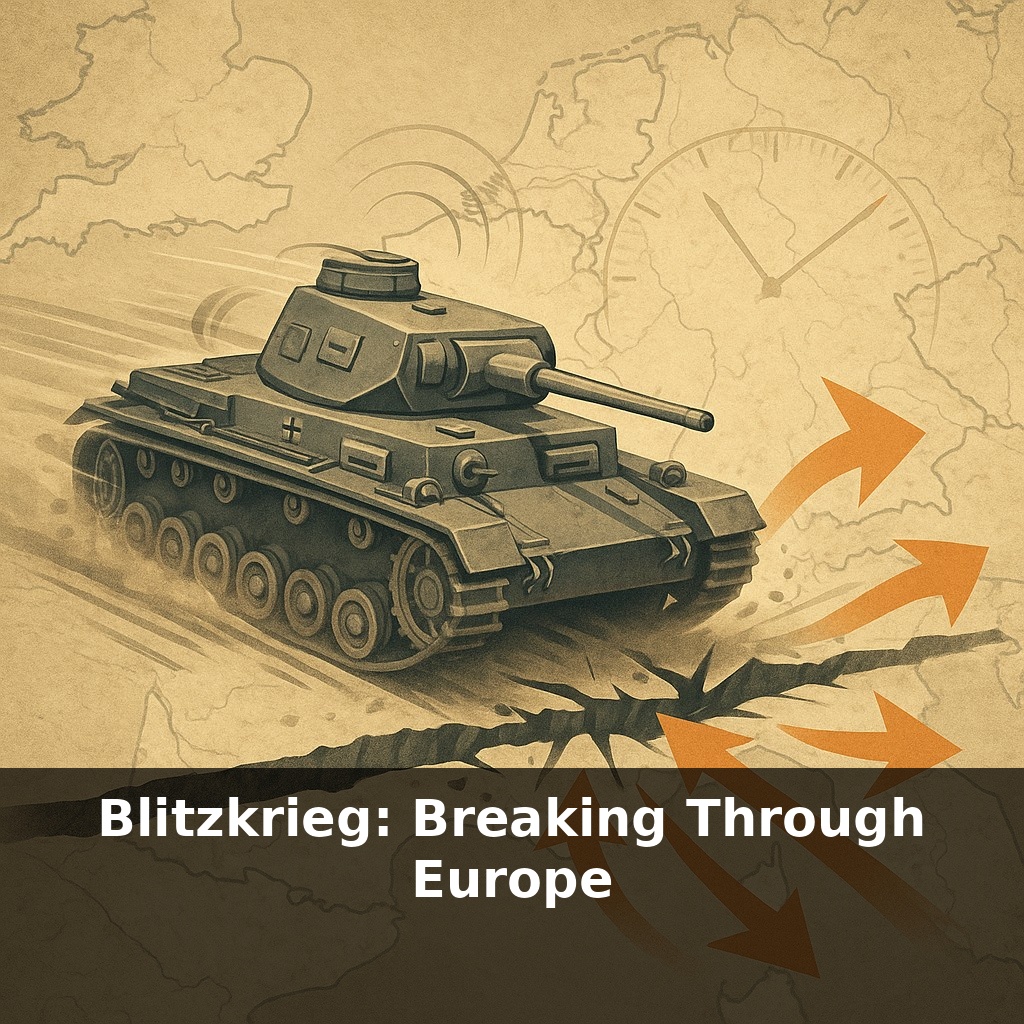
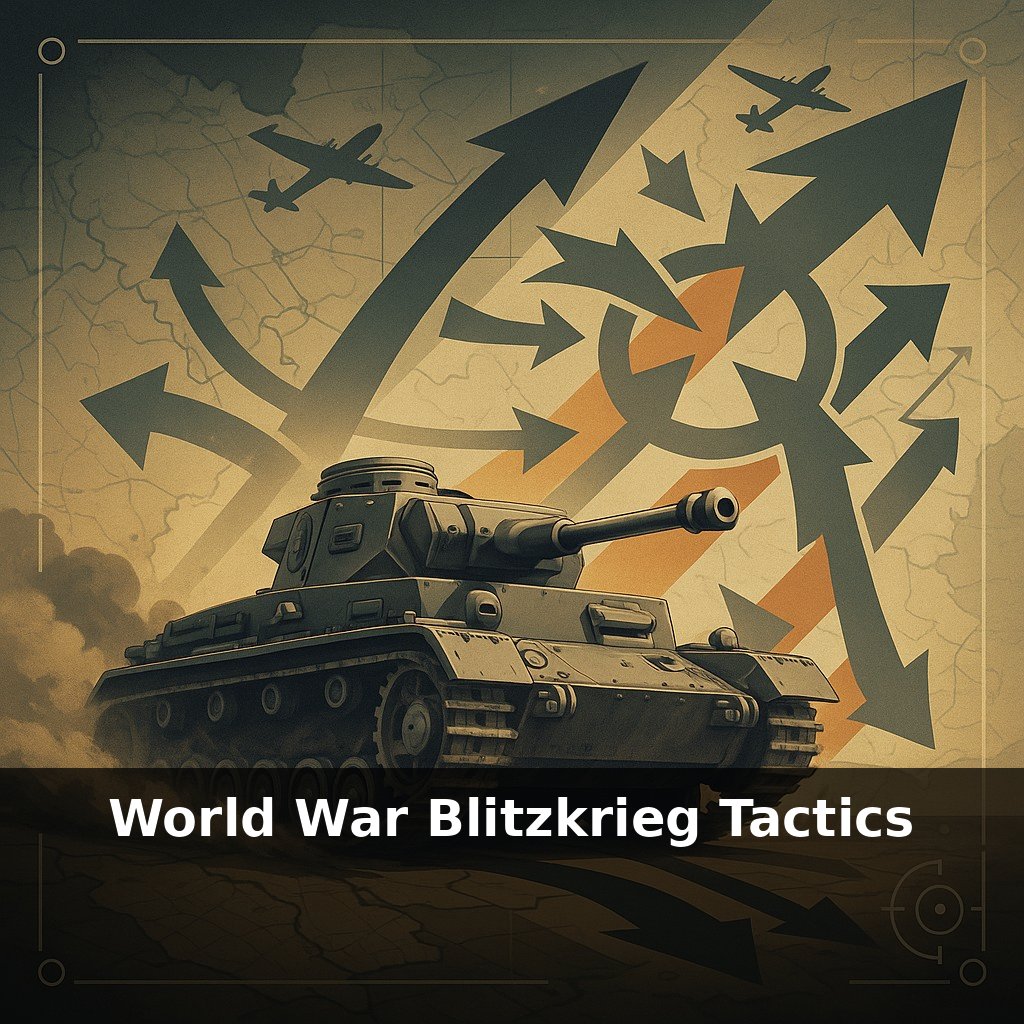
A single German tank division in 1940 often had fewer tanks than the French facing it—yet it was the French armies that collapsed in weeks. In this episode, we drop into the chaos of that campaign and ask: how did “less” armor turn into a devastating advantage?
French commanders in 1940 didn’t just misjudge German strength—they misjudged German *speed*. Their plans assumed days to react, reposition, and plug holes; German units were punching new holes in hours. Radios crackled nonstop in Panzer columns, while many Allied units still relied on field phones and dispatch riders that literally had to find a wire… or a road that wasn’t already jammed with refugees.
This episode follows the moment that tempo flipped the battlefield: when columns of armor, infantry, and Stukas stopped acting like separate tools and started behaving like a single, fast-moving weather front, rolling over one defensive line after another before reports of the first breach even reached headquarters.
Your challenge this week: when you study any major campaign or operation, track *time* as carefully as terrain or troop numbers. Ask: who forced whose clock to speed up—and who paid the price for reacting late?
German planners didn’t just want to move fast; they wanted to *decide* fast. Before 1939, staff officers ran map exercises where wooden blocks—tanks, infantry, aircraft—were pushed in tight, synchronized waves, rehearsing how to exploit even tiny cracks in an enemy line. Doctrine like *Auftragstaktik* (mission command) told junior leaders what *goal* to achieve, not exactly *how* to do it, so they could adapt when roads clogged or bridges vanished. Operational plans became less like rigid blueprints and more like a conductor’s score, allowing tempo to surge or soften as opportunities appeared.
The crucial twist in 1939–40 wasn’t just *moving* fast, but *where* that speed was pointed. German planners stopped thinking in terms of evenly pushing a front line forward. Instead, they hunted for seams—rivers poorly defended, forest sectors assumed impassable, junctions between two armies whose radios didn’t talk to each other.
That’s why the Ardennes mattered. On maps in Paris and London, it looked like a natural shield: thick woods, narrow roads, few good crossing points. French high command judged it “difficult for large-scale armored operations,” so top-tier divisions sat elsewhere. German staff turned that assumption into an opportunity, threading columns through the terrain at night, using strict march discipline to keep roads from choking with vehicles.
Here’s where the real coordination showed. Tanks didn’t rush blindly; engineers went forward to clear obstacles and prep bridges. Reconnaissance units nosed ahead to find weak spots and identify artillery positions. As soon as resistance stiffened, Stukas were vectored onto specific nodes—bridges, crossroads, signal centers—rather than just “bombing the front.” The aim was to smash *connections* more than units: cut phone lines, crater key junctions, stun headquarters that were trying to assemble a response.
Motorized infantry followed close enough to secure flanks and expand gaps, but not so close that they clogged the spearhead’s roads. Supply convoys were scheduled almost like trains: fuel, ammo, repair crews flowing forward along pre-assigned routes, because a halted Panzer regiment was just an expensive roadblock.
Once a gap opened, the emphasis shifted from “breaking through” to “breaking apart.” Instead of doubling back to clean every pocket, armored groups drove deep toward river crossings, rail hubs, and command posts—targets that kept the enemy’s whole system functioning. Many Allied units weren’t defeated in set-piece battles; they woke up to find their lines of retreat and communication silently sliced.
Your challenge this week: when you look at any fast-moving campaign, trace not the arrows on the map, but the *nodes* they target—bridges, HQs, junctions. Ask: were planners trying to destroy forces, or to unplug the enemy’s entire network?
Think less about columns of tanks, more about *where* the shock landed. In 1940, German air liaison officers rode with forward armor, using radios to request Stuka strikes on a specific bridge or crossroads they’d just spotted, sometimes within minutes. That meant the “flying artillery” wasn’t tied to a timetable; it hunted live opportunities.
One recorded sequence near Sedan shows how granular this could get: recon units identified a French artillery battery sighting in on a crossing; coordinates went up the chain; Stukas rolled in, silenced the guns, and within an hour engineers were expanding the bridgehead under much lighter fire. No huge set-piece battle, just a series of rapid, surgical hits on the key joints holding the defense together.
Like a storm system that targets pressure lines rather than open fields, these blows concentrated on junctions where multiple units depended on the same roads, depots, or signal centers—places where a single crater or collapsed bridge rippled through an entire army’s ability to react.
Blitzkrieg’s deeper warning isn’t just “move fast,” but “expect your map to be wrong.” Future offensives will fuse drones, AI targeting, and cyber strikes to blind sensors and jam networks before ground forces move. That shifts vulnerability from front lines to server rooms and data pipes. Think of it like heat spreading through metal: stress one point and the whole structure distorts. The real contest becomes whose system can absorb shocks, reroute, and still make coherent decisions under pressure.
Blitzkrieg hints that future battles won’t just be about bigger forces, but about *where* and *when* pressure is applied. Think of modern systems—power grids, finance, even social media—as landscapes with hidden weak ridges. The open question is: who’s quietly mapping those ridges now, and whose plans depend on them staying invisible?
Try this experiment: Pick a complex project you’re working on (work, study, or personal) and run a 48-hour “Blitzkrieg offensive” on it. First, choose one decisive objective (your “Warsaw” or “Paris”) and list 3–4 bold, fast-moving actions you can take that bypass your usual “fortified lines” (meetings, overthinking, perfectionism). For the next two days, work in concentrated 90-minute “armored thrusts” with no email, phone, or multitasking—aim to punch through one bottleneck per block, not polish everything. At the end of 48 hours, compare: Did this focused, high-speed push get you further than your usual slow, cautious advance, and where did “logistics” (energy, time, support) start to break down?