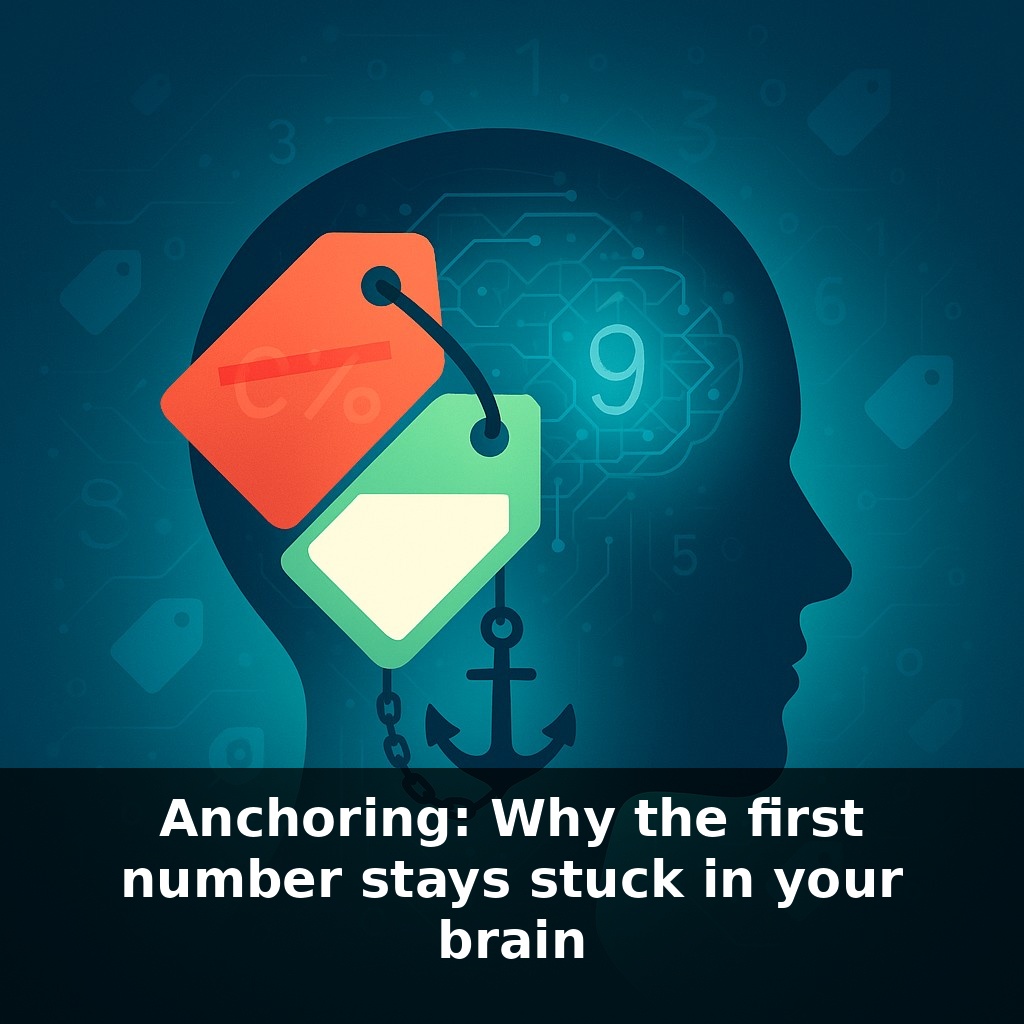
You hear “This laptop was originally $2,000, now just $1,199,” and suddenly the “deal” feels irresistible. Same laptop, same features—but that first price quietly hijacks your brain. Today, we’re diving into why your mind clings to the first number it hears.
Your brain doesn’t just latch onto the first number in stores; it does it with almost every money decision you make—often without your consent. Ask for a raise? The first salary figure mentioned shapes what feels “fair.” Browse apartments? The initial listing you see quietly calibrates what “expensive” and “cheap” mean for the rest of the day. Even judges—trained to be objective—award higher damages when they’ve heard higher numbers beforehand.
What’s sneaky is how reasonable your adjusted judgment feels afterward. You’ll tell a story about market rates, experience, or “gut feel,” while your mind is still orbiting that first figure. And this doesn’t just change what you pay or accept; it shapes what you think is possible at all: what counts as a “big” income, a “realistic” budget, or a “risky” investment. Anchors don’t just tug on your choices—they redraw the mental scale you’re using to measure them in the first place.
Anchors don’t just show up in obvious money moments like sales tags and salary talks; they seep into the quiet corners of your financial life. The first “reasonable” rent your friends mention can shape what cities you even consider living in. The initial retirement number you see in a calculator can silently dictate whether you feel on track or hopeless. Even a random crypto price someone quotes at a party can color what feels like a “bargain” later. Over time, those early numbers act like a soundtrack in the background, setting the key your later money choices tend to play in.
Here’s the strange part: your brain *knows* the first number might be irrelevant—and still leans on it.
In classic experiments, people spun a rigged “wheel of fortune” that stopped on a random number, like 10 or 65. Then they were asked: “What percentage of UN countries are in Africa?” People who saw 10 guessed far lower than those who saw 65. The wheel was obviously fake, totally unrelated to geography. Yet the number still pulled their estimates by 20–30% on average.
That pull shows up in money decisions constantly, but in less obvious ways than a big red “SALE” sign.
You check one “expert” stock forecast of $400 a share. Every later prediction you see, every chart you read, gets mentally compared to that figure. A $310 target suddenly feels “conservative,” even if, in isolation, it’s wildly optimistic. Or you hear a friend casually mention they’re aiming to retire with $3 million. That number lodges in your head; now $800k—once perfectly motivating—feels suspiciously small.
Professionals aren’t immune. In one study with judges, simply increasing the amount a prosecutor requested made awards climb, roughly $150 for every extra $1,000 demanded. These are people explicitly trained to separate facts from rhetoric—yet a single figure, heard early, still bends their sense of “appropriate.”
Part of the problem is effort. Moving away from an early number isn’t just a willpower issue; it’s work. Brain imaging studies show regions linked to deliberate reasoning light up more when people try to adjust. Your mind is literally burning extra resources to correct… and usually doesn’t correct enough.
Now layer on social proof. The first rent you see in a hot neighborhood, the opening salary range in a job posting, the “typical” wedding budget on a blog—each one arrives wearing the disguise of “how things are done.” You’re not just pulled toward a number; you’re nudged toward a norm. Say “everyone pays around $2,500” and suddenly $2,200 feels thrifty, even if it was $1,600 last year.
Over time, these early figures form a quiet baseline. Not a single dramatic moment, but an accumulation: the first tech salary you’re offered, the initial home price your agent “wouldn’t go below,” the inaugural bonus that silently becomes your reference for “good years” and “bad ones.”
You sit down to “quickly” check flight prices. The first search shows $720, so when another site lists $640, it feels like a win—never mind that a week ago you’d have called $400 expensive. Or you scroll a job board and see one role at $180k; suddenly the $115k posting you’d once celebrate looks oddly underwhelming, even if it’s still a big step up for you.
This shows up in everyday conversations too. A friend casually mentions their “small” $30k wedding, and without noticing, you file that away as a rough benchmark. Later, a $22k quote feels almost frugal. Same with subscription creep: after agreeing to $15/month for one app, $9.99 for another seems negligible, because your brain is quietly comparing it to that higher figure rather than to zero.
In medicine, patients often cling to the first risk percentage they hear for a treatment. A doctor might later present better data, but that early number still colors what feels “safe enough,” even when everyone’s trying to be objective.
As money moves into screens, headsets, and live-updating dashboards, the “first numbers” you see may be chosen by algorithms, not humans. Early crypto bids, surge-fare estimates, or “from $X/night” hotel tiles can become quiet steering wheels for entire markets. In VR malls or AI-run negotiations, even default sliders and pre-filled offers may set de facto boundaries. Think of them less as hints and more as opening moves in a game whose rules you haven’t fully read yet.
Those first numbers aren’t just traps; used deliberately, they can be tools. You can set your *own* opening figures—what you offer first in a negotiation, the budget you decide is “normal” for groceries, the range you treat as acceptable for rent—before anyone else speaks. Like tuning an instrument, the note you choose at the start shapes every sound that follows.
Before next week, ask yourself: 1) “Where in my life right now am I letting the *first* number I saw (like a list price, a salary band, or a ‘standard’ consulting rate) quietly set the bar for what I think is reasonable—and what would change if I deliberately imagined that first number being 30–40% higher or lower?” 2) “The next time I see a price, estimate, or ‘typical’ figure today, can I pause and ask: ‘If I *hadn’t* heard this number first, what would *I* have guessed based on past experiences, comparable options, or my actual budget?’” 3) “In my next negotiation or big purchase this week, what number do *I* want to anchor first—based on my research and goals—rather than reacting to someone else’s starting point?”