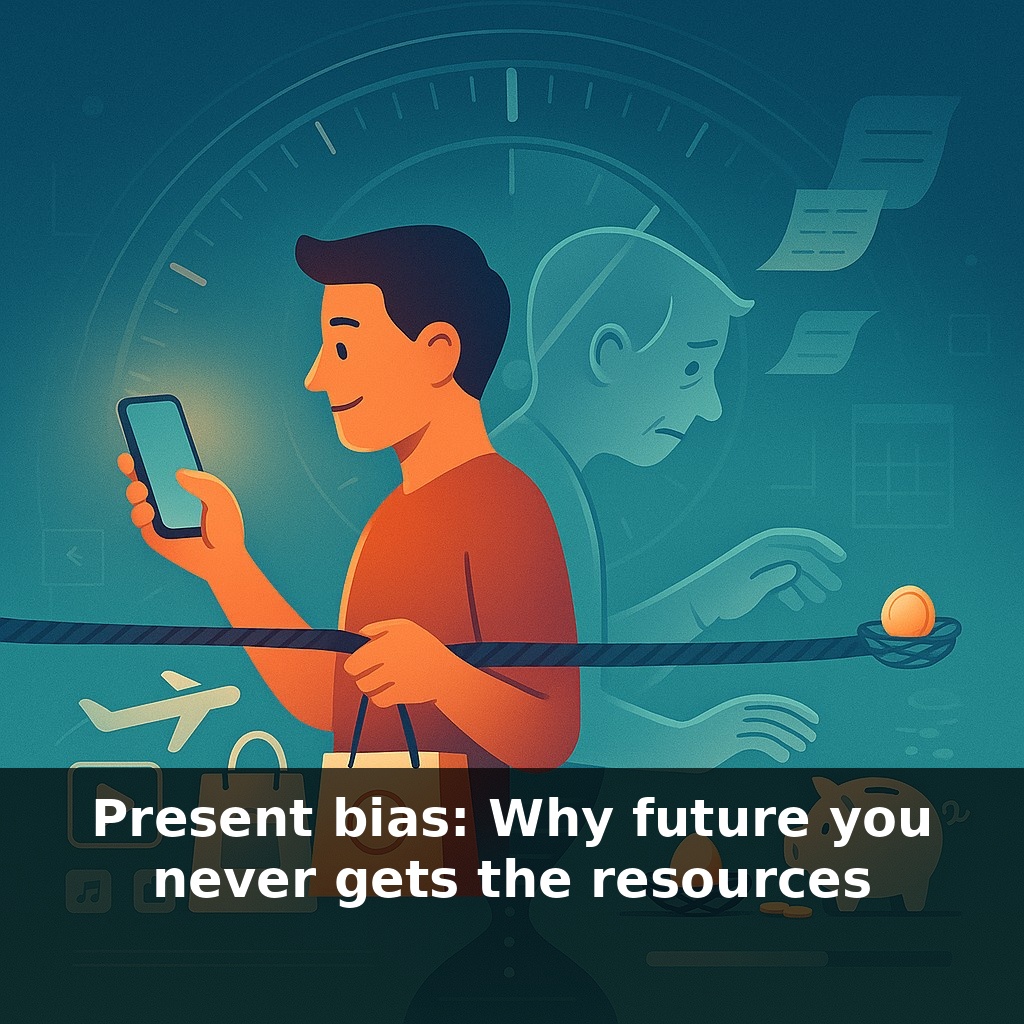
About half of people nearing retirement in the U.S. have only around ninety thousand dollars saved—far below what experts say they’ll need. Yet those same people will happily upgrade a phone or take one more trip. How does “right now” keep stealing from “years from now”?
Economists have a name for this tug-of-war between today and tomorrow: present bias. It’s not just “being bad with money”; it’s a systematic way our brains misread time. Offer us $50 now or $60 in a month, and many grab the $50. But move both options into the future—$50 in a year or $60 in a year and a month—and suddenly waiting the extra month feels fine. Same $10 difference, same 30-day wait, totally different choice. That mental glitch quietly shapes countless daily decisions: upgrading streaming instead of boosting savings, choosing convenience food over cooking, scrolling instead of learning skills that could raise future income. Present bias doesn’t shout; it whispers, “You’ll start later.” In this episode, we’ll unpack why that whisper is so persuasive—and how to rig your environment so future you finally gets a fair vote.
Psychologists and neuroscientists see the same pattern economists describe, but from the inside out. Brain scans show that when a reward is right in front of us, emotional and reward circuits light up fast, while regions responsible for planning and self-control respond more slowly, like a cautious friend arriving late to a heated argument. That delay matters. Under stress, fatigue, or endless micro‑decisions—choosing lunch, replying to messages, reacting to ads—the “right now” systems get even louder. The result: we constantly re-negotiate with ourselves, and the long-term side keeps getting crowded out.
Think about how this plays out across an ordinary week. Monday morning, you swear this is the month you’ll “get serious” about money. By Friday night, the only thing that got serious was takeout and same‑day delivery. Nothing dramatic happened; you just made a series of tiny choices that all leaned slightly toward “now.” Present bias rarely shows up as one huge mistake—it’s the slow drift of countless 5% compromises.
Behavioral economists map this with what’s called hyperbolic discounting: your preference for immediacy doesn’t shrink smoothly over time, it drops sharply between “now” and “later,” then flattens. That’s why “start saving next month” sounds painless—both options live in the vague future—while “start today” feels like a cut.
Companies and governments quietly design around this. When UK employers made pension saving the default rather than an opt‑in extra, participation jumped without a big education campaign. Most people didn’t suddenly become more disciplined; they just went along with the path of least resistance. Your brain is exquisitely sensitive to friction: a form to fill out, a password to find, a decision to revisit. Each small hassle acts like a tiny “tax” on future‑oriented actions.
This is also why one‑time decisions beat ongoing ones. Choosing a savings rate once and letting it auto‑increase with raises is far easier than re‑choosing every year. Each fresh decision reopens the door for “eh, I’ll bump it later.” Structurally, the world is full of “subscribe now, cancel later,” but very few “save now, enjoy later” defaults.
The environment amplifies things. Sale countdowns, limited‑time offers, in‑app notifications—these are engineered to make “right now” louder and more urgent than “later.” Your planning self isn’t weak; it’s outnumbered and outgunned.
Your challenge this week: pick one money behavior you *know* you want—like increasing a contribution or paying extra toward a debt—and redesign it so it requires no fresh willpower for at least six months. That might mean setting an automatic transfer on payday, enrolling in an auto‑escalation feature, or scheduling a calendar block with a friend where you both commit to locking in a choice. The goal isn’t to “be stronger”; it’s to make the better path the easy path, and let default settings do the quiet work your future self keeps hoping you’ll start.
Think about smaller, everyday trade‑offs where that same shortcut shows up. You promise you’ll cook more “once life calms down,” then walk past your own groceries to tap a delivery app. You swear you’ll learn a new skill “after this busy week,” then let one more episode auto‑play. The stakes feel low in the moment, but the pattern compounds.
Companies understand this rhythm. Streaming platforms preload the next show because they know you’re more likely to go with whatever’s already happening. Fitness apps that schedule sessions on your calendar see higher follow‑through than ones that simply track workouts; pre‑committed time beats good intentions.
Musicians use a similar trick: they don’t decide whether to practice each day; they decide once to rehearse at 7 p.m. after dinner, then build life around that. No fresh debate, less room for “later.” You can mimic that with money by tying actions to existing routines: every raise triggers a fixed bump in saving, every tax refund sends a set slice to a separate account before you even “see” it.
As lifespans stretch and careers look more like playlists than single albums, treating money choices as one‑off events stops working. Present‑focused habits that felt harmless at 30 can snowball into hard limits on where you live, who you can help, and what work you’re free to say no to. Tech will lean into this gap: apps that “skim” tiny amounts from each tap‑to‑pay, dashboards that show future‑you’s options like alternate endings, and workplace systems that quietly turn windfalls into buffers instead of temptations. The frontier isn’t just getting people to save; it’s designing systems where doing nothing gradually helps your future instead of eroding it—so the silence between big financial decisions becomes productive, not costly.
Future‑you isn’t a stranger; they’re just you with more memories and fewer options if you ignore them. Treat them like a close friend moving into your house next year: what would you stock, fix, or set up now so they feel supported, not stuck? Each small system you build today is like leaving the porch light on so they don’t arrive in the dark.
Before next week, ask yourself: “If my tendency toward present bias disappeared for just 10 minutes today, what concrete decision would I make right now to protect future me—cancel a subscription, move money into a ‘future me’ account, or block off a no-meeting focus block on my calendar?” Then ask: “Looking at my week ahead, where am I clearly favoring ‘easy now’ over ‘better later’—hitting snooze, doom-scrolling at night, skipping meal prep—and what is one specific friction I can add (or remove) today to nudge myself toward the future-benefiting choice?” Finally: “If future me could send me one short message about what they wish I’d prioritize this week (health, money, learning, relationships), what exactly would it say—and how can I reserve 20 minutes on my calendar today that honors that request like it’s a meeting with someone important?”