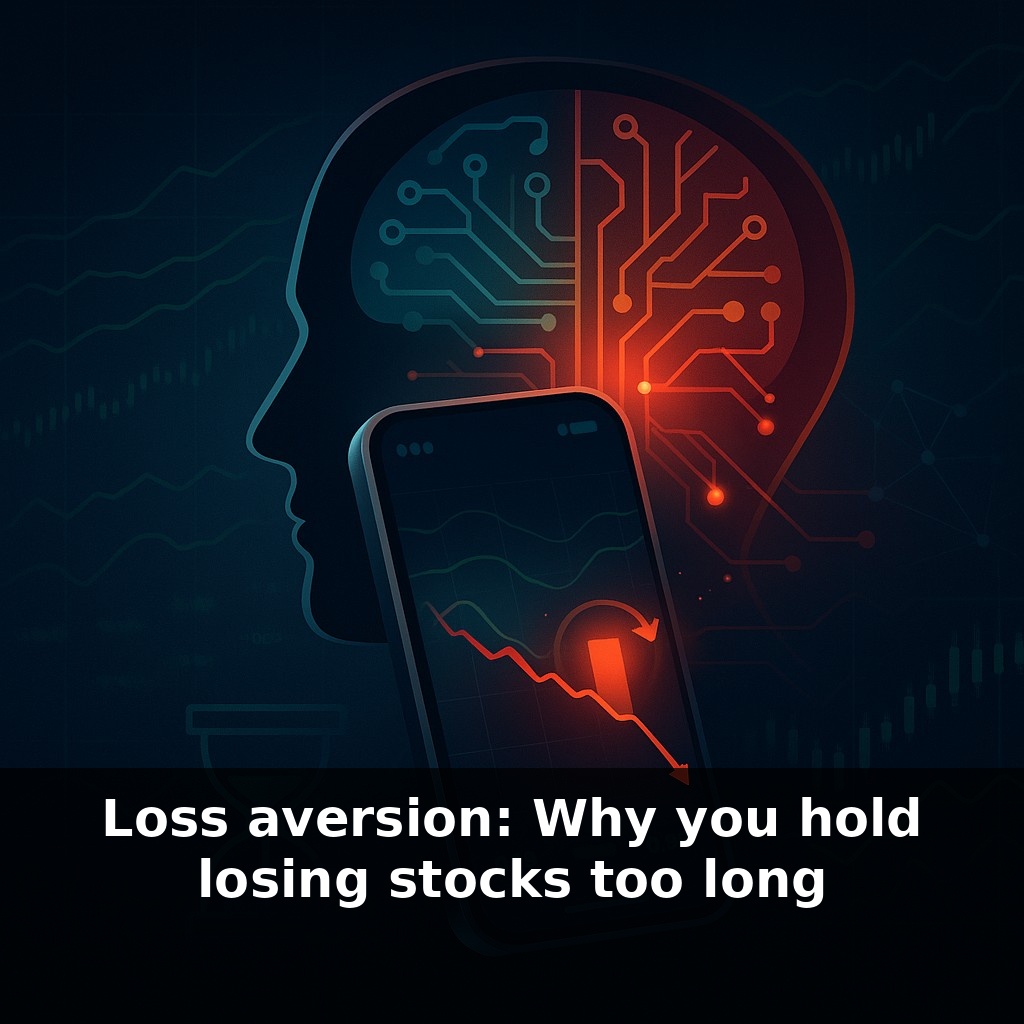
You sell your winners fast and babysit your losers for months—maybe years—yet still call it “being patient.” Here’s the twist: research shows that urge to hold a red-number stock isn’t discipline at all. It’s your brain quietly preferring the *possibility* of breakeven over actual progress.
So you stare at that red position in your account and think, “It’s only a loss if I sell,” as if your brokerage statement were a kind of Schrödinger’s portfolio where reality waits on your decision. Meanwhile, the market moves on, fresh opportunities appear, and your capital stays handcuffed to yesterday’s story. Loss aversion doesn’t just nudge you toward caution; it quietly rewrites the rules you use to judge success, turning “Did this investment still make sense?” into “Can I avoid feeling stupid?” That emotional reframing is costly. It makes you more likely to double down on bad ideas, chase break-even mirages, and ignore healthier choices sitting right next to them in your watchlist. In this episode, we’ll dissect how that happens and what to do about it.
So instead of asking “Why do I feel this way about losing stocks?” let’s zoom out and ask a different question: “What *system* is this feeling operating inside?” Markets don’t care what you paid; they only care what your capital is doing now. Yet most portfolios end up organized like a messy closet: old mistakes pushed to the back, rarely worn but never tossed, because throwing them out would sting more than the space they waste. That’s how dead money quietly accumulates—line by line on your statement—while newer, stronger ideas fight for room. The cost isn’t just financial; it’s cognitive bandwidth tied to yesterday’s choices.
Here’s the strange part: your brain doesn’t even *look* at gains and losses on the same ruler. In Prospect Theory experiments, people consistently demand a much bigger upside to accept a possible loss of the same size. Barberis’s meta-analysis pins that “extra pain weight” at roughly 2.25x. On a trading screen, that tilt means a -$1,000 drop grabs far more mental real estate than a +$1,000 gain ever will—so your attention gets glued to the wound, not the whole body of your portfolio.
That warped ruler shows up clearly in real accounts. Odean’s 1998 study of 10,000 investors found they were far more likely to sell a stock that had gone up than one that had gone down, even when future performance didn’t justify it. Losing positions stuck around about 50% longer, dragging returns lower by roughly 3.5 percentage points a year. In other words, the “I’ll just wait” instinct behaves like a quiet performance fee you pay to your own nervous system.
It gets more subtle when you zoom out from single trades to years of behavior. Morningstar’s “Mind the Gap” report found that, over a decade, U.S. investors earned about 6% while their funds earned 8.4%. That 2.4-point gap is mostly timing—buying high, selling low. Part of that timing error is what happens when investors only sell after pain becomes unbearable, then hesitate to reinvest because they “don’t want to lose again.” Loss aversion first keeps them in too long, then keeps them out too long.
Taxes add another twist. On paper, realizing losses can be valuable. Systematic tax‑loss harvesting—selling losers, banking the deduction, and rotating into similar exposure—has been estimated to add 0.5–1% to annual after‑tax returns. Yet many affluent investors ignore this because “locking in a loss” feels worse than any abstract tax benefit feels good. The math is clear; the emotion wins.
And this bias doesn’t disappear with experience. Professional managers show the same “disposition effect”: faster to realize gains, slower to realize losses. Skill may reduce the magnitude, but the tendency persists, because it’s baked into how humans weigh outcomes. Recognizing that it survives CFA exams and risk committees is oddly liberating—it means the goal isn’t to become fearless, just to design habits that stop your fear from running the portfolio.
Think of a guitarist obsessed with one bad note during a performance. The crowd heard a solid solo; all they remember is the tiny mistake, so they keep replaying that bar at home instead of learning new songs. Investors often treat a red position the same way: not as one line in a larger “setlist,” but as a personal flaw they must fix. That’s why you’ll see someone happily add fresh cash to a sagging single name they “want to get right,” while refusing to add to a broad index fund that’s quietly compounding.
You can spot this in how people talk: winners get numbers (“up 38%”), losers get stories (“this has to turn; the CEO has a plan”). Stories make it harder to walk away. The more narrative you wrap around a loser—“disruptor,” “undervalued gem,” “market overreaction”—the more selling starts to feel like giving up on an identity, not reallocating capital.
Professional algorithms don’t do this. They tag a position as risk, return, and correlation, then adjust. No grudges, no redemption arcs—just, “Does this still earn its place today?”
Some fintech apps are already testing “sell nudges”: if a position lags your plan, they surface prompts the way fitness apps remind you to stand. Over time, AI could learn your personal pain thresholds and suggest actions *before* you freeze—flagging better replacements, surfacing tax angles, or even pausing impulse deposits into chronic losers. The open question: will these tools act like helpful coaches, or like casinos learning exactly which buttons to press?
Noticing this bias is less about becoming fearless and more like tuning an instrument: small adjustments, repeated often, change the whole sound. As tools get better at surfacing patterns you overlook, the real edge may belong to investors willing to treat each sell decision as a fresh audition—“Would I buy this today?”—instead of a verdict on their past self.
Before next week, ask yourself: 1) “Looking at my portfolio right now, which specific losing stock am I holding mainly because I ‘don’t want to lock in a loss,’ and if I woke up with that same amount of cash instead, would I honestly choose to buy this stock today at this price?” 2) “If this stock dropped another 20%, what would I wish I had done today—and what concrete rule (e.g., ‘I sell if it’s 25% below my purchase price or if the thesis changes’) would have protected me?” 3) “What original reason did I have for buying this stock (growth story, valuation, dividend, etc.), and does that reason still hold up based on current facts—not hope—when I read the latest earnings or news this week?”