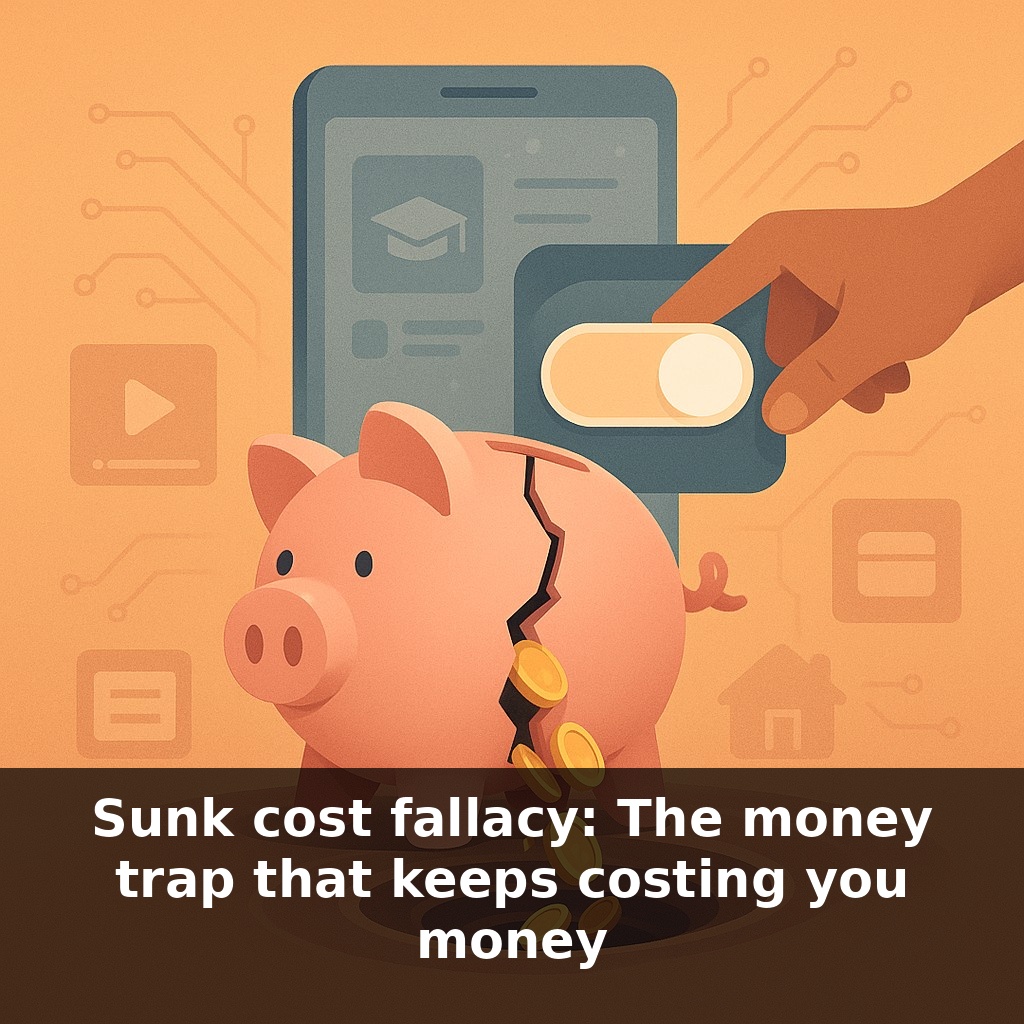
About half of investors admit they cling to losing stocks just because they’ve “already lost too much.” Now zoom in: you’re halfway through a terrible online course, a costly remodel, a doomed side hustle. You know it’s not working—so why is walking away the hardest move to make?
You’ve seen this play out with money, but sunk costs quietly steer choices far beyond your portfolio. That subscription you never use but keep “just in case.” The side project that eats your weekends because you already poured months into it. The degree, career path, or business strategy you defend long after your gut has checked out—because changing course would mean admitting the old path isn’t paying off.
What’s tricky is that experience and effort *do* matter; not every rough patch is a sign to quit. The real challenge is separating persistence from stubbornness. Are you continuing because the future payoff still looks strong—or because the past cost feels too painful to let go of? In this episode, we’ll zoom in on that line: how to recognize when you’re investing wisely in your future, and when you’re just protecting your past.
Sometimes the “cost” isn’t even yours. Teams keep a doomed product alive because the founder sacrificed weekends for it. Families pressure someone to stay in a degree because “we’ve all supported you this far.” In these moments, the fallacy piggybacks on loyalty, identity, and fear of disappointing others. And your brain doesn’t help: it files past effort as something sacred, not to be wasted. That’s why a fresh opportunity can feel oddly threatening—choosing it seems to erase the old path. Our goal here isn’t to judge those instincts, but to understand how they quietly shape what you do next.
Money decisions are supposed to be about the future, yet your brain quietly keeps glancing in the rearview mirror. That rearview obsession shows up in three predictable ways.
First, **mental accounting**: your brain labels money by its “story,” not its actual value. A bonus feels like “fun money,” a down payment feels “too big to fail,” a startup you funded becomes “my baby.” Once a dollar is tagged with an identity, you’re more likely to defend the story than evaluate the odds. That’s why people double down on a flailing business but happily walk away from a similar opportunity they never touched—same numbers, different narrative.
Second, **loss aversion distorts the scale**. In lab experiments, people demand much more money to accept a loss than they’d ever pay to get an equivalent gain. The pain of closing a project “in the red” weighs more than the quiet benefit of freeing time, cash, and energy. On a spreadsheet, the decision is neutral; in your body, it feels like ripping off a bandage in slow motion. Neuroscience work backs this up: brain regions tied to threat flare when you contemplate quitting, as if stopping were danger itself.
Third, **self-justification turns decisions into identity tests**. Once you’ve argued for a path, promoted it, maybe staked your reputation on it, reversing course isn’t just “ending a project”—it can feel like rewriting who you are. This is one reason large organizations keep funding overdue, overbudget initiatives: no one wants to be the person who “admits failure,” so groups slide into a kind of shared denial. The U.S. Air Force’s decision to cancel the A-12 was so notable precisely because it cut against this social gravity.
These forces can even hijack strengths you’re proud of. Discipline becomes rigidity when schedules stay fixed after circumstances change. Loyalty becomes a trap when you keep investing in a partner’s idea you’d never back as a stranger. Ambition backfires when “making it work” overshadows “is this still worth it?”
To navigate this, you don’t need to feel less; you need clearer checkpoints. The skill isn’t heroic detachment—it’s learning to pause midstream and ask, “If I arrived here fresh today, with the same resources and knowledge, would I choose this again?” That one question shifts attention from the sunk past to the negotiable future.
Think about where this shows up outside of money. A band keeps a weak song on the album because they spent months in the studio polishing it— even though it drags the whole record down. A city keeps patching an outdated transit line instead of planning a better route, because scrapping the old blueprints would mean admitting years of planning missed the mark.
On a smaller scale, it’s the third rewrite of a project proposal no one asked for, the relationship you keep defining as “going through a phase,” the conference you attend again because “I always go,” even though last year’s notes are still untouched.
One useful tell: notice when your reasons drift toward the past tense—“I’ve already…,” “We’ve put so much into…,” “After everything I did to get here…” Future‑oriented choices sound different: “Given what I know now…,” “From this point on…,” “Over the next year, this still beats my alternatives.” That subtle language shift is often the first hint that your brain is recalibrating around what comes next, not what’s already been paid.
Quitting early can quietly become a superpower as money and technology intertwine. As AI tools flag patterns you miss, they won’t just tell you *what* looks off, but *when* to reconsider course. Think of them less as bosses and more as co‑pilots, tapping your shoulder before turbulence. As more people normalize walking away from bad bets—projects, apps, even careers—reputation may shift: not toward “who endured the longest,” but “who redirected fastest when the world changed.”
Treat each decision like updating a playlist: some tracks fit who you are now, others belong to an older version of you. As tools surface clearer feedback—metrics, reviews, tiny red flags—you gain more chances to reorder things. Your challenge isn’t to predict perfectly, but to keep editing when the rhythm of your life clearly changes.