About half of companies using AI admit they don’t formally check it for bias—yet they still let it screen job applicants, approve loans, and flag crimes. In this episode, we’ll step into those decision rooms and ask: who’s really responsible when the AI gets it wrong?
In this episode, we’re going to move closer to the front lines of human-AI collaboration—where real people feel the impact of abstract design choices.
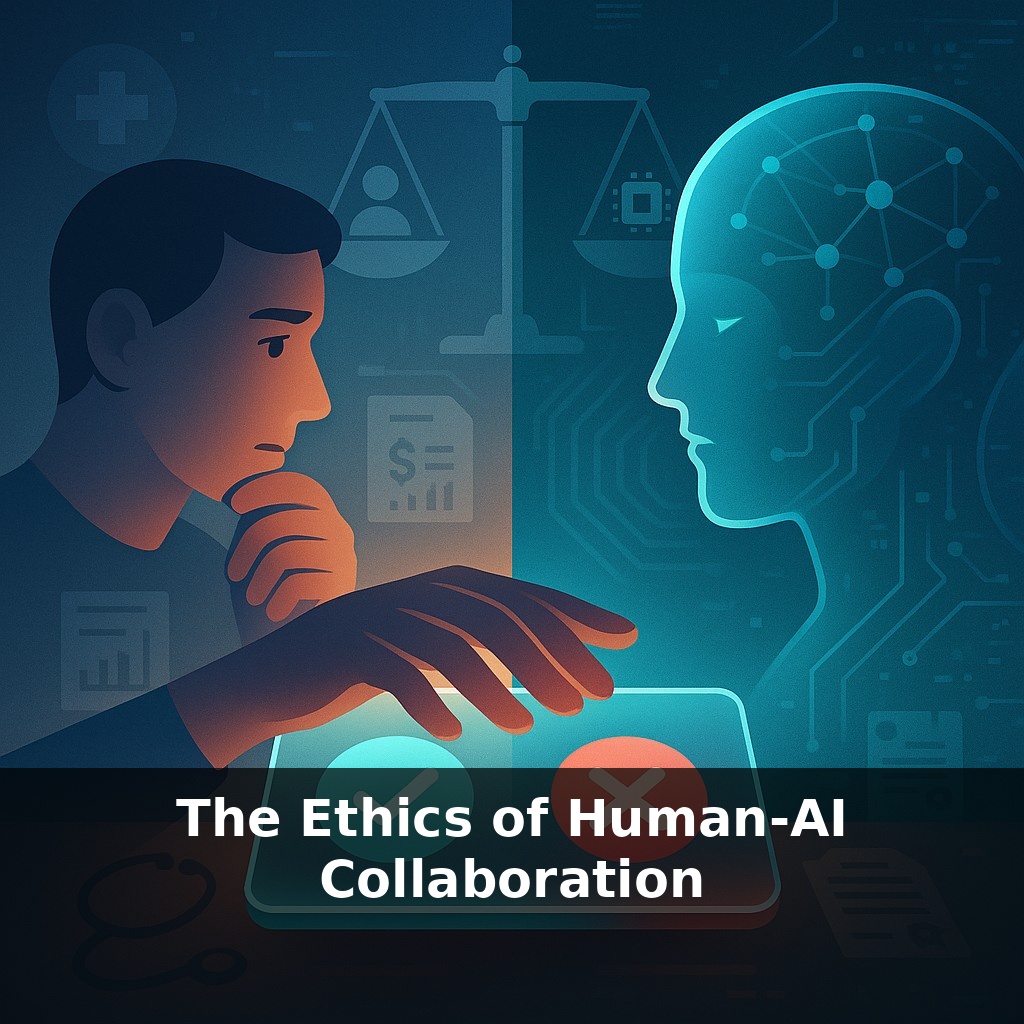
A doctor double-checking an AI-generated diagnosis. A loan officer overriding an automated rejection. A content moderator pushing back when a system flags activism as “harmful.” These aren’t edge cases; they’re becoming ordinary work.
We’ll explore what happens when privacy, transparency, and human autonomy collide with commercial pressure and technical convenience. If an AI can quietly infer your health status from your shopping data, is that innovation, intrusion, or both? And when a model’s recommendation contradicts a human expert, whose judgment should prevail—and who carries the moral weight of that decision?
We’ll look at how teams can design collaboration so AI supports human values, rather than silently steering them.
In practice, most human-AI collaboration doesn’t look dramatic. It’s quiet, routine, and buried inside dashboards, prompts, and default settings. An AI suggests which patient to see first, which transaction to flag, which applicant to nudge forward—and the human often clicks “accept” because the system feels confident, fast, and backed by data. The deeper ethical questions surface later: when the output is wrong, can anyone retrace how it happened? Did the person at the screen feel free to disagree, or subtly coerced by metrics, time pressure, and interface design that treats AI’s guess as the “right” answer?
The pressure to move fast with AI means many systems are shipped in a “good enough for demo” state and then quietly promoted to “good enough for people’s lives.” The MIT–PwC finding that most companies lack formal bias audits is a symptom of a deeper pattern: ethical safeguards are often treated as optional features, not core infrastructure.
That pattern shows up in hiring. Amazon’s abandoned recruiting tool didn’t fail because the algorithm was uniquely bad; it failed because the organization treated historical data as a neutral teacher. When “successful” past resumes were mostly from men, the system learned to associate maleness with merit. No one built a “discriminate against women” feature—but no one built guardrails against it either.
Surveillance technologies illustrate a different failure mode. IBM’s decision to step away from general-purpose facial recognition wasn’t driven by technical limits; it was a recognition that some applications tilt so strongly toward abuse—mass tracking, racial profiling—that “fixing” them with better accuracy misses the point. In some domains, the ethical move is not to optimize but to withdraw.
Then there’s data protection. Stanford’s work on language models reconstructing training data shows how even well-intentioned systems can leak what they were never meant to reveal. A clinician, a lawyer, or a banker might believe they’re consulting a neutral tool, while the model is quietly echoing fragments of someone else’s confidential records. The harm isn’t just hypothetical if a motivated attacker can probe the system until sensitive snippets appear.
All of this complicates accountability. Traditional oversight assumes you can inspect records, understand reasoning, and assign responsibility. With modern AI, explanations are often statistical, partial, and post hoc. Teams end up negotiating “good enough” transparency: logs of inputs and outputs, impact assessments, red-team reports, structured escalation paths when humans disagree with the model.
Designing that negotiation well is the heart of ethical collaboration. It means deciding in advance where humans must retain veto power, how dissent is recorded, and when the safest choice is to limit or refuse automation entirely—even when the business case is strong and the technology is impressive.
A credit analyst stares at a dashboard where one number glows green: “Approval score: 0.91.” There’s no flashing red sign that the applicant recently changed jobs, has medical debt, or supports three dependents—those details are folded into that single score. The ethical question isn’t just whether the model is “fair,” but whether the interface nudges the analyst to treat that 0.91 as destiny or as one voice among many.
In a newsroom, an editor leans on AI to prioritize which tips to investigate. If the system quietly downranks stories from certain neighborhoods or languages, entire communities can fade from coverage without a conscious editorial choice. The harm shows up as silence, not scandal.
Think of an AI system like a camera lens: if the lens is smudged or the filter tinted, every photo you take will be distorted—no matter how advanced the camera body is. The practical task is not worshipping or rejecting the camera, but learning when to zoom, when to change lenses, and when to put it down.
Laws will arrive unevenly, but their effects will ripple far beyond compliance teams. Creative fields may lean on AI for drafts while unions negotiate which tasks are off-limits. In classrooms, students could co-write with models while universities watermark machine-assisted work instead of banning it. Everyday apps might surface “why this suggestion?” panels, just as food labels list ingredients. The deeper shift: treating AI less like a wizard and more like a colleague whose influence we’re obliged to track.
As AI seeps into calendars, inboxes, and creative tools, ethics won’t live in policy PDFs—it’ll live in tiny choices: whether to click “accept,” to ask “why this?,” to override a suggestion. The frontier isn’t only in labs or laws; it’s in treating every interaction as a chance to steer collaboration toward dignity, rather than default convenience.
To go deeper, here are 3 next steps: 1) Read the “OECD AI Principles” and the EU’s “Ethics Guidelines for Trustworthy AI” (both free online) and highlight 3 principles you want to bake into your own AI use (e.g., transparency, accountability, human oversight). 2) Run one of your current AI-assisted workflows (like drafting emails, code, or analysis) through the free Aletheia Framework or the AI Ethics Impact Group’s “Assessing AI” checklist and note exactly where human review or consent should be added. 3) Watch at least one lecture from the MIT course “Ethics of AI and Big Data” on YouTube, then pick a specific AI tool you actually use (ChatGPT, Midjourney, GitHub Copilot, etc.) and update its settings or your usage pattern (e.g., data sharing, logging, or review steps) to better align with the ethical concerns raised in the episode.