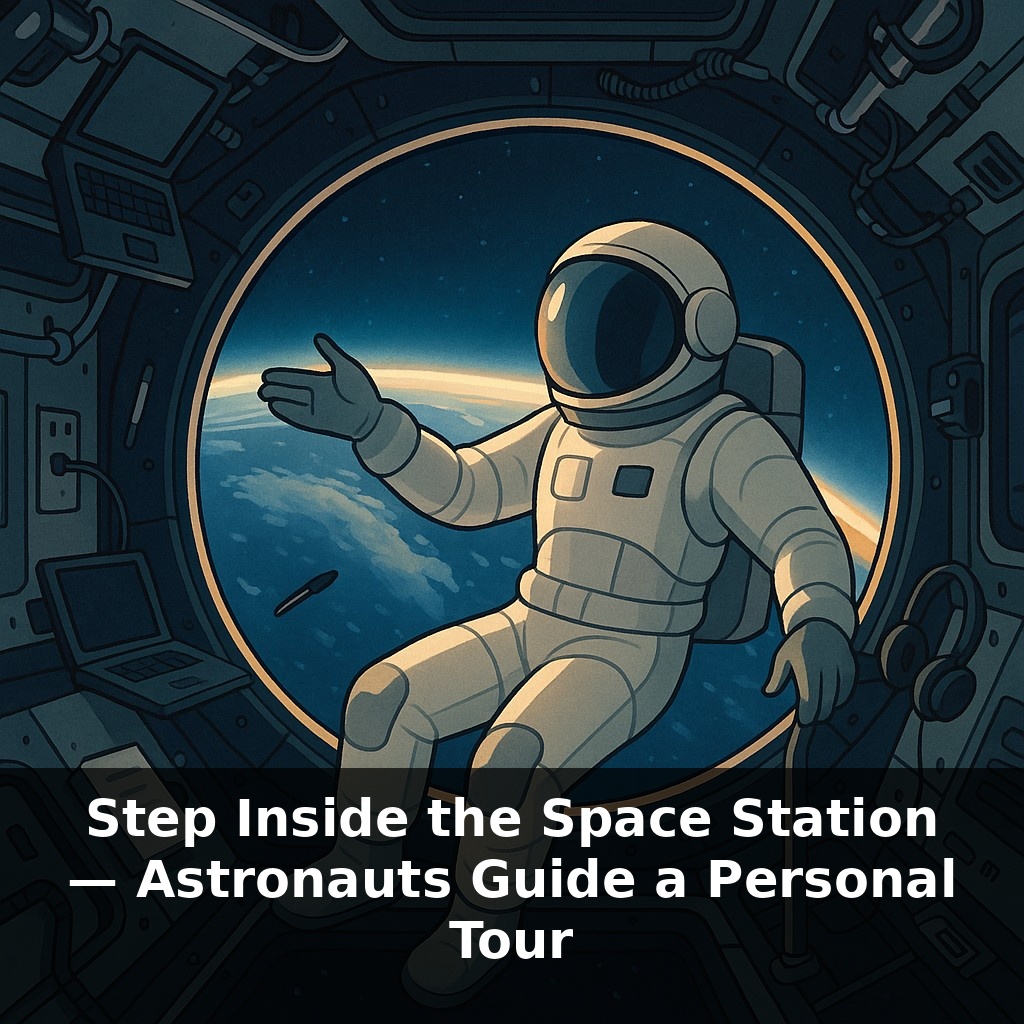
Step Inside the Space Station — Astronauts Guide a Personal Tour
📝 Transcript
Sixteen sunrises, sixteen sunsets—every single day. Now, hold onto a handrail in your mind as an astronaut pushes off a wall and glides past you. A pen drifts by, a quiet fan hums nonstop, and Earth hangs in the window, slowly turning beneath this floating home.
There’s no “up” or “down” here—only “toward the window,” “back to the lab,” or “over by the treadmill bolted to the wall.” The station’s interior feels less like a hallway and more like the inside of a 3D maze: every surface has laptops, experiments, cables, and handrails, and any one of them might become your “floor” for the next few minutes. As we float through, you’ll notice a constant background whisper of fans; that wind is life itself, pushing air so no invisible pockets of carbon dioxide collect around sleeping astronauts. Labels and color codes are everywhere, a kind of orbital street map that keeps supplies, tools, and scientific gear from disappearing into the station’s white, boxy wilderness like raindrops vanishing into a cloud. Today, your guides are the people who call this maze home.
The crew’s tour starts in what passes for a “front door”: a hatch ringed with bungee cords, tool bags, and cameras waiting for their next spacewalk. Nearby, a windowed cupola gives astronauts a panoramic Earth view and a place to quietly decompress between experiments. Follow them “forward” and the station shifts from home to high‑tech lab: gloveboxes where they poke hands into thick sleeves to handle delicate samples, racks pulsing with unseen data, and small experiment cubes that might hold anything from protein crystals to tiny plants testing how to grow without ever feeling their own weight.
On your left, your guide hooks a foot under a rail and stops beside a rack the size of a wardrobe. Panels swing open to reveal laptops, valves, and silver tanks. This is one of the station’s “utility closets,” but instead of umbrellas and old coats, it holds the systems that quietly keep everyone alive: water, air filters, power converters. A checklist floats nearby, tethered by a thin cord—paper is still king when you need to glance, confirm, move on.
They tap a small gray box and grin. “That’s yesterday’s sweat.” Up here, humidity from breathing and exercise is captured, condensed, cleaned, and turned into tomorrow’s coffee water. Nearby lines route recycled urine to another processor. You’re watching a closed loop in action, where every drop is precious and tracked. Maintenance on these systems eats a big slice of the crew’s week: replacing filters, swapping out sensors, chasing down tiny leaks before they become big problems.
Drifting “aft,” the mood shifts from machinery to daily routine. You pass a wall dotted with toothbrushes, clippers, and floating hygiene kits. A crewmate demonstrates “washing up” with a squeeze bag of no‑rinse soap and a towel that will be carefully dried and stowed, not tossed. Every object has a designated spot; losing a simple comb can mean a frustrating hunt through hundreds of cubic meters.
Further along, the smell changes slightly—warmer, a hint of spices. You’ve crossed into the galley. Food packets line a panel in labeled pouches: thermostabilized entrees, freeze‑dried veggies, tiny bottles of hot sauce prized for cutting through space‑dulled taste buds. One astronaut kneads a packet of curry, clips it to a tray, and snips the top. Tortillas—favored over crumb‑making bread—wait in another bag, ready to become improvised sandwiches.
Across from the galley, a laptop screen cycles through experiment timelines, exercise slots, and communications windows with mission control centers scattered across the globe. The schedule is color‑blocked and dense; five minutes here, ten there, a long stretch reserved for a delicate procedure whose data may feed into cancer treatments or new materials back on Earth.
Your guide glances at the clock and pushes off toward the next module. “Stick around long enough,” they say, “and you’ll feel the place breathing with you—systems, science, and people all on the same rhythm, just 400 kilometers above home.”
Some of the most surprising moments on station come from the quiet in‑between spaces—like drifting past a rack and spotting a tiny sphere of “marble” water, perfectly round, with a tablet of dissolved dye pulsing inside it. Astronauts might film how that dye spreads, giving fluid‑dynamics researchers data they can’t get on Earth. A few modules away, a crewmate coaxes tiny flames in a sealed chamber. Fire here is stubby and blue, sometimes forming ghostly, wobbling balls; studying how it behaves helps design safer engines and better fire‑safety systems for future vehicles.
Not everything feels high‑stakes. A weekend “photo safari” might have someone parked at a window, patiently catching cities at night, lightning crawling across cloud tops, or the thin airglow tracing Earth’s limb. Another crew member may be tuning a small musical instrument, testing how fingers learn without weight—turning spare minutes into a never‑before‑played “microgravity practice room” suspended between worlds.
Future stations will borrow this lived‑in choreography: quieter machines, smarter walls that track tools, and cabins that morph from lab to bedroom like stage sets between acts. Designers study how crews improvise—taping notes near gloveboxes, timing breaks by Earth’s limb—to script better habitats for tourists and Mars crews. Your grandchild’s “first apartment” might orbit, with AR arrows guiding them from hatch to hammock as easily as a map app today.
Soon, tours like this may be streamed live to classrooms, with students “pinning” questions to modules the way you’d stick notes on a fridge. Astronauts could tag favorite nooks—quiet corners to think, windows best for storms—like a cosmic guidebook. The station becomes less a distant lab and more a shared treehouse in orbit, branches reaching toward whatever comes next.
To go deeper, here are 3 next steps: 1) Pop open the free interactive ISS tour on NASA’s “Station Tour” page and use Google Earth’s ISS layer or the ESA Columbus module 360° view to virtually “float” through the modules the astronauts described. 2) Pull up the live “ISS Tracker” (e.g., Spot the Station by NASA) and the “ISS Live Now” YouTube stream so you can watch Earth from the Cupola in real time and compare it to how the astronauts described the view. 3) Download the ISS operations or crew notebooks from NASA’s Technical Reports Server (NTRS) and, while listening to the episode again, pause at each module they mention (like Destiny, Zvezda, or the Cupola) and skim the corresponding document pages to see the real procedures and layouts they’re talking about.
From this course
Astronaut Diaries: Voices from Space
10 episodesUnlock all episodes
Full access to 10 episodes and everything on OwlUp.
Subscribe — $1.99/monthLess than a coffee ☕ · Cancel anytime