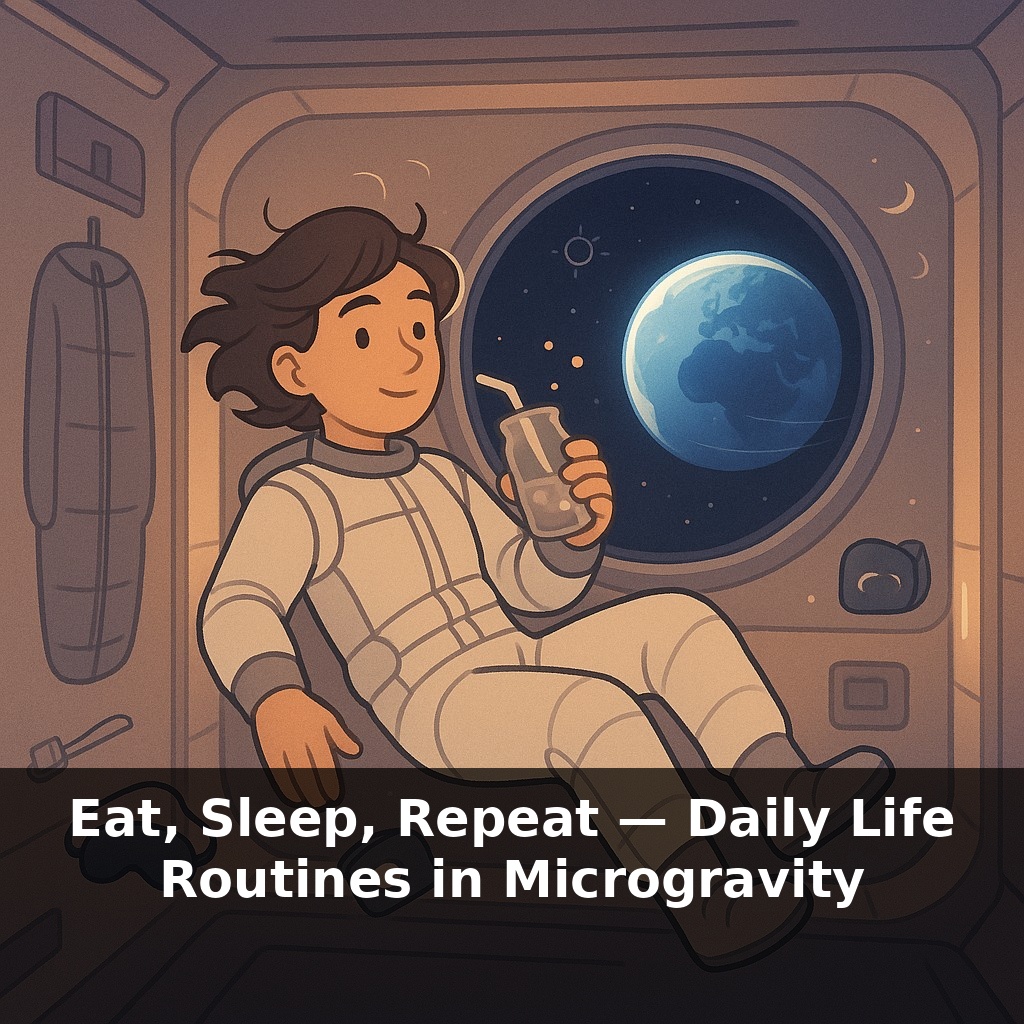
Astronauts set an alarm for “morning”…then wake up to their sixteenth sunrise. In this episode, we drop straight into an ordinary day in extraordinary gravity: how you eat without a table, sleep without a bed, and build a daily rhythm when “down” doesn’t exist.
“Lights out” on the space station doesn’t mean darkness—it means negotiation. Your body still thinks in 24‑hour days, but the world outside your window is flipping from day to night every 45 minutes. To stay sane, crews lean on something more powerful than any gadget: routine.
This episode, we step past the novelty of floating meals and Velcroed pillows and ask: what does an actually livable life look like in orbit? The answer is surprisingly strict. Astronauts follow a timetable closer to a train schedule than a flexible office calendar, with every five‑minute block planned—exercise, lab work, cleaning filters, even talking to family.
Yet within that structure, tiny rituals emerge: a favorite window for “morning,” a preferred corner for “bedtime,” a shared snack after a tough repair. The station runs on physics; the people on it run on habits.
The structure is strict, but the day itself stretches and bends in odd ways. Your “morning commute” might be hand‑over‑hand through three modules to reach the lab. Breakfast is squeezed from packets while a laptop floats at eye level, already loaded with the day’s procedures from Mission Control. Outside, the station skims over continents faster than most people drive across town. Inside, the environment is carefully tuned: air constantly scrubbed, noise humming like distant traffic, lights shifting color through the “day” to nudge sleepy brains into staying on Earth time.
Breakfast starts with inventory as much as appetite. Every pouch has a barcode; every barcode lives in a database in Houston. Scan, log, eat. Over six months, that careful tracking ensures the promised 1.7 kilograms of food and water per person per day actually lines up with what’s floating in the pantry. Menus cycle so you’re not stuck with the same casserole for half a year, and crews get to pre‑select favorites on the ground—macaroni here, tortillas there, the occasional “bonus” candy for morale. Salt and pepper come in liquid form, or they’d drift into fans and electronics.
Anchoring to eat is almost automatic now—feet under a bar, knee hooked around a beam—but the effort shifts to protecting bones and muscles. The schedule carves out a solid 2.5 hours for exercise on three specialized machines: a treadmill with bungees that pull you “down,” a cycle you ride while floating, and the ARED, a resistance device that uses vacuum cylinders instead of weights. Miss more than a few sessions and the numbers show it: month by month, bone density quietly erodes. Workouts become less about vanity, more about coming home able to walk.
Between experiments, maintenance, and briefings with Mission Control, small rituals scaffold the day. The same window for a quick look at Earth before a demanding repair. The same music playlist before a spacewalk review. These anchors matter when the station swings from Chile to China in the time it takes to answer an email.
Sleep is scheduled generously—8.5 hours on the calendar, closer to 6.5 in reality. Light panels shift color to mimic an Earth evening; laptops dim; fans provide a steady hush. You zip into a sleeping bag fixed to the wall or ceiling of a phone‑booth‑sized cabin, a thin psychological door between you and the shared volume outside.
Hygiene slots in around everything else. No shower: instead, a squeeze of rinse‑less shampoo, a wipe‑down with pre‑moistened cloths, toothbrush and tiny globe of water caught before it escapes. The routine saves kilograms of water per day, invisible mass that never had to ride a rocket. Like a carefully tuned piece of music, each repeated note—scan, strap in, exercise, wipe down, lights to “evening”—keeps bodies and minds in tempo with a planet they only see from above.
On Earth, you might hit snooze or shift a meeting; on orbit, the “maybe later” moments are where trouble can quietly start. A delayed equipment check might mean condensation creeping into a connector. Skipping a mood‑check survey could hide the first signs of burnout in a crewmate who hasn’t seen home in months. The day’s pattern is less a checklist and more a weather map: tiny changes, watched over time, reveal fronts of fatigue or storms of stress before they break.
Astronauts learn to read their own routines the way pilots read instruments. If you linger longer than usual at a window, that might be a nudge to schedule an extra call home. If you rush through a lab task, you flag it for review before a small oversight becomes an experiment lost. Even “free time” is logged, not to control it, but to notice: are you always retreating to the same corner, the same playlist, the same game? In a place with no rain or wind, patterns in behavior become the forecast.
Future crews heading to Mars will stretch today’s playbook into something closer to a self-sustaining village. Closed-loop life-support will have to treat every breath and sip like a shared bank account, with sensors tracking “spending” and “interest” in real time. Fresh greens from compact farms could double as mood boosters and CO₂ scrubbers. The same data guiding astronauts’ sleep and nutrition may soon personalize care on Earth—like a quiet co-pilot, tuning light, diet, and meds to your own hidden cycles.
In the end, space “ordinary” may loop back to Earth. The same sensors tracing microgravity meals and restless nights are already testing custom light recipes for shift workers and students, tuning brightness like a dimmer on jet lag. As missions lengthen, those quiet adjustments in orbit could seed the playlists and lighting in your future bedroom.
Here’s your challenge this week: For the next 24 hours, run your day like you’re on the ISS—schedule your activities into tight “orbits” of 90 minutes, with specific blocks for exercise, meals, work, and sleep prep, just like an astronaut’s timeline. During one meal, secure everything on a tray and eat without letting anything leave that space, mimicking how astronauts keep food from floating away. Do one “space workout” session using only bodyweight (think resistance-band style: slow squats, wall push-ups, planks) and log exactly how many minutes you complete. Before bed, follow a strict shutdown routine—no screens for 30 minutes, lights out at a fixed time—treating it like you’re aligning with station “night” and see how closely you can stick to the full plan.