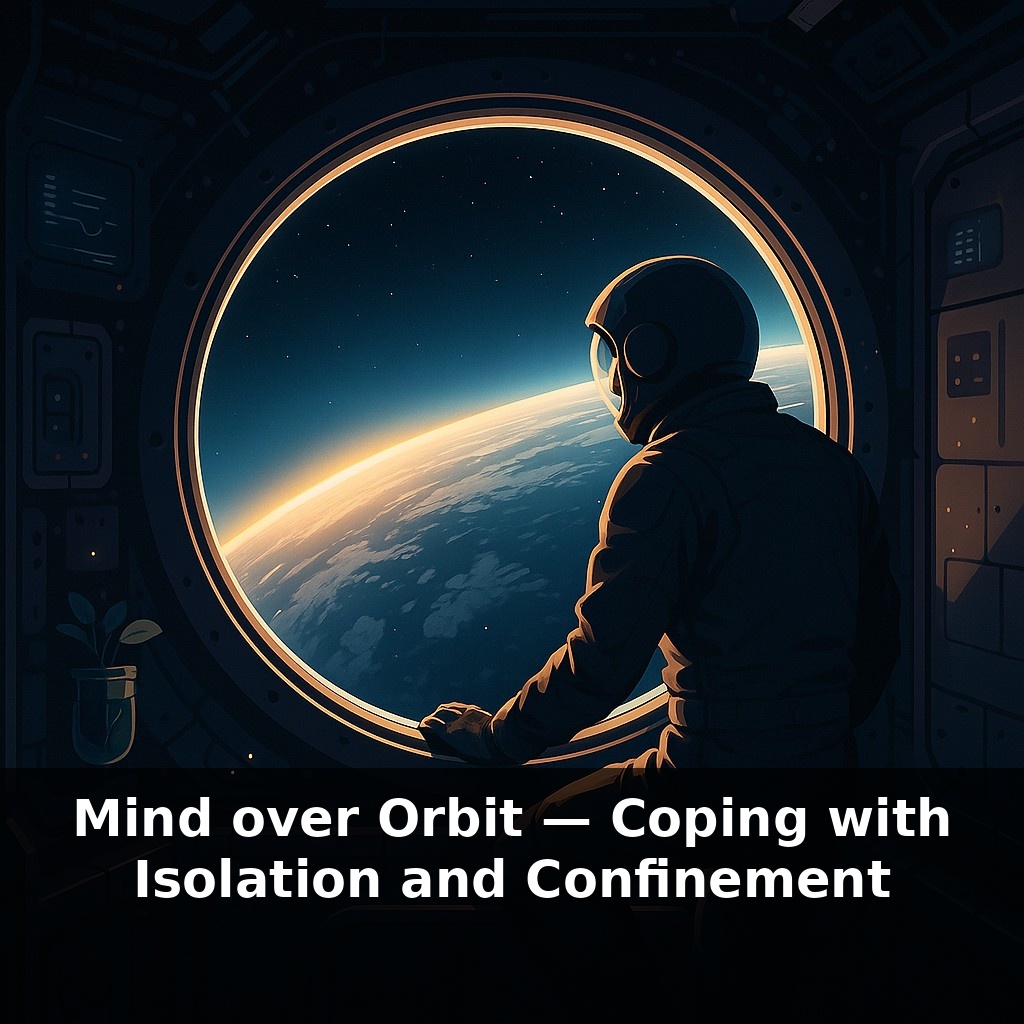
Sixteen sunrises in a single “day,” but no real morning. An inbox of messages from Earth, yet you can’t hug a single sender. Today, we’re diving into a quiet tension: how astronauts can be constantly connected—and still face bone-deep loneliness in orbit.
The ISS loops Earth every 90 minutes, but astronauts don’t let their minds spin with it. Instead, they bolt their days to structure: a wake-up tone at the same time, mission briefings, two hours of mandatory exercise, scheduled calls, lights dimmed on cue. The chaos outside the window is matched by choreography inside.
Psychological support is treated like any other system: monitored, tested, adjusted. NASA bakes in “psych ops” the way it plans oxygen levels—preflight training in coping skills, mid-mission check-ins, and postflight reintegration. Crews learn tools like mindfulness and cognitive reframing not as wellness trends, but as survival gear for the psyche.
And in the middle of all this rigor, there’s deliberate softness: a playlist that reminds you of home, a chosen photo tacked near your sleep pod, or a few quiet minutes of Earth-gazing to reset a restless brain.
Up here, isolation isn’t just being far away; it’s being sealed in with the same few faces, the same modules, the same hum of fans, day after day. Crews don’t wait to feel “off” before acting. They treat mood like engineers treat temperature: something to track before it drifts out of range. Subtle shifts—more snapped replies, a missed joke, a longer pause before answering CapCom—are early warnings. Even the air itself matters; slightly elevated CO₂ has been tied to foggier thinking and short tempers, so atmosphere monitoring doubles as a mental-health check as much as a life-support task.
Routine becomes a kind of scaffolding for the mind, but astronauts still have to live inside it. That’s where micro‑rituals come in—tiny, personally meaningful habits threaded between official tasks. One crew member always floated to the same window after dinner, not just to look at storms, but to deliberately “end” their workday. Another saved a particular snack for Fridays only, to recreate the feeling of a weekend. These may sound trivial, yet in a place where every day risks blending into the next, they’re anchors that keep time feeling human instead of mechanical.
NASA also scripts in what it calls “psychological support activities,” but the content is intensely individual. Crews pre-select movies, books, and playlists that match the emotional arc of their mission. Early weeks might get comedies; later, when novelty fades and fatigue creeps in, more familiar, comforting media takes over. Even care packages are timed: fresh photos, kids’ drawings, or a favorite brand of coffee arrive when motivation typically dips on past expeditions. That timing is based on decades of data from Skylab, Mir, Shuttle–Mir, and ISS crews who logged their moods as carefully as they logged scientific results.
Communication with home is treated with the same precision. On paper, a thirty‑minute family video call per week sounds stingy. In practice, it’s calibrated. Too frequent, and some astronauts found themselves emotionally yanked back to Earth every day, making re‑entry to station life harder. Too rare, and homesickness swelled into distraction. So planners tune both frequency and timing—avoiding calls right before intense operations, for instance—to help conversations replenish rather than drain.
Inside the crew, cohesion is cultivated, not assumed. Commanders get training in conflict navigation specific to cramped, inescapable environments. They practice “task switching” between being the formal leader during critical procedures and a more relaxed peer during meals, so rank doesn’t suffocate casual connection. Regular “crew conferences” give everyone a sanctioned space to air small annoyances before they calcify into grudges. Sometimes it’s as mundane as music volume or how long someone hogs the treadmill, but clearing that static protects trust when real emergencies hit.
Aboard long missions, astronauts talk about mood like weather: not something you control, but something you can predict and prepare for. They map “psychological seasons” of a flight—the early storm of novelty, the flat gray of the middle stretch, the restless gusts right before coming home. Just as a pilot studies cloud patterns, crews learn their own warning signs: the way music stops sounding good, or jokes land a beat too late, or they skip a normally cherished photo window.
When those internal forecasts look stormy, they don’t wait for lightning. Some schedule a harder workout; others ask for a lighter timeline or a different task mix. Counselors on the ground might suggest a “mental EVA”—a planned, brief change of scenery within the station, paired with a call or message at a precisely chosen time.
For future Mars missions, planners are even testing “digital campfires”: curated message threads, delayed by minutes or hours, where crews and families trade stories knowing replies won’t be instant—but will be thoughtful.
Future missions turn these orbit-tested habits into a toolkit for Earth. Long before Mars, designers are treating mood like another life-support loop to monitor and fine‑tune. AI counselors might flag subtle shifts in speech, like a change in tempo in a familiar song, and suggest adjustments before strain peaks. The same systems could quietly support people in polar bases or locked hospital wards, threading small moments of choice and meaning into otherwise scripted days.
Astronaut diaries hint at a quiet revolution: treating mood like a shared instrument the whole crew tunes together. On Earth, that could mean workplaces pacing projects like seasons, hospitals scripting “mental EVA” breaks, or families planning tiny rituals the way farmers watch tides—small, repeating signals that keep our inner orbit from slowly drifting off course.
To go deeper, here are 3 next steps: 1) Watch NASA’s “Psychological Training for Long-Duration Spaceflight” mini-lectures on YouTube and copy *one* concrete habit astronauts use (e.g., a daily “mood check” scale from 1–10) into your phone as a recurring reminder for the next 7 days. 2) Download the free “Expeditionary Crew Skills” workbook from NASA or ESA and actually complete the sections on conflict management and emotional self-regulation, pretending your “crew” is your household or closest colleagues. 3) Pick one confinement-heavy memoir—either Scott Kelly’s *Endurance* or Chris Hadfield’s *An Astronaut’s Guide to Life on Earth*—and read just the first chapter today, then test-drive one tactic they describe (like pre-scheduling “micro-celebrations” or practicing “aiming small” with daily goals) in your own isolated environment tonight.