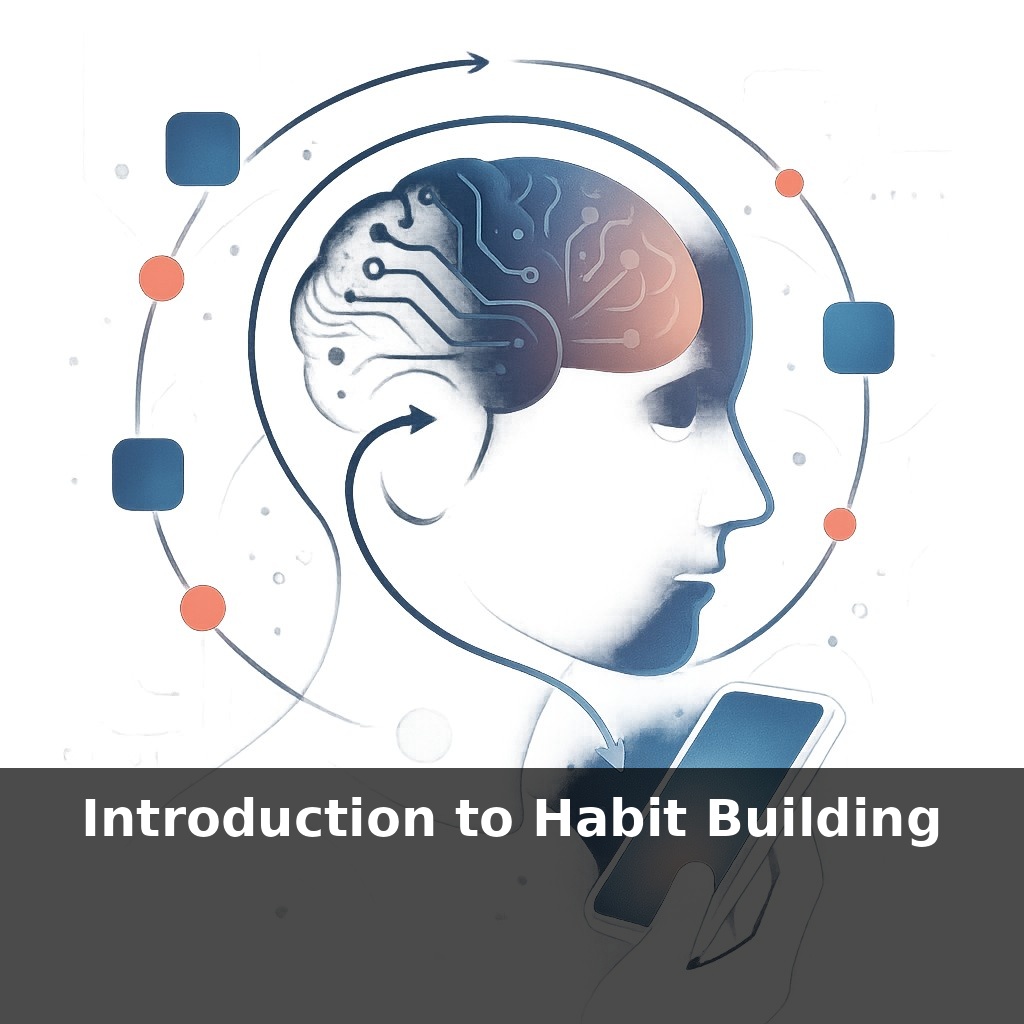
Introduction to Habit Building
📝 Transcript
About half of what you did today ran on autopilot—and most of it wasn’t designed by you. You checked your phone without thinking, opened the same apps, reacted the same way to stress. In this episode, we’ll pull back the curtain on who’s really writing your daily script.
About 40–45 % of what you did today was driven by habits, not fresh decisions—and tech quietly amplifies that. Every notification, red badge, and autoplay timer is designed to trigger a cue–routine–reward loop in your brain. But the same wiring can work for you, not just for your apps.
In this episode, we’ll zoom in on *how* tiny, tech-shaped actions stack up. Answering one Slack message in bed “just to check”? That can become a 20-minute scroll habit within weeks. But setting a 2-minute shutdown routine at 9:30 p.m. can, over 66+ days, turn into a reliable “digital sunset” that protects your sleep and focus.
We’ll break down: - Why small, repeatable tech behaviors beat big digital detoxes - How to pick one “atomic” tech habit that’s actually sustainable - Simple environment tweaks—like where you charge your phone—that change your default actions without willpower
Here’s the key shift: instead of trying to overhaul your whole “digital life,” you’ll get farther by targeting one tiny behavior that happens *often*. Frequency beats drama. A habit you touch 15–20 times a day (like unlocking your phone) has far more leverage than a weekly 2‑hour “focus block.” Research on implementation intentions shows clear “if X, then Y” plans can *double* follow‑through, so we’ll anchor new routines to moments that already exist: first unlock after waking, opening your laptop, or seeing a notification after 9 p.m. This way, repetition does the heavy lifting.
Think of your phone as a lab bench: every tap is a data point you can redesign. To make this practical, you’ll work with three levers—specificity, scale, and scaffolding.
**1. Get surgical about the moment**
Vague: “Use my phone less at night.” Precise: “After 9:30 p.m., on the first unlock, I open Kindle instead of Instagram.”
Notice three concrete pieces: - **Trigger**: “after 9:30 p.m., on the first unlock” - **Action**: “open Kindle” - **Target behavior**: replacing 1 app, not your whole evening
That level of detail is where the 2010 meta‑analysis found 2× better follow‑through. Aim for one trigger that already happens **at least 5–10 times a week**.
**2. Shrink the action until it’s slightly embarrassing**
Your brain resists actions that cost too much energy. Your first version should take **≤ 60 seconds**, even if the long‑term habit is bigger.
Examples: - Focus: When you open your laptop for work, spend **30 seconds** closing all non‑work tabs. - Learning: On your commute, listen to **1 minute** of a language app as soon as Spotify opens. - Boundaries: When Slack lights up after 6 p.m., add **one sentence** to your “tomorrow” list before replying.
If you’re only succeeding < 80 % of the time, it’s still too big. Cut it in half.
**3. Stack one safeguard on top**
One small safeguard can multiply your odds of repeating the action. Use tech against itself:
- **Friction**: Move the “problem” app to the last screen; bury it in a folder. Extra 2–3 swipes = extra decision point. - **Prompt**: Rename a folder to your rule: “After 9:30 → Read 5 pages.” - **Pre‑commitment**: Set a 9:25 p.m. calendar alert: “In 5 minutes: switch to reading app on first unlock.”
You’re engineering a mini‑system where the path of least resistance *is* your chosen action.
**4. Track repetitions, not streak perfection**
Aim for **50–100 reps**, not “never miss a day.” If you hit the trigger 10 times a week, that’s 5–10 weeks of practice. Miss a day? Irrelevant. The only failure is not restarting at the next trigger.
**Your challenge this week:** Pick **one** tech moment you repeat daily (first unlock, first tab, first notification after a set time). Design a 60‑second replacement action, add one safeguard, and log how many times you execute it over **7 days**. Your score is **total reps**, not streak length.
Think in terms of leverage. Instead of “be more mindful,” tie your small action to a **specific tech behavior** with a clear win you can measure in minutes, taps, or pages.
Example 1 – Email control: - Trigger: First time you open email each morning. - Action: Spend **45 seconds** starring only the 3 messages that truly matter today. - Safeguard: Set your inbox to show **10** emails per page, not 50, to cap the initial flood. - Target: Cut “morning email drift” from 25 to **10 minutes** within 2 weeks.
Example 2 – Health via screens: - Trigger: First video you watch on YouTube after work. - Action: Stand up and do **10 squats** before hitting play. - Safeguard: Rename your YouTube home screen bookmark to “10 squats first.” - Target: Accumulate **300 squats** in 30 days without “going to the gym.”
This isn’t about willpower; it’s about attaching a **countable action** to a screen moment you already hit **dozens of times** a week and letting repetition quietly stack the gains.
Behavior change tech is on track to get sharply more precise. In the next 3–5 years, your watch could detect stress spikes within 30 seconds and auto‑prompt a 3‑breath pattern 10 times a day. Learning apps may adapt difficulty every 20–30 taps to keep you in the “sweet spot” of focus. Expect defaults to shift too: routers shipping with 11 p.m.–6 a.m. pause modes, or cars limiting notifications above 30 mph. Start noticing which systems already “nudge” you—then decide which deserve that power.
Treat this as building a tiny “portfolio” of behaviors: one well‑chosen action, repeated 70–100 times, can reclaim 3–5 hours a month from default tech use. As you succeed, upgrade only 10–20 % at a time—slightly longer, slightly harder, slightly more meaningful. In 6 months, you’ll have 4–6 invisible systems quietly pulling your day in a better direction.
Try this experiment: Pick one tiny habit from the episode’s examples—like doing 2 push-ups after you brush your teeth at night—and run it for the next 3 days. Before you start, tape a sticky note to your bathroom mirror that says “2 push-ups after brushing” so the cue is impossible to miss. Each night, immediately after brushing, do the 2 push-ups, then say out loud “Habit done” and give yourself a quick fist pump to test how celebration affects your motivation. At the end of day 3, notice: did the clear cue + tiny size + quick celebration make it easier to show up, even when you were tired?
From this course
Atomic Habits in Practice: Build One Habit at a Time
9 episodesUnlock all episodes
Full access to 9 episodes and everything on OwlUp.
Subscribe — $1.99/monthLess than a coffee ☕ · Cancel anytime

