You designed almost none of your “daily routine” on purpose—yet it quietly decides your energy, focus, and even income. One small change in what you do right after waking up or sitting at your desk can tilt the whole day. So the real question is: who’s actually designing your routine?
Roughly 40–45% of what you do each day is already automated—but “automatic” doesn’t mean “optimized.” In this episode, we go one layer deeper: instead of asking *what* you do, we’ll ask *how each action is wired*.
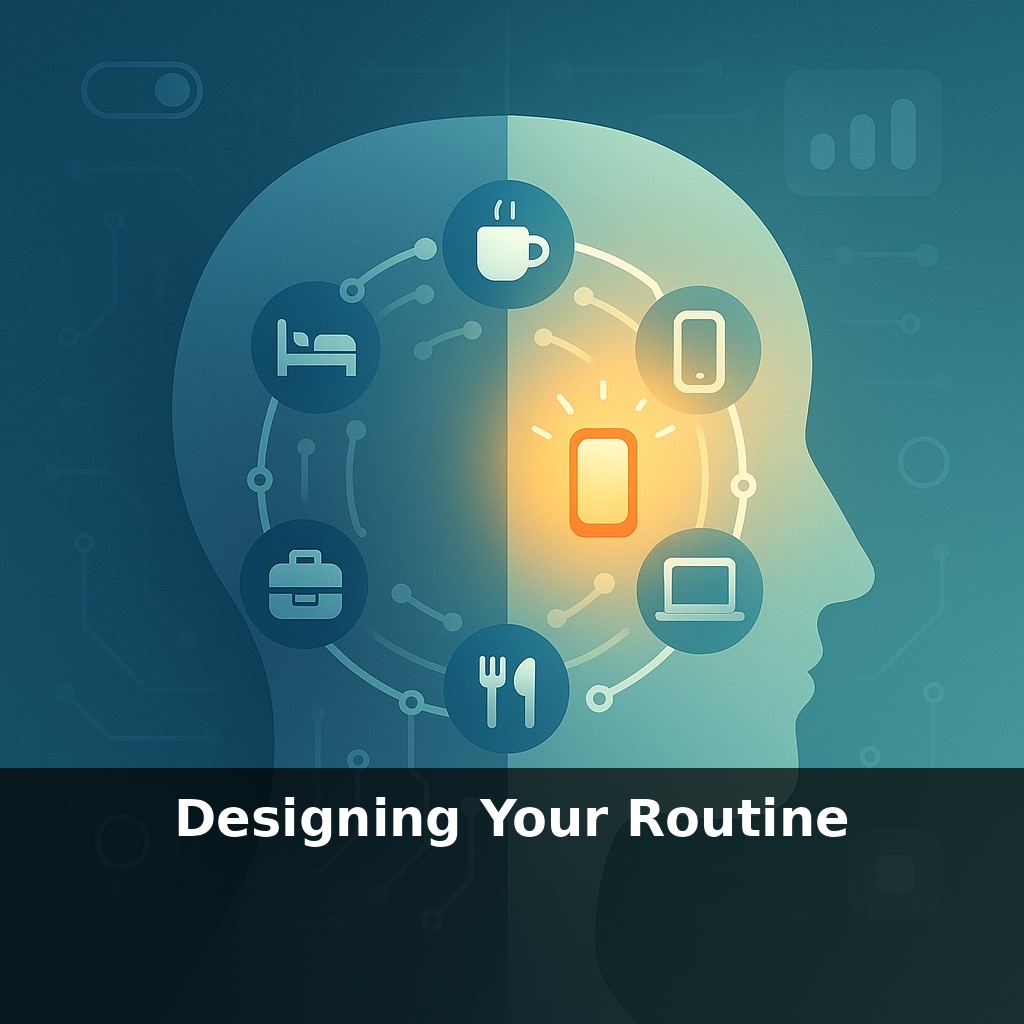
Most people try to upgrade their lives the way they update apps—by installing big, ambitious goals. But your brain doesn’t run on goals; it runs on loops: cue → action → reward. Modern research shows that when this loop is clear and easy, your basal ganglia start treating the behavior like a default setting, not a decision that drains willpower.
So rather than forcing yourself to “be more disciplined,” you’ll learn to engineer tiny, reliable loops. Think of it like adjusting the rails of a train track: shift them a few centimeters here, and the destination quietly changes over time—along with your results.
Designing a routine starts with a humbling truth: your future behavior will be dictated less by motivation and more by whatever is easiest in the moment. That’s why research finds simple habits—like drinking a glass of water—lock in far faster than complex ones like a full gym session. The real leverage is in how you shape the *moment before* the habit: the cue you choose, the friction you remove, and the small reward that makes your brain say, “Let’s do that again.” In this episode, we’ll turn that into a practical system you can plug a single, high-impact habit into.
Designing one powerful routine starts with a choice: *which* behavior deserves a permanent parking spot in your day? Not ten behaviors—one. The research on hydration vs. gym habits hints why: complexity massively stretches how long “automatic” takes. A morning stretch, a nightly shutdown checklist, a two‑minute “plan the day” pass at your desk—these are structurally simple, even if their long‑term impact is huge.
So your first design step isn’t grit; it’s **scope**. Shrink the behavior until it reliably fits into 30 seconds or less. That doesn’t mean you only ever stretch for 30 seconds; it means the **entry ramp** is that short. Once you’re moving, you can always do more. If starting requires negotiation, though, the loop never stabilizes.
Next is **anchoring**. In Episode 2 you picked cues; now you’ll weld a single action to a single cue with implementation intentions: “If it is [situation], then I will [tiny action].” That “if–then” script sounds trivial, but the data say otherwise—on average, it nearly doubles follow‑through. You’re not hoping you’ll remember; you’re pre‑deciding.
Now clear the path. Friction hides in boring details: Is the notebook always in the same place? Does the app open straight to the right screen? Is there one obvious physical spot where “this habit happens”? Each extra step is a tiny tax you pay every time. Your job is to make performing the habit feel like rolling downhill.
Then comes the part people skip: **instant reward**. Not a distant outcome like “better health,” but something you feel *now*. This could be a micro‑hit of progress (a streak counter, a checkbox, a visible tally), a physical cue (good coffee only after your planning pass), or a brief emotion you actively name: “Nice—that’s three days in a row.” You’re teaching your brain, “This loop ends in a win.”
Think of it like planting a single tree in a windy field: you stake it (clear anchor), water it regularly (easy action), and add fertilizer right away (immediate reward). Do that consistently and, over time, it grows strong enough that you don’t have to think about it—it stands on its own, quietly reshaping the landscape of your day.
Think of the routine you’re designing like a tiny “core script” that runs before a big scene. You’re not changing your whole day—you’re editing the first line so the rest of the dialogue is easier to say.
Two quick examples.
1) A software engineer wants to read technical docs daily but keeps “forgetting.” She doesn’t add “read more” to her to‑do list. Instead, she tacks a 60‑second doc skim onto something she already does: unlocking her laptop after lunch. Her cue is the screen waking up, her action is opening one bookmarked page, her reward is marking a tiny ✅ on a sticky note by her monitor. No calendar alerts, no grand plan—just a micro‑script that quietly runs five days a week.
2) A support manager keeps ending days scattered. She designs a “last 3 minutes” shutdown routine: when the clock hits 4:57, she closes chat, lists the top three items for tomorrow, then drops her laptop in a drawer. The sound of the drawer becomes a tiny ritual that signals, “Work is done.” Over time, that sound alone nudges her mind out of work mode—even on chaotic days.
Smart routines don’t stay in your head; they spill into tools. As wearables and apps learn your rhythms, they’ll quietly propose new anchors: “You usually pause here—want to attach a 20‑second stretch or reflection?” Over time, these systems may feel less like alarms and more like subtle travel guides, suggesting small detours that add up to a different destination entirely. The open question: how much of your route do you want them drawing for you?
So your week becomes a quiet lab: you tweak anchors, trim friction, test small rewards. Some will flop; note them and move on. Like compounding interest on a savings account, the gains don’t look dramatic at first—until they do. Over months, these tuned loops stop feeling like “systems” and start feeling like you finally aligned your days with your real priorities.
To go deeper, here are 3 next steps: Block 90 minutes tomorrow using the free “Routinist” or “Sunsama” trial to map your ideal morning and evening routines directly into a time-blocked daily schedule, including your wake-up time, first deep work block, and shutdown ritual. Grab James Clear’s *Atomic Habits* and use the Habit Stacking method to attach one new keystone habit (like a 10-minute planning session after coffee) to an existing anchor in your day. Finally, install “RescueTime” or “Screen Time” tracking and let it run for the next 7 days to gather real data on where your time actually goes, then compare it to your designed routine next week and adjust one block that’s clearly out of sync.