About half your “bad” habits may not be bad decisions at all—just the same tiny spark firing over and over. You grab your phone, open an app, or pour a drink, and it feels automatic. In this episode, we’ll hunt for that spark: the hidden cue that quietly starts it all.
Roughly 40–45% of what you’ll do today will unfold on habit, not fresh choice. But instead of trying to “fix” the behavior itself, this episode zooms in one step earlier: the moment right before you act.
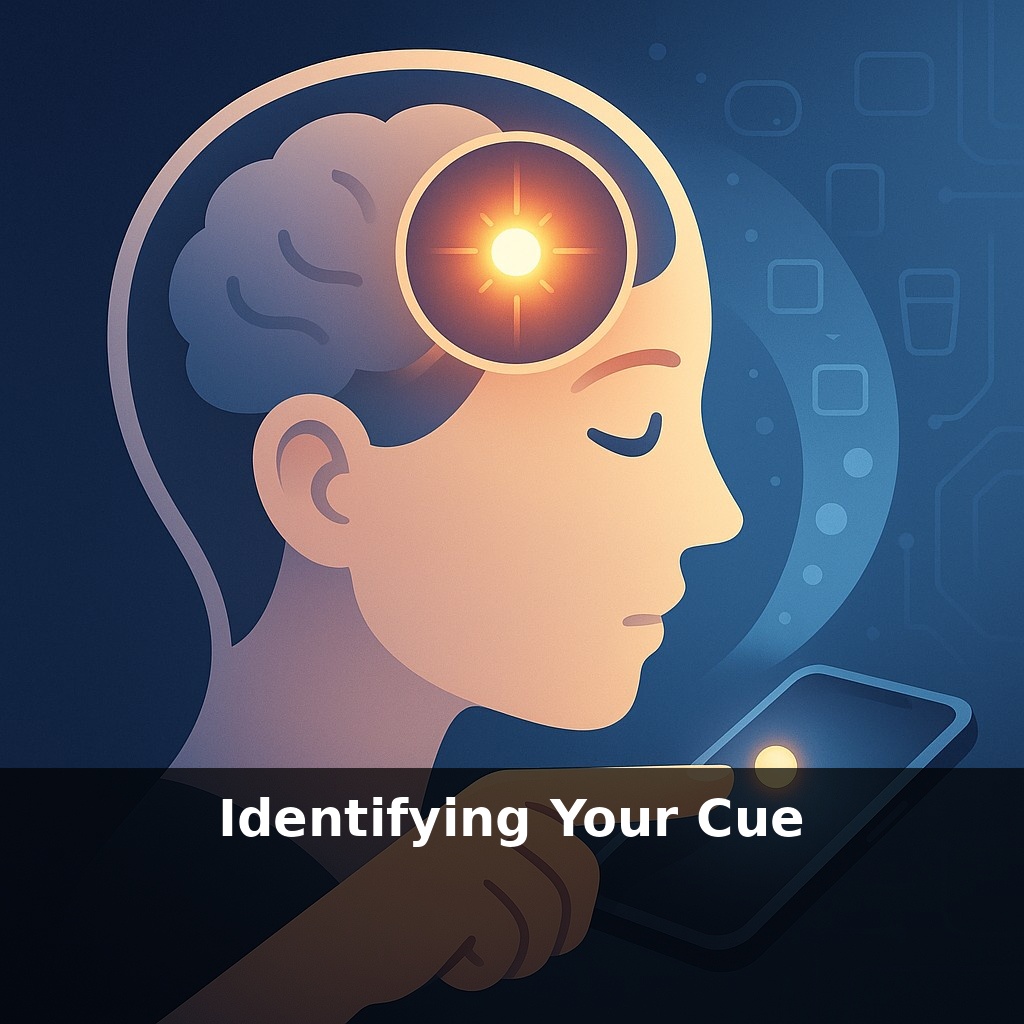
In habit research, that moment is called the cue—what you see, feel, or experience that quietly steers you toward the next move. It might be a Slack ping that sends your hand to your phone, a certain time of night that nudges you toward Netflix, or a subtle feeling of tension that pushes you back to email instead of deep work.
We’ll treat your day like a data set: when, where, and what tends to happen in the 30 seconds before a habit fires. Rather than guessing, you’ll start logging those tiny “pre-moments” so patterns can surface. Once you can point to the exact trigger, redesigning your environment and swapping routines stops being guesswork and starts feeling like editing a script you finally can see.
Think of this as moving from “spot the problem” to “trace the pattern.” In tech terms, you’re not just noticing a bug—you’re opening the logs to see what ran right before the crash. Instead of blaming willpower when you scroll, snack, or stall, we’ll get curious about the sequence: the tab you had open, the notification that flashed, the calendar block that just ended.
We’ll zoom out from single moments to clusters: how certain tools, times of day, or teammates reliably precede what you do next. Once you can see those chains, you can start experimenting with small edits—one link at a time.
You’ll get farther if you assume your behavior is rational—*for the cue it’s responding to*. Your job now is to reverse‑engineer those “good reasons.”
Researchers usually group cues into five buckets: **time, place, emotional state, other people, and preceding action.** In real life they stack, but teasing them apart helps you see which levers you can actually pull.
**Time.** Many actions fire on rough clocks: first thing after waking, right after lunch, late at night. You might swear you’re “choosing” to open social or email, but check the timestamp—does it cluster at 9:05, 2:00, 10:30? That regularity is useful; it means you can attach a different behavior to the same slot.
**Place.** Location quietly narrows your options. At your desk, you default to one set of tabs; on the couch, another. Even micro‑locations matter: standing at the kitchen counter versus sitting at the table can lead to different food decisions. Tech teams exploit this: icons on your phone’s home screen get tapped far more than those buried in folders.
**Emotional state.** Internal weather is one of the most underrated drivers. Boredom, anxiety, or mild frustration often precede “quick hits” like refreshing dashboards or inboxes. If you only look at the action, it looks irrational. If you notice the feeling it reliably follows, it starts to make perfect sense.
**Other people.** Who you’re with (or who just pinged you) can act as a switch. One coworker Slacks and suddenly you’re gossip‑scrolling; another messages and you dive into GitHub. Social proximity changes which behaviors feel normal.
**Preceding action.** Many of your loops are simple chains: end a meeting → open Twitter; ship a ticket → grab a snack. These links are valuable because they’re stable. Change the “next step” and you’ve quietly rewritten the script without arguing with yourself.
Identifying these categories is less about theory and more about tagging reality. For a few days, you’re not trying to *change* anything. You’re just labeling: “time,” “place,” “emotion,” “person,” or “previous action” whenever you catch yourself mid‑loop—like a developer adding lightweight comments to a messy file so it’s easier to refactor later.
Your brain already treats cues like a routing algorithm: certain “inputs” send you down the same path every time. Treat today like a live debugging session and simply label what the system is doing.
Example 1: You’re coding, hit a confusing bug, feel a tiny wave of frustration, and—without thinking—open a new tab for news or social. Instead of judging it, pause and name the stack: “emotion: stuck,” “preceding action: error,” “place: IDE + browser.” After three or four occurrences, you’ll see this isn’t random; it’s a pattern your brain trusts.
Example 2: Every time your calendar alert says “meeting ended,” your mouse drifts to email. Again, tag it: “time: top of the hour,” “preceding action: Zoom call,” “person: whoever just assigned work.” That combination is like a saved search your brain runs automatically.
Analogy from travel: you’re mapping the layovers on your daily flight path. Once you know which airport you *always* pass through, you can decide to reroute—not just hope to land somewhere better.
As devices learn your rhythms, cue‑spotting becomes a two‑way street. Your watch might flag, “You always tense up before this meeting—want to breathe instead of scroll?” Cities could do the same at scale: subtle lighting near stairs, quiet zones that nudge focus, crosswalk cues that sync with your walking pace. Think of it less as control, more as collaborative steering: you design the rules, tech supplies gentle course corrections when old loops try to take the wheel.
Once you catch these tiny “start signals,” you’re free to play with them—like gently tuning an instrument instead of smashing it. You might swap one small next step, delay it by a minute, or pair it with a different reward. Think of this week as drafting blueprints, not pouring concrete; you’re learning how the structure responds before locking anything in.
Try this experiment: Tomorrow, set a timer for 10 minutes and deliberately delay your usual “cue” by changing your environment right when that urge would normally hit. For example, if your cue is flopping on the couch and opening Instagram after work, spend those 10 minutes standing at the kitchen counter sipping a glass of water and reading one page of a book instead. Notice: does the urge to scroll get weaker, stronger, or just shift to a different cue (like opening the fridge)? Jot down exactly what happened in those 10 minutes and repeat the same swap for three days to see if that specific cue–routine link starts to loosen.