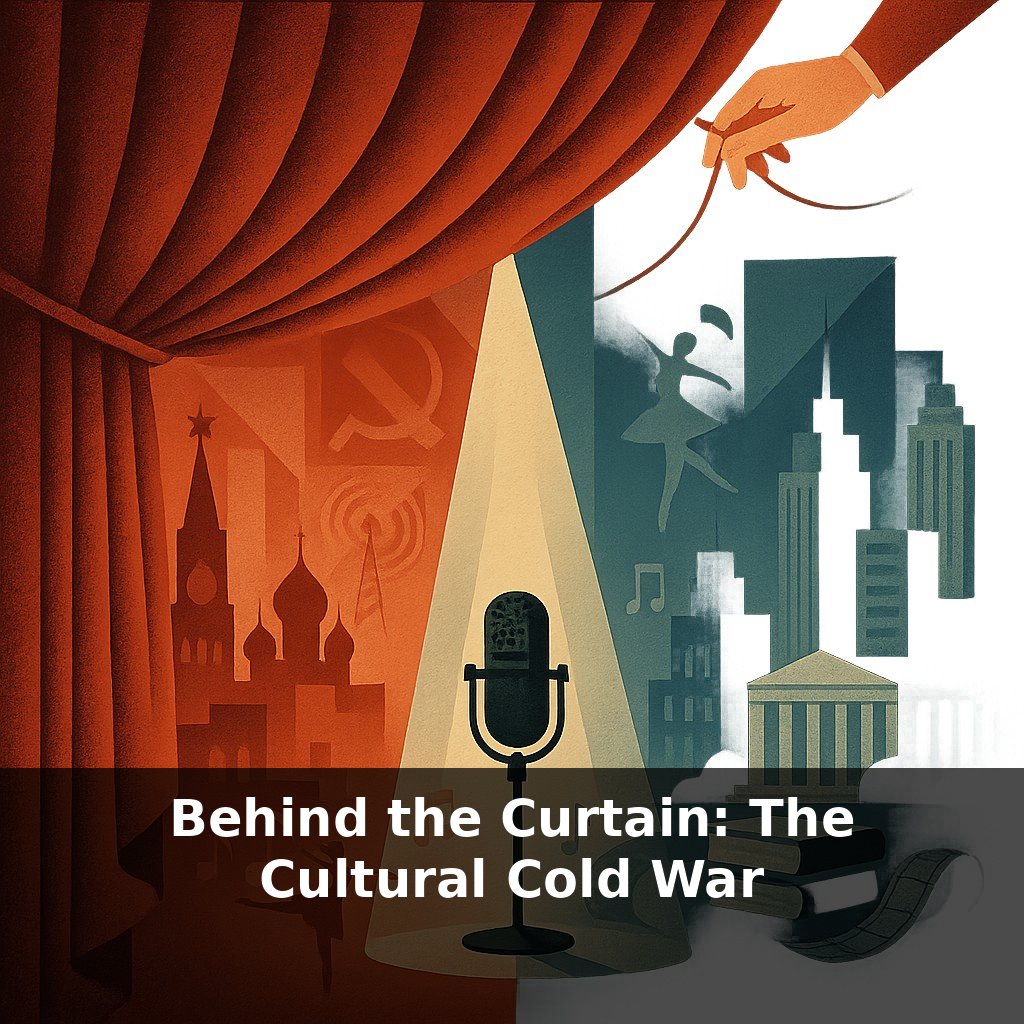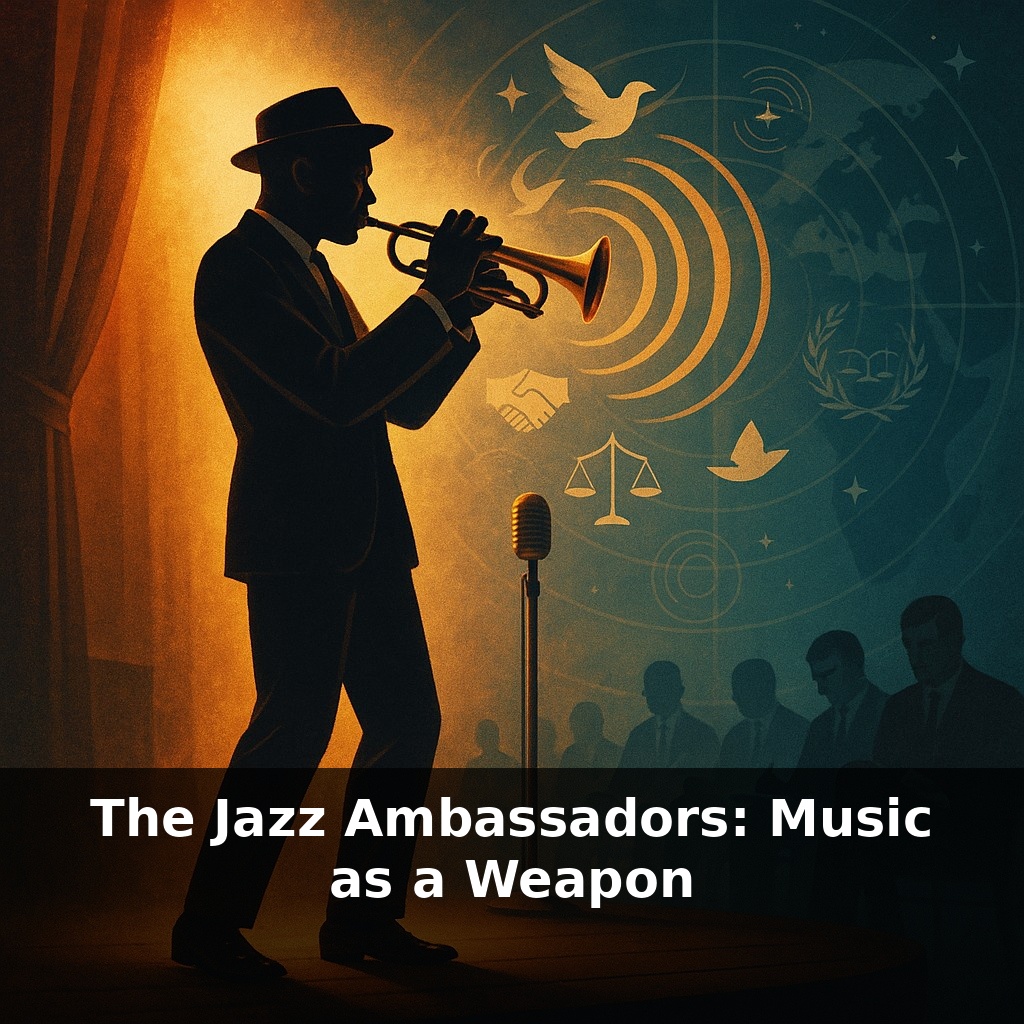
On a dusty stage in the Middle East, a Black American trumpeter lifts his horn—and somewhere in the audience, a Soviet cultural officer starts taking notes. The CIA has spies, the Pentagon has missiles. But in this story, the frontline weapon is a backstage jam session.
By the late 1950s, Washington had learned a hard lesson: charts and speeches rarely change hearts, but a horn solo sometimes can. The same government that funded rockets and reconnaissance satellites quietly invested in plane tickets, per diems, and battered instrument cases, sending bands into auditoriums where U.S. ambassadors could only dream of drawing a crowd. Instead of policy talking points, these travelers carried set lists—and the unscripted risk of improvisation. They walked into places where colonial flags had just come down, where newspapers printed U.S. race riots alongside Soviet boasts. On paper, they were “cultural presentations.” Onstage, they were something messier: Black and white Americans sharing choruses, breaking curfews, and sometimes breaking with their own government, even as they performed in its name.
The State Department didn’t pick jazz at random; it arrived there by process of elimination. Classical music felt too European, Hollywood films were tangled in commercial interests, and patriotic pageants looked clumsy in newly decolonized capitals. Jazz, by contrast, already moved along informal routes—records traded in black markets, riffs copied from shortwave radio like recipes passed neighbor to neighbor. Officials noticed that where embassies were distrusted, jam sessions drew curious crowds, giving Washington something it rarely enjoyed abroad: an invitation instead of a summons.
The first official tour in 1956 put Dizzy Gillespie’s big band on a plane to the Middle East and South Asia, backed not by a record label, but by the State Department’s seal. Inside the bureaucracy, the program had a dry name and a line-item budget; outside, it looked like a rolling carnival of drums, horns, and curious onlookers. Gillespie’s band hit 14 countries, 45 concerts, and something else Washington quietly craved: newspaper front pages that showed cheering crowds instead of burning flags.
Officials wrapped this in lofty language—“mutual understanding,” “cultural exchange”—but the logistics were intensely practical. Tours were routed where new governments were choosing between Washington and Moscow. Embassies filed cables rating local enthusiasm, tracking which pieces got the loudest applause. A roaring ovation for a bebop solo could end up summarized in a memo, the musical chaos converted into the bureaucrat’s favorite metric: evidence.
Race sat uneasily at the center of it all. The U.S. wanted to advertise racial progress while southern schools were still segregated and northern cities were erupting. Sending Black stars like Louis Armstrong, and later Duke Ellington, onto global stages was both an honest showcase of artistic genius and a strategic gamble. Audiences were often well informed about U.S. racism; some arrived with protest signs, others with pointed questions. Musicians had to walk a narrow path—refusing to be propaganda puppets, yet aware that simply standing there, integrated bands in full flight, contradicted Soviet caricatures.
Many artists pushed back in real time. Armstrong delayed a planned Soviet tour over Little Rock, telling reporters he wouldn’t play “for people who treat me that way.” Dave Brubeck co-wrote “The Real Ambassadors,” a satirical musical that poked at the very program employing him. The State Department, hungry for credibility, tolerated a surprising amount of dissent, calculating that unscripted honesty might be more persuasive than polished talking points.
Meanwhile, the broadcasts of Willis Conover’s Jazz Hour stitched these far-flung moments together. Someone who’d seen an open-air concert in Accra could later recognize a familiar trumpet tone on shortwave, the way an investor tracks the same company across different markets and starts to trust the pattern, not the pitch. Bit by bit, a sonic map of America circulated—complex, sometimes dissonant, but unmistakably alive.
Ellington’s band stepping into newly independent Nigeria wasn’t just a concert; it was closer to an unscheduled town hall. Onstage, they’d quote local folk melodies inside long solos, a musical nod that said, “We hear you,” without a speech or slogan. Listeners caught that. Some brought home the memory like a souvenir; others formed local bands, translating what they’d heard into their own idioms, so the “American” message returned a little less American each time.
In Eastern Europe, students huddled in dorm rooms around smuggled tapes of these tours, reading them the way traders read price charts: searching for signals beneath all the noise—How tense is the crowd? Does the band sound free or cautious? A blistering drum break could feel like a hint that not everything in the West matched official brochures, but that something real was breathing there.
And sometimes, the current reversed. Musicians came home with new scales, rhythms, and politics, having absorbed as much as they projected, turning a one-way campaign into a loop.
Governments still hire bands, but the crowd now also follows YouTubers and underground playlists. A slick anthem endorsed by a ministry can feel like an ad, while a scrappy bedroom track crosses borders on its own. Future “jazz ambassadors” may be algorithm-selected as much as handpicked, their tours mapped by streaming data instead of cables. Think of states less as conductors and more as playlist curators, nudging taste but never fully controlling what people hit repeat on.
In the end, these tours left more questions than answers: Who owns a song once it’s crossed fifty borders? When a style born in segregation becomes a global language, does it dilute protest or spread it, seed-like, on the wind? As playlists replace passports, the real test may be whether today’s viral sounds can still smuggle doubt, hope, and curiosity past any border.
Before next week, ask yourself: 1) If Louis Armstrong had been invited into *my* community as a cultural ambassador today, what tension, stereotype, or silence would I most want his band to challenge—and where in my daily life do I currently avoid that kind of uncomfortable bridge‑building? 2) Thinking about how the State Department sent Black jazz musicians abroad while Jim Crow laws still stood at home, where do I see a gap between what my country (or workplace, or community) says it values and what actually happens—and what’s one specific conversation I could have this week to gently call out that contradiction? 3) If “jazz as a weapon” really means improvising with courage and listening, what’s one real situation coming up (a meeting, family debate, online thread) where I could experiment with more listening, more openness, and a little more creative response instead of my usual defensive script?