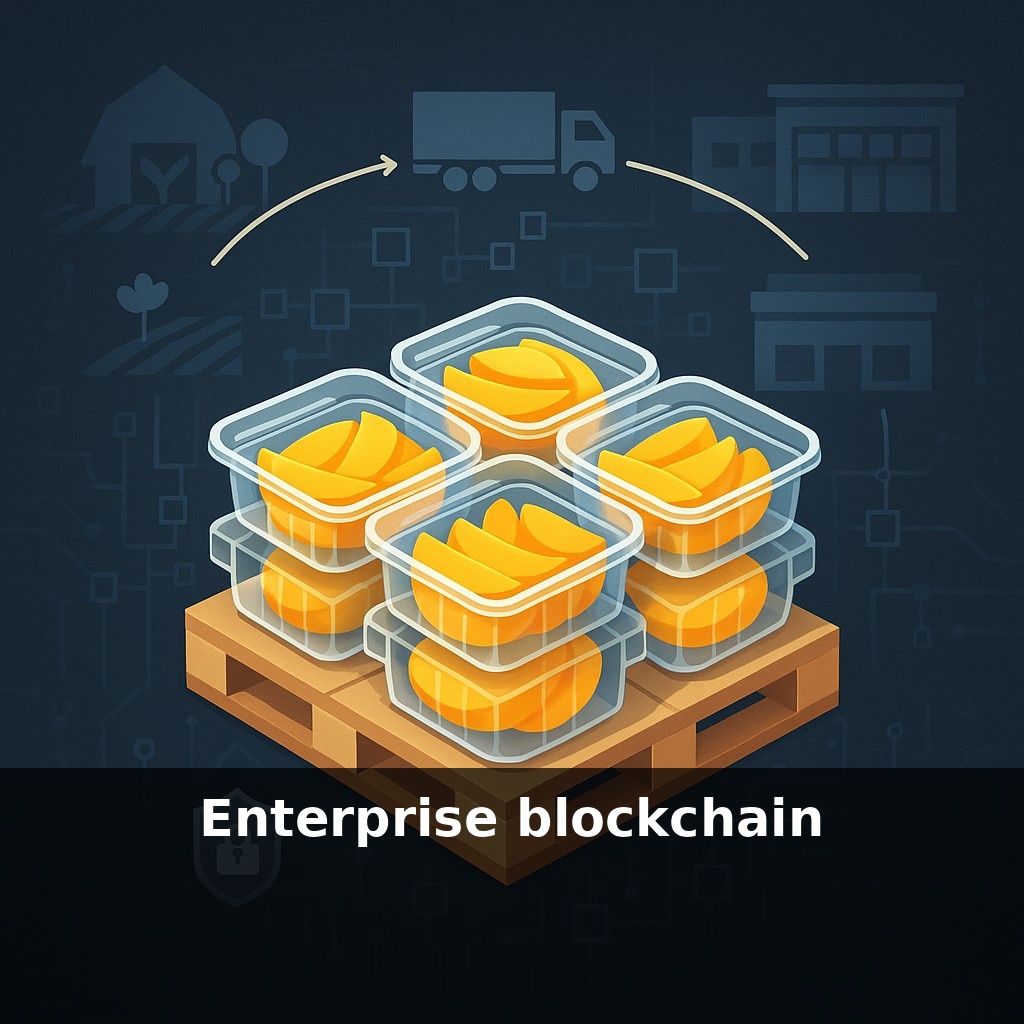
A pallet of sliced mangoes moves from a farm in Latin America to a supermarket shelf. Behind the scenes, a system quietly tracks every handoff in seconds, not days. No cryptocurrency, no trading apps—just a shared record that none of the companies involved can secretly rewrite.
Walmart’s mango story is just one glimpse of a quiet shift: enterprises are turning blockchain into plumbing for how money, goods, and data move between organizations. What’s changed isn’t the buzzword count—it’s the focus. Instead of chasing volatile tokens, large firms care about audit trails that regulators trust, contracts that execute themselves, and cross-company workflows that don’t require a small army of people reconciling spreadsheets at month-end.
Banks settle intraday repo trades, shipping firms log container handoffs, and pharma companies track cold-chain data, all on systems where every participant sees the same history and disputes are resolved by code and governance, not email threads. In this world, the “blockchain question” inside enterprises is no longer, “Should we use it?” but “Where does a tamper-evident, time-stamped backbone remove the most friction?”
J.P. Morgan uses it to shrink settlement windows; Walmart uses it to shrink recall windows. But the real story is how these systems quietly rewire trust between companies that don’t fully trust each other. Logistics partners, banks, insurers, and regulators can now plug into the same fabric and react in hours instead of weeks. Frameworks like Hyperledger Fabric and Corda let firms pick who sees what, while still agreeing on “what actually happened.” It’s less about shiny apps and more about upgrading the invisible rails that move paperwork, payments, and approvals.
Gartner’s US$3.1 trillion forecast isn’t about everyone suddenly paying in tokens; it’s about stripping out the invisible drag in how organizations coordinate. Inside a single company, you can standardize processes and systems. The real mess starts the moment data, money, and goods cross a boundary—another bank, another supplier, another regulator, often in another country and legal regime.
That’s where enterprise blockchains quietly shift the game. Instead of each firm maintaining its own “version of the truth” and emailing files around, they plug into a common data layer with rules encoded up front. Hyperledger Fabric, Corda, and Quorum are less “apps” and more operating systems for these shared backbones. They decide who can join, what they can see, how decisions are finalized, and how disputes are escalated when code isn’t enough.
Take trade finance. A single shipment might involve an exporter, importer, two or three banks, an insurer, a carrier, and customs. Today, that web runs on PDFs, faxes in some corridors, and reconciliation teams. On a permissioned network, the letter of credit, shipping data, and payment triggers can live in one place, with smart-contract logic controlling release of funds when milestones are met. No one party “owns” the system; the governance model does.
Or consider compliance. Regulators want granular auditability; firms want privacy and performance. Modern enterprise chains support selective disclosure: a regulator node can verify that a transaction met agreed rules without seeing every commercial secret. That’s a big part of why energy and latency constraints that dog public, proof-of-work chains don’t apply here—consensus is optimized for known, vetted participants.
The interesting paradox: the more competitors and counterparties rely on the same infrastructure, the less time they spend arguing about whose ledger is right, and the more they can compete on actual products, pricing, and service. In practice, the hardest problems aren’t technical at all; they’re about aligning incentives, defining standards, and deciding who’s responsible when the code—and the humans behind it—get something wrong.
A freight forwarder, a customs broker, and a port operator join a new network and discover they’re all working off synchronized timestamps. Suddenly, late fees tied to “arrival time” stop being arguments and start being math. In another sector, a consortium of insurers records policy changes and claims events on a shared rail; when a hurricane hits, overlapping coverage is spotted instantly, cutting both double-payouts and denial disputes.
Think of an orchestra where each section once followed its own private conductor; with a single, visible score, the real work shifts to agreeing on tempo and interpretation, not on which notes exist. That’s why governance committees in projects like IBM Food Trust or J.P. Morgan’s Onyx matter as much as the code—they define who can change rules, how upgrades roll out, and what happens when participants misbehave.
Your challenge this week: pick one multi-party process you’re involved in—vendor onboarding, claims handling, trade documentation—and map every time data is retyped, rechecked, or reconciled. Then ask: if all parties saw the same, locked timeline of those events, which steps simply disappear?
Once asset ownership, ESG metrics, and even central-bank money are natively digital, coordination shifts from after-the-fact checking to real‑time orchestration. A carbon credit could “travel” with a container of goods and automatically retire on delivery, while a CBDC leg settles the payment in parallel. Like a good film editor tightening every cut, these rails compress dead time between events, making previously impossible business models—continuous micro‑settlement, dynamic risk pricing—feel routine.
As these rails thicken, they start to feel less like a niche innovation and more like an operating layer for whole markets. Think of it as moving from handwritten notes to a score that can be remixed: new entrants plug in niche services, incumbents refactor old ones, and “compliance by design” becomes a feature you can compose, not a hurdle you bolt on.
Before next week, ask yourself: 1) “If I had to pick one real business process in my company—like supply chain traceability, inter-company settlement, or compliance reporting—that could genuinely benefit from shared, tamper-evident data, which would it be and why?” 2) “Looking at our current tech stack (ERP, databases, integrations), where would an enterprise blockchain actually plug in, and what existing manual reconciliation or audit steps could it realistically remove in the next 6–12 months?” 3) “Who are the 2–3 specific partners, vendors, or internal teams I’d need in a consortium-style pilot, and what concrete data or transactions would we all be willing to put on a shared ledger as a low-risk first experiment?”