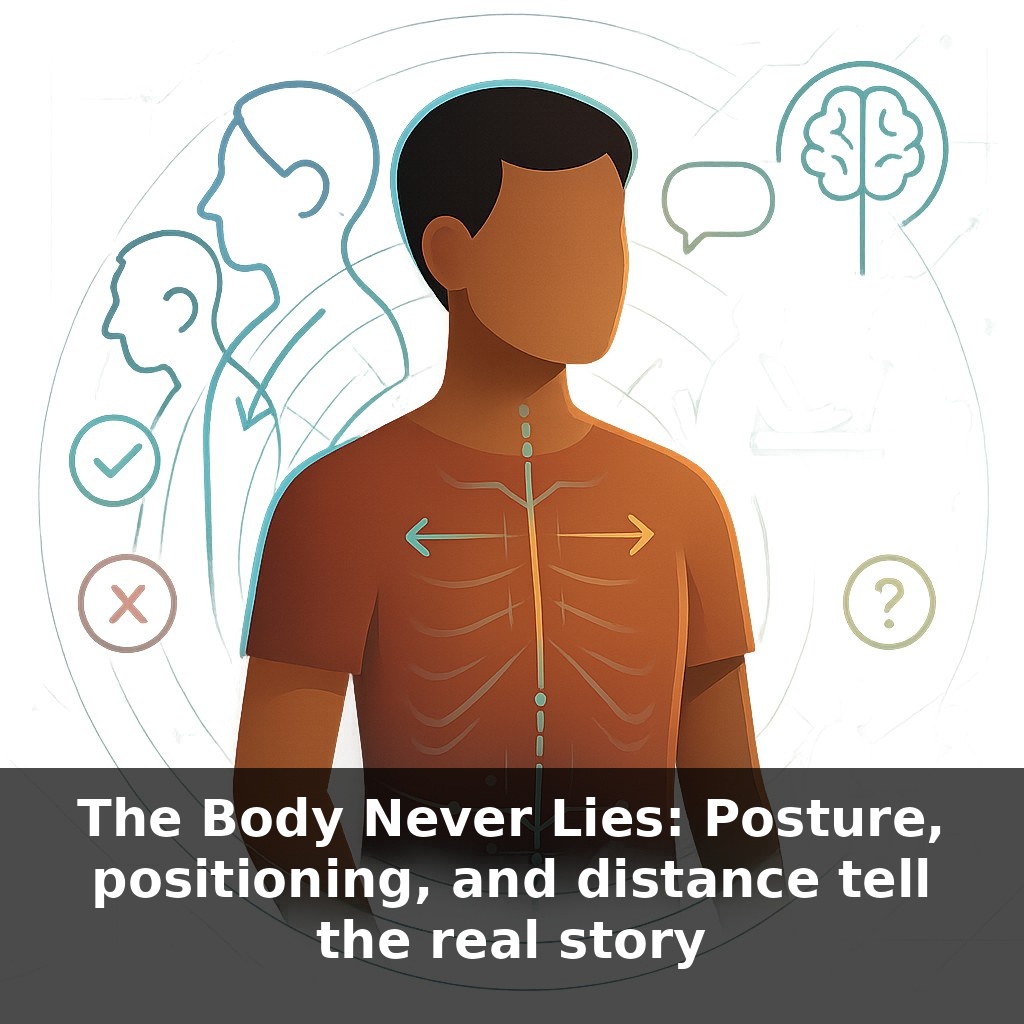
About half of what you “say” today will come out of your body, not your mouth. In a job interview, on a first date, even ordering coffee—your posture, how you angle your shoulders, and the distance you keep may decide the outcome long before your words arrive.
Think of today as a live feedback loop: while you’re talking, every shift in how you sit, stand, or lean is quietly voting “yes,” “no,” or “not sure yet” on whatever is happening. You don’t cast these votes consciously—but other people still count them. Research labs track this in millimeters and milliseconds: a manager tilts back a few degrees when doubtful, a friend’s torso subtly drifts closer when they’re genuinely engaged, a team’s chairs inch into a loose circle when trust grows. These micro-adjustments don’t just *reflect* your internal state; over time, they can reinforce it, nudging you toward ease or tension, openness or defensiveness. In this episode, we’ll zoom in on three under-rated signals—how much space you occupy, which way your body “points,” and how near or far you stay—and how they silently rewrite every conversation you’re in.
Notice how your body behaves when no one’s “watching”—on a long video call, in line at the store, or scrolling in bed. That’s your baseline: the default settings other people meet in every interaction. Some of it is habit (slouching over a laptop), some is protection (crossed arms on a crowded train), and some is strategy (leaning back in a tense meeting). Culture, childhood rules about “taking up space,” and even room layout all tweak that baseline. Today we’ll explore how to spot your own default settings—and how tiny, deliberate shifts can change the tone of a room before a single word lands.
Start with how much territory you quietly claim. In labs that map people’s movements, confident participants don’t just “stand tall”—they allow elbows to drift a bit wider, feet to plant firmly, gestures to travel through more air. Anxious participants shrink: ankles wrap around chair legs, bags become shields on laps, hands retreat to pockets. Neither style is morally better, but they send different invitations. Broad, relaxed positioning tends to read as “I can handle this.” Compressed, guarded positioning often signals “I’d rather be invisible right now.”
Next, notice where your torso actually aims. Not your eyes—those can lie—but the line from your chest through your hips. In negotiation research, small shifts of orientation predict outcomes: when two people lock into a slight V-shape, both angled toward a shared “third point” like a whiteboard, they collaborate more; when they square off directly, conflict escalates faster. Rotating a few degrees toward someone usually increases perceptions of warmth; rotating away, even politely, can register as disengagement or subtle rejection.
Distance works like a dimmer switch on all of this. Step a bit closer while staying relaxed, and people often disclose more. Step back at the wrong moment, and you may see micro-freezes, self-touching, or a sudden change of topic—tiny signs you’ve cooled the connection. Studies using motion-tracking show that pairs in sync don’t just mirror gestures; they co-manage distance, swaying in and out like dancers keeping the same beat.
These patterns show up in teams too. When Bank of America reorganized break areas so colleagues could naturally face one another, posture shifted from parallel lines to loose circles—and conversation volume, idea exchange, and even heart-rate patterns changed with it. The furniture didn’t make people more social; it simply made certain orientations and distances effortless.
Treat these cues as hypotheses, not verdicts. Crossed legs might mean stress—or just a wobbly chair. The power is in watching clusters over time: territory, torso, and distance lining up to tell a consistent story you can finally hear.
Watch a group in an airport lounge and you’ll see this in action. Two strangers start out with laptops as barriers, knees angled away. As the flight delay drags on and they warm up, bags slide aside, knees uncross, torsos edge toward a rough triangle that includes the departures board. Nobody announces, “We’re more comfortable now,” but the configuration quietly says it.
In a project meeting, notice who orbits the whiteboard. The person who keeps drifting into the center often becomes the unofficial coordinator, even if their title doesn’t match. Their stance gives everyone a “reference point,” so questions and eye lines start routing through them.
At home, pay attention during an argument that resolves versus one that stalls. In the ones that heal, there’s usually a moment when both people end up side‑by‑side—looking at a shared object, a screen, a note—rather than locked face‑to‑face. That sideways alignment can de‑weaponize eye contact enough for real listening to start.
As sensors shrink and cameras sharpen, the “silent layer” of interaction becomes measurable in real time. Classrooms could flag a drifting cluster of students before grades slip; hospitals might spot early agitation in dementia patients by subtle shifts in how they sit or stand. Leaders may train with VR that exaggerates their own signals like a playback in slow motion. The tension: tools that can protect and personalize can just as easily be tuned to monitor, rank, and quietly exclude.
Treat this as a lifelong decoding game: each commute, meeting, or family dinner is a new “dataset” to read. Over time you’ll spot patterns the way musicians hear key changes—a tilt before a hard question, a subtle lean before someone speaks up. The more fluent you become, the more chances you have to adjust in real time, and quietly rewrite how moments unfold.
Start with this tiny habit: When you notice yourself hunching over your phone or keyboard, straighten just your collarbones—gently lift them one inch and let your shoulders drop. As you do it, silently ask yourself, “What story is my body telling right now—guarded, rushed, or open?” Then, without changing anything else, soften your jaw and un-cross your arms for just one full breath. That’s it—one inch up, one breath, one quick check-in with your body’s real message.