A single word, spoken in the wrong tone, can lose you a job, a date, or a deal—before the listener has even processed what you said. In the time it takes to blink, their brain has already judged your mood, confidence, and intent… all from how your voice hits their ears.
Your voice is constantly “leaking” data you never consciously approved. In a tense meeting, you might choose your words carefully, but your pace accelerates, your pitch climbs half a step, and your pauses get shorter. Colleagues may not notice these details consciously—yet their brains are already adjusting how much to trust you, how stressed you seem, and how open you are to pushback. This isn’t just a social quirk; it’s becoming a digital signal too. Call centers flag “escalations” from vocal strain before customers mention a problem. Experimental mental‑health apps listen for tiny shifts in energy and rhythm that can precede depressive episodes. And voice assistants are learning to sound less robotic not by changing what they say, but by bending syllables and stretching silences in ways that feel more human.
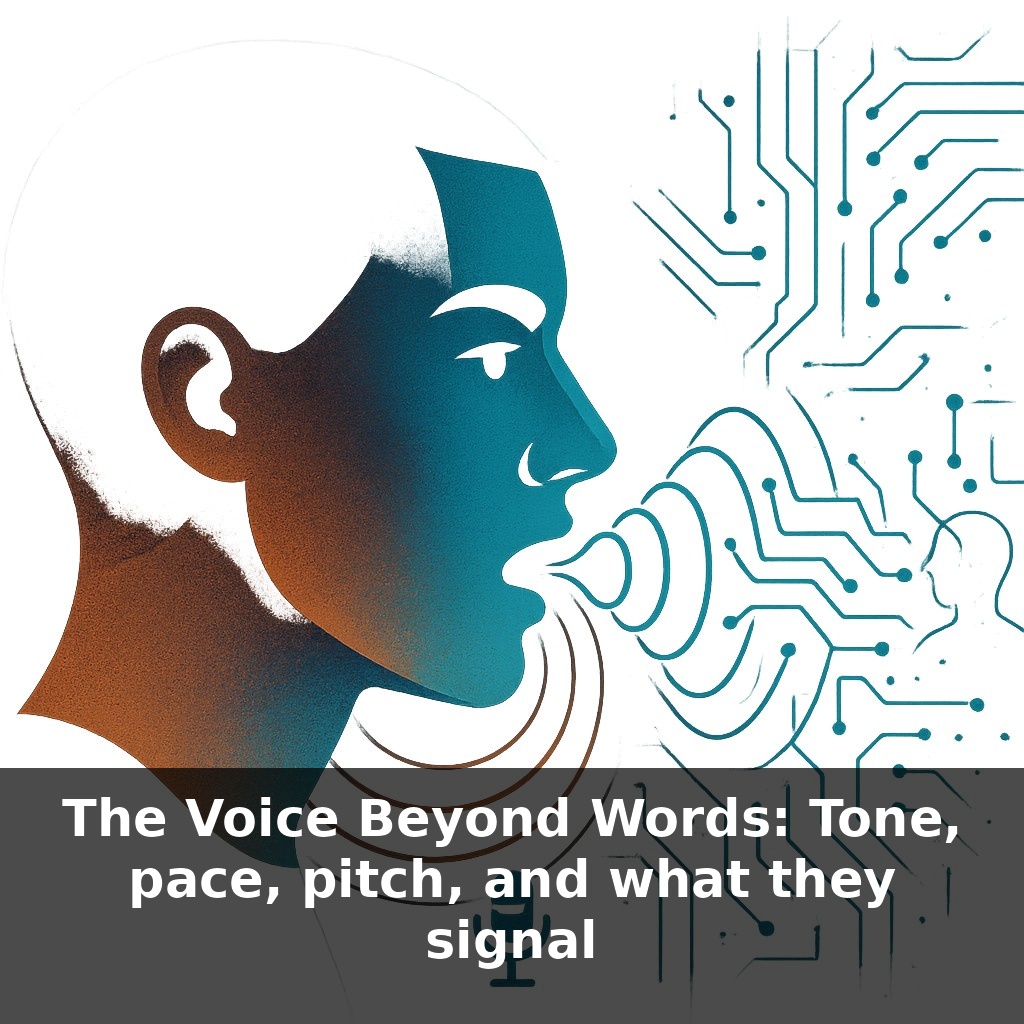
Psychologists call this “prosody,” but you experience it every day as the difference between “We need to talk” that calms you and the same words that make your stomach drop. Your brain is timing micro‑pauses like a drummer counting beats, tracking pitch rises like a GPS recalculating risk. In under a quarter of a second, you’re already tagging a voice as safe, tense, bored, or pushy—long before the logical part of you weighs the actual message. Tech is racing to keep up: algorithms now scan these contours the way spelling‑checkers scan text, quietly scoring our calls, check‑ins, and voice notes for patterns we barely notice.
Most of what you notice consciously is “content”: the statement, the joke, the request. But under that, three dials are doing a lot of the social work: pace, pitch, and rhythmic variation.
Pace first. In English, casual talk clusters around 4–5 syllables per second. You don’t measure that, but your nervous system does. When someone suddenly drops to a slow, measured delivery, it often reads as “serious” or “dominant,” even if the words stay friendly. Push past your listener’s comfortable range—closer to auctioneer speed—and you trigger a different reaction: people stop evaluating your ideas and start just trying to keep up. That’s why fast can feel sharp and smart up to a point, then abruptly flip to “pushy,” “anxious,” or “salesy.”
Pitch sits on another axis. Humans tend to read slightly lower pitch as more grounded and slightly higher as more uncertain or excited. The Klofstad data on presidential voices is one noisy example of a broader pattern: across many cultures, deeper voices are often granted more authority. But this is a curve, not a straight line. Drop your voice too far below your natural baseline and you drift into “performing power,” which listeners often tag as forced, aggressive, or even insincere. Subtle shifts—on the order of a few Hertz—can change whether a question sounds exploratory, defensive, or accusatory.
Then there’s variation: the contour of how your pitch, volume, and speed rise and fall over a sentence. Flat contours are efficient for instructions and status updates, but they quietly dampen warmth and enthusiasm. Large, animated contours create energy, but over long stretches they can feel chaotic or juvenile in high‑stakes settings. Companies obsess over this. One internal Amazon experiment reportedly boosted Echo engagement after engineers added more contour to Alexa—tiny lifts on greetings, softer landings on confirmations—without changing a single scripted phrase.
The emerging twist is that machines now “listen” for these patterns the way we do, but at scale and with memory. A customer‑support system might not care what you’re arguing about; it cares that your pace has climbed 20 % over your baseline and your pitch range has narrowed—classic stress markers. Early mental‑health tools track similar drifts across weeks, flagging users whose once‑lively variation has flattened into monotonous, low‑energy speech.
Your challenge this week: run three live experiments with your voice.
Experiment 1 – Pace pivot: In your next low‑stakes conversation (coffee chat, stand‑up, daily check‑in), intentionally deliver one short point at your normal speed, then restate the same point 30 % slower, without changing the words. Watch for tiny shifts: Do people lean in more? Interrupt less? Ask a follow‑up only after the slower version?
Experiment 2 – Pitch window: Record yourself saying the same neutral sentence three ways: slightly higher than usual, slightly lower, and in your most natural voice. Play them back the next day and, without overthinking, jot the first three adjectives each version evokes. Then, if possible, ask one trusted person to do the same—no context, just “How does this one *feel*?”
Experiment 3 – Contour contrast: In your next meeting or class, choose one key idea you really care about. Mark one word in that sentence to emphasize with a deliberate change in pitch or volume, and insert a micro‑pause right before it. Later, review any notes, decisions, or comments: Did that idea travel further than others you mentioned?
By the end of the week, you’re not aiming to “perfect” your voice; you’re building a mental dashboard. The goal is to notice which small adjustments predict better questions, fewer misunderstandings, or smoother pushback. Once you can feel those levers in low‑stakes settings, you’ll have far more control when the stakes—and the microphones—get bigger.
A negotiation coach once had founders rehearse their funding pitch twice: first as if they were explaining it to a bored customs officer, then as if they were narrating a documentary about their own success ten years later. The words stayed identical; investors consistently rated the “documentary” takes as more strategic and less risky. In clinics, some neurologists quietly track changes in a patient’s pace and pitch range the way others track blood pressure—gradual slowing and narrowing can hint at cognitive decline long before test scores slip. One sales team I worked with color‑coded transcripts of their calls: green for steady, flexible delivery; red for rushed or flat stretches. Deals almost always clustered in the green zones. A useful experiment: treat your next difficult conversation like tuning an instrument before a performance—adjust one string at a time (pace in one call, then variation in another) and listen for when the dialogue suddenly feels easier, not just louder.
As voice becomes another data stream, “small talk” won’t be small anymore. Your calendar app might someday nudge, “Tuesday’s 3 p.m. pattern looks like burnout—reschedule?” Hiring tools could quietly down‑rank you because your late‑day calls sound tense. In medicine, a 30‑second reading could sit beside blood tests, catching issues before symptoms surface. The upside is early support and more adaptive tech; the risk is being scored on signals you never meant to send—and never got to review.
As sensors creep into cars, earbuds, and meeting rooms, your voice may soon be treated like a health dashboard and a reputation score rolled into one. Think of each call like a trail of footprints in fresh snow: individually faint, but together revealing patterns of strain or balance that others—and algorithms—can quietly start to follow.
Try this experiment: Before your next 1:1 or meeting, record a 60-second voice memo where you explain the same idea three times—first in a flat, rushed tone; second with slower pace and warmer tone; third with slightly higher pitch and more energy at key words. Then, in the actual conversation, consciously use version #2 (slow + warm) for the first two minutes, especially on your greeting and first explanation. Afterward, ask the other person one specific question: “How did I come across just now—more calm, more intense, or about the same as usual?” and compare their answer with how each recorded version sounded to you.