Most people get nonverbal cues wrong more often than a coin flip. You see a nose scratch, a glance away, crossed arms—and your brain rushes to judgment. In this episode, we’ll slow that rush down and explore why single signals lie, and why only patterns tell the real story.
Eighty percent of your snap judgments from one gesture are probably wrong—and still, your brain loves making them. It craves quick, simple stories: “She crossed her arms, so she’s closed off.” “He rubbed his neck; he must be lying.” In reality, those stories are usually fan fiction, not fact.
In this episode, we’ll zoom out from isolated moments and into the broader “rhythm” of someone’s behavior. Rather than chasing any one movement, you’ll start learning to notice how signals line up over time, across situations, and under pressure.
We’ll look at why skilled interrogators, negotiation experts, and even emotion‑reading AIs quietly ignore most one‑off cues—and what they focus on instead. And we’ll explore how you can apply the same discipline in daily life, so your read of people becomes less about gut guessing and more about consistent, testable patterns.
To do that, we need to shift how we *watch* people. Most of us zoom in on the “loudest” moment—a sudden arm cross, a micro‑expression—then freeze it in our memory like a screenshot. But body language works more like a short video clip than a single frame. The timing, sequence, and repetition of behaviors matter as much as the behaviors themselves. Anxious fidgeting right after a pointed question means something different from the same fidgeting during small talk. Our goal now is to train your attention on when signals appear, how often, and what reliably seems to come just before and after them.
Think of what we’re doing now as upgrading from “Where’s Waldo?” to reading sheet music. Instead of hunting for one loud movement in a crowded scene, you’re starting to notice how multiple notes line up into a recognizable melody.
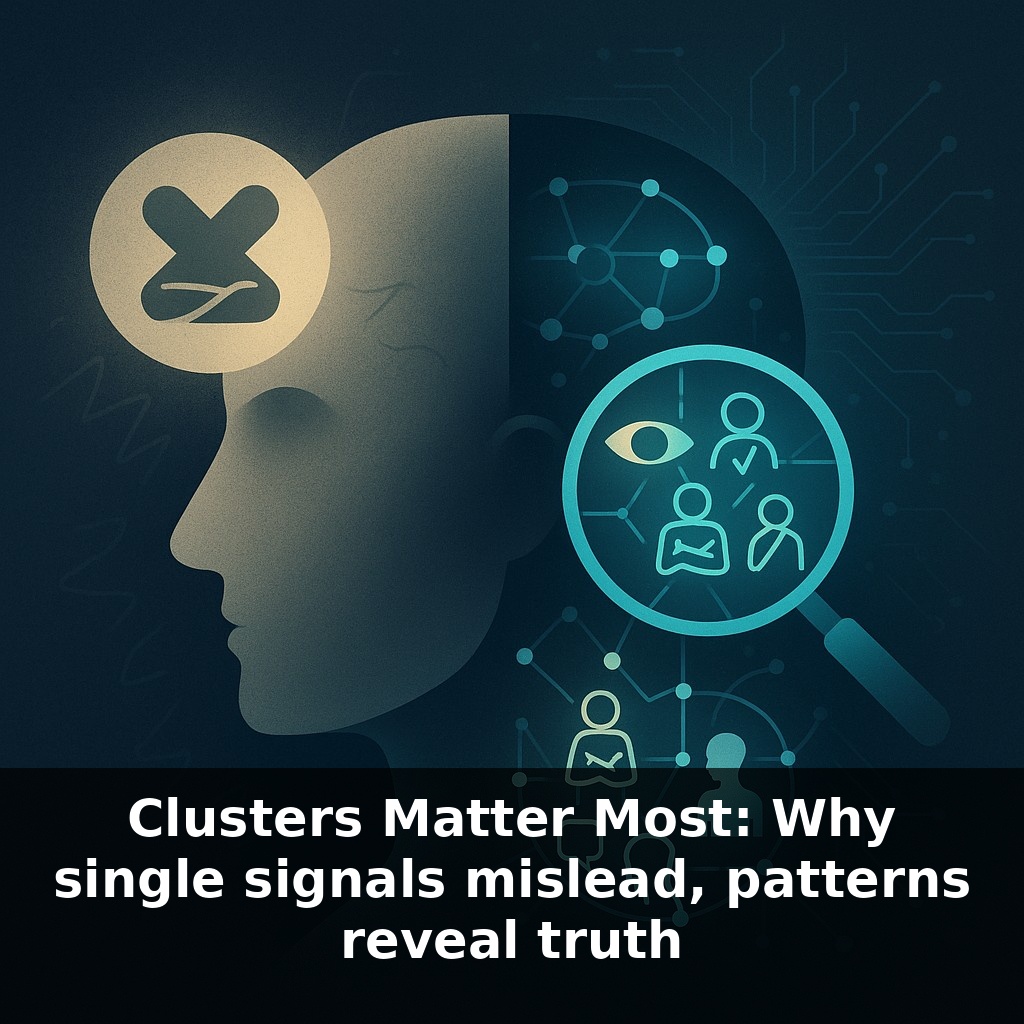
Researchers see this shift clearly in the data. When observers lock onto a lone cue, their accuracy hovers around chance; when they wait for 3–5 matching behaviors in the same moment and situation, accuracy shoots up. It’s the *co‑occurrence* that matters: several signals pointing in the same emotional direction, not just happening near each other.
So what actually belongs in a useful cluster?
First, look for *channel agreement*: does the face, voice, posture, and gesture all lean toward the same state—relaxed, tense, interested, resistant? MIT’s multimodal work shows that combining channels is where understanding jumps, and your brain can do a low‑tech version of that.
Second, look for *theme*, not twins. Clusters aren’t five copies of the same gesture; they’re different behaviors expressing the same underlying state. For example, in a tough meeting you might see: shoulders rise slightly, breathing shallow, lips press, feet pull back under the chair, and hands disappear from the table. Different movements, same theme: withdrawal and self‑protection.
Third, weigh *synchrony with context*. A defensive cluster right after you mention budget cuts means more than the same cluster when someone is just cold or tired. What changed in the environment right before the behaviors showed up? Topics, people entering, deadlines mentioned—those shifts often act as triggers.
Fourth, compare against a *personal baseline*. A “nervous” laugh in someone who always laughs that way belongs to their normal signature, not automatically to a stress cluster. What counts as meaningful is deviation from how *this* person typically sits, gestures, and reacts.
Finally, zoom out in time. Reliable patterns reappear. If the same set of behaviors keeps resurfacing around the same topics or people, you’re likely seeing a genuine signal, not noise. Your goal isn’t to decode every twitch—it’s to patiently collect enough aligned evidence that guessing turns into grounded inference.
A simple way to feel the difference is to “zoom in” on one moment, then pull back. Say you’re giving feedback to a teammate. You notice they rub their temple. If you stop there, you’re stuck guessing: tired, stressed, bored? But watch what *else* happens in the next 10–20 seconds. Do their answers get shorter? Does their pen suddenly go still? Do they stop meeting your eyes when you mention deadlines but perk up when you talk about resources? Now you’re not chasing a gesture; you’re tracking a storyline.
You’ll see the same thing in social situations. At a party, someone might stand with folded arms because they’re cold. But if, whenever a certain topic comes up, they also angle their feet toward the door, tighten their jaw, and start checking their phone, you’re likely touching a sensitive area.
In medicine, no doctor panics over a single cough; concern rises when cough, fever, and fatigue arrive together and worsen in step. Treat your observations the same way: look for signals that show up together, change together, and come back in similar moments.
Soon you’ll see cluster thinking spill far beyond conversations. Cars may track micro‑patterns in drivers’ posture and gaze to ease off speed or suggest a break. Remote coaches might watch gesture, voice rhythm, and response lag like a jazz trio, adjusting difficulty in real time. In global teams, leaders who notice recurring clusters around certain agendas can redesign meetings, much like a game designer reshapes a level where players always get stuck.
Treat this like learning a new city: the first visit feels random, but after a few trips you start knowing which side streets connect, where traffic slows, where people naturally gather. Your challenge this week: when something “feels off” with someone, don’t react—mentally bookmark it, then wait to see if the same flavor of behavior shows up again.