Right now, as you’re listening, your brain is quietly generating thoughts you don’t choose. Here’s the twist: research shows that simply watching those thoughts—without fixing, fighting, or following them—can dial down stress chemistry almost as much as a solid night’s sleep.
So if thoughts stream on their own and stress chemistry responds to how we relate to them, the obvious question is: where does choice actually live? Buddhist mindfulness makes a radical claim here—not that you can control what appears in the mind, but that you can train *where* and *how* you place attention. Modern neuroscience backs this up: brief, repeated shifts from “inside” a thought to *watching* the thought change blood flow in key regulation networks, strengthening your brain’s capacity to step back the next time.
This is less about becoming calm and more about becoming skillful. Instead of automatically chasing every mental storyline, you start to notice tiny decision points: do I feed this worry, or let it pass? It’s like learning to use a new settings panel in your own mind—you discover sliders for engagement, curiosity, and release that were always there, just buried under default habits.
Here’s where Buddhist philosophy adds a sharper edge: it claims that this capacity to step back is not just a mental hack, but a glimpse of a deeper freedom. Instead of “fixing your mindset,” you start noticing how identities, opinions, and even moods are built moment by moment. Neuroscience quietly concurs: in studies, people who practice this kind of observing show both lower cortisol and less activity in brain regions tied to sticky self-criticism. The practical upshot is stark: the same situation can either tighten into a story of “me failing” or loosen into data your mind is processing.
Most of us only notice the mind *after* it has already sprinted off: the replay of an argument, the sudden spike of shame, the quiet “I’m not good enough” humming under everything. From a Buddhist perspective, what we call “me” is largely this stream, taken very personally. The practice of observing and letting go starts to reveal that personalization in real time.
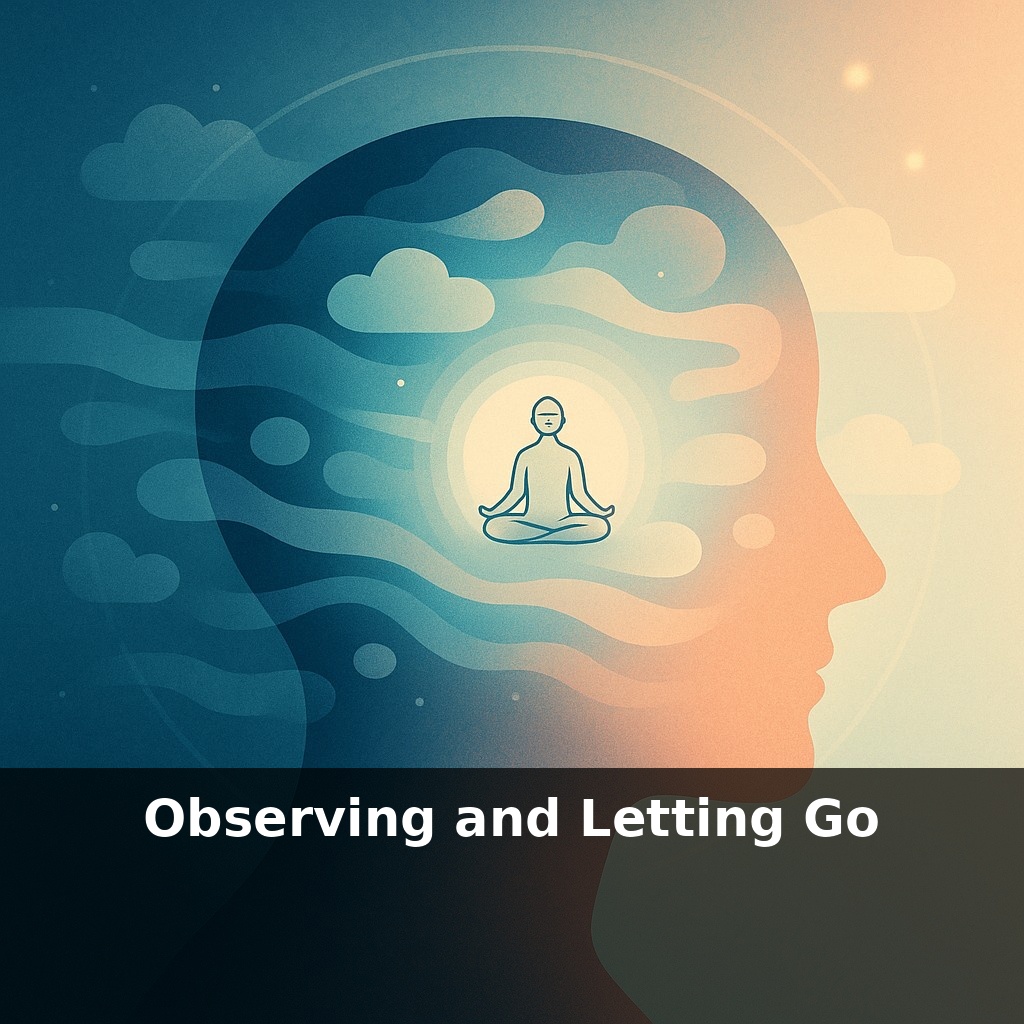
Here’s the pivot: instead of asking, “Why am *I* like this?” you begin to ask, “What is the mind doing *right now*?” That tiny grammatical shift—from “I” to “the mind”—is not self-denial; it’s strategic distance. In cognitive science, this shows up as “decentering” or “cognitive defusion”: the thought “I always screw things up” is tagged as a mental event, not a verdict. In Buddhist terms, you’re seeing the thought as *conditioned*, not as your essence.
This is where “letting go” becomes precise. It is not pushing away, distracting yourself, or pretending not to care. It has three steps:
1. **Contact** – You actually feel the pulse of the experience, whether it’s tightness in the chest or a flash of anger, without numbing out. 2. **Label** – You name it lightly: “worrying,” “planning,” “self-attack.” Research shows that such labeling briefly quiets limbic reactivity. 3. **Release** – You stop feeding it: no extra commentary, no argument with it, just a gentle return to something simple, like the breath or the feeling of your feet.
Repeated often, this sequence reshapes habits. MBCT trials showing reduced depressive relapse aren’t about people never feeling sad again; they’re about people recognizing the *early* spiral—“Here comes the ‘I’m a failure’ script”—and declining the invitation to follow it all the way down.
A single analogy, and then we’ll stay concrete: letting go is like closing a background app on your phone. You don’t smash the phone or ban all apps; you just stop letting one program drain the battery unnoticed.
Philosophically, this undercuts the idea that you *are* your latest narrative. The mind can still generate “I’m terrible” or “I’m amazing,” but you’ve seen behind the scenes: both are passing constructions. Neuroscientifically, those 20-minute daily sessions that can shrink amygdala volume are not magic; they’re accumulated reps of this contact–label–release cycle, gradually training a new default: notice, allow, and put it down.
Consider three everyday “labs” where this shows up.
First, during email: you see a vague subject line from your boss, and a fast surge of heat in the face. In that instant, you don’t debate the storyline; you mentally note “tightness, bracing,” feel the breath once, then choose to open the message slowly instead of catastrophizing in advance.
Second, in conversation: a friend talks over you. Rather than replaying the slight, you feel the small collapse in the chest, note “hurt,” and stay curious: “Can I finish that thought?” The point isn’t saintly detachment; it’s testing how a millimeter more space changes the next sentence you speak.
Third, alone at night: the mind starts drafting worst‑case scenarios. You register “forecasting,” sense the weight in the stomach, and deliberately shift attention to sounds in the room. Not to erase fear, but to see it coexist with a wider field of experience.
Over days, these micro‑experiments map where your reactivity hides—and where release is actually possible.
Practiced over years, observing-and-letting-go stops being a “technique” and starts behaving more like a quiet operating system upgrade. Social media spikes, office politics, family drama still arrive, but your mind routes them differently—like traffic being smoothly diverted by smart signals before a jam forms. At scale, this could shift whole workplaces: fewer email flame‑outs, calmer negotiations, leaders who can pause a reflex and choose a wiser norm in real time.
Over time, this quiet retraining rewires your defaults: the mind still launches pop‑ups, but fewer steal the whole screen. You start noticing tiny freedoms: pausing before a snarky reply, loosening a grudge on your commute, choosing rest over one more scroll. Not enlightenment, just small, repeatable acts of release that slowly recalibrate what “normal” feels like.
Before next week, ask yourself: 1) “When I notice a recurring thought loop (like replaying a past conversation or worrying about how I ‘should’ have shown up), what happens in my body in the first 10 seconds—and can I simply sit and watch that sensation instead of trying to fix it?” 2) “In one daily situation where I usually react on autopilot (scrolling my phone at night, snapping at a partner, overworking), what would it look like to pause for three breaths, silently say ‘I see you’ to the urge, and let it pass without obeying it?” 3) “If I imagined placing one heavy story I’m carrying (about who I have to be, or what I must achieve) on a bench beside me for just five minutes today, what tiny bit of freedom or curiosity might open up in that space?”