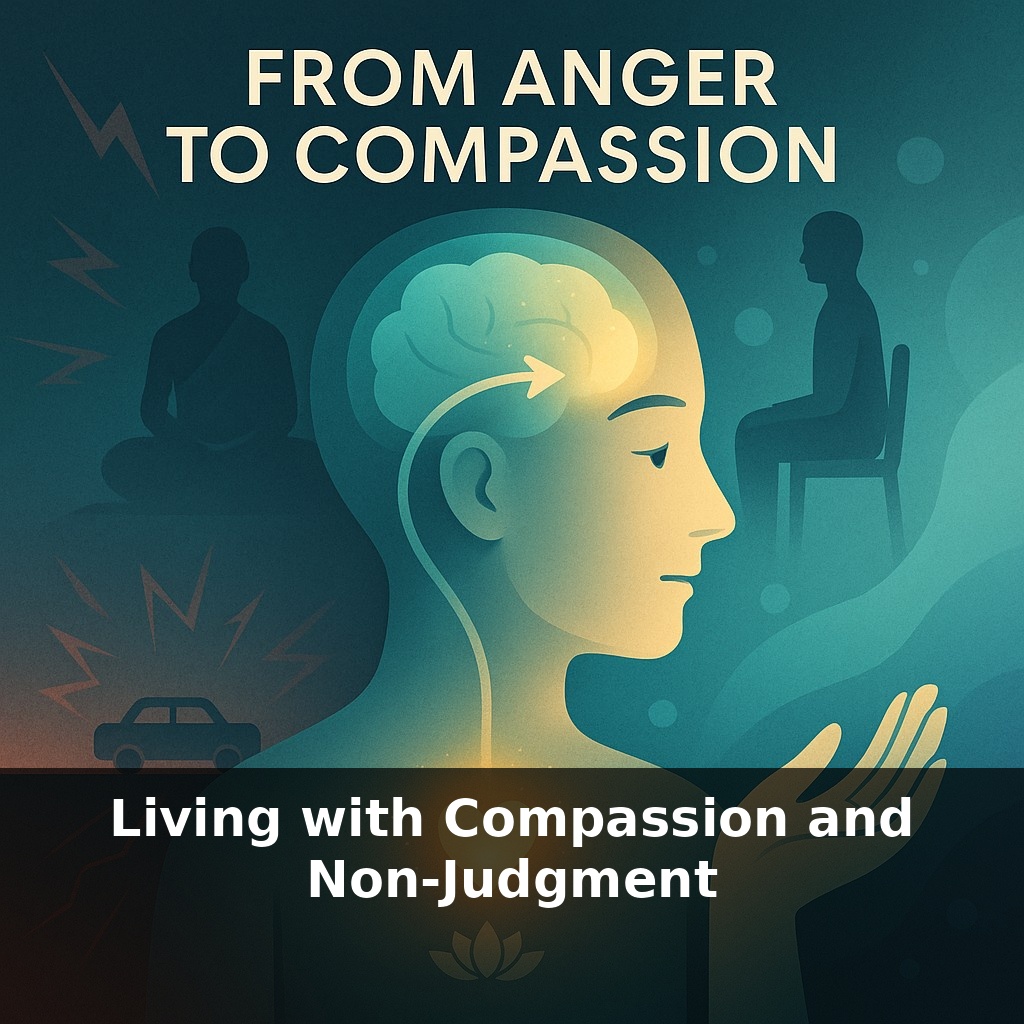
A brain scan can light up differently after just weeks of practicing kindness. Now, hear this: you’re cut off in traffic, your heart jumps, anger rises—then, suddenly, you’re curious instead of furious. How does that switch happen, and could you train it on purpose?
A monk in Tibet and a therapist in New York are quietly doing the same radical thing: training attention to land on suffering without flinching or blaming. That tiny shift—turning toward pain with warmth instead of attack—turns out to be neurologically expensive at first, but incredibly profitable over time. Research now shows that compassion and non-judgment don’t just *feel* noble; they alter stress hormones, conflict patterns, even how lonely or connected we feel on an ordinary Tuesday afternoon. And this isn’t limited to meditation cushions or therapy rooms. Hospitals are testing compassion protocols on burnout, schools are piloting non-judgment exercises to reduce bullying, and some startups treat “how we relate to difficulty” as a core skill, like coding or sales. In this episode, we’ll explore what living this way actually looks like in real conflicts, deadlines, and family arguments.
Instead of asking you to become some endlessly patient saint, this episode looks at tiny, testable moves in regular life. Think of tense meetings, unread emails, or that one relative who always “knows best.” Modern studies now track how small shifts in how we speak to ourselves and others can change not only mood, but heart rate, immune markers, even how quickly we recover after social rejection or failure. We’ll zoom in on three arenas—work, close relationships, and your inner critic—and ask: what does compassion plus non-judgment *actually* look like when things are messy, unfair, or boring?
A Johns Hopkins review found that brief mindfulness-based trainings can rival antidepressants for mild to moderate depression symptoms. That’s impressive—but what does it *feel* like from the inside when you actually start living with compassion and less judgment?
At work, it often starts with one tiny move: separating *impact* from *intention*. Your teammate misses a deadline. The old habit is, “They don’t care; they’re unreliable.” A compassionate, non-judging mind asks, “What happened?” before it asks, “Whose fault?” The behavior can still be challenged, boundaries can still be clear, but the person isn’t turned into a villain. Teams at Google’s “Search Inside Yourself” program reported less blame and more problem-solving after practicing a simple pause: label the emotion (“frustrated,” “anxious”), notice the story you’re telling, and then ask one curious question instead of delivering a verdict.
In close relationships, the same shift shows up in micro-moments. Your partner snaps at you. Instead of silently prosecuting them in your head, you notice your hurt, breathe once, and *wonder* what strain they might be under. Not excusing harmful behavior—just refusing to reduce a complex human to a single bad moment. Therapists see couples move from “You always…” to “When this happens, I feel…” once they stop judging their own emotions as wrong and start treating them as data.
With your inner critic, living this way is radical. The research on self-compassion suggests that speaking to yourself like you would to a respected friend is more motivating than harsh self-attack. In practice, that might sound like: “You messed that up—and of course you’re embarrassed. What’s one small repair you can make?” No drama, no global judgment about your worth. Over time, this tone becomes a default setting, not a special exercise.
For adolescents in the Raes et al. study, non-judgmental awareness seemed to interrupt the “stuck on replay” habit of rumination. Adults can borrow the same move: when your brain replays a mistake for the tenth time, label it as “the replay loop,” notice the sensations in your body, and gently redirect attention to the next right action.
Your challenge this week: pick one arena—work, relationships, or self-talk—and choose a specific moment that usually triggers judgment. For 7 days, when that moment appears, practice this experiment: delay your first judgment by 10 seconds and insert one curious question (to yourself or the other person). At the end of the week, review: Did anything about your reactions, stress level, or connection change, even slightly?
Think of three everyday “test zones.” First, digital life: you open your inbox to a blunt message. Without changing a word of your reply, you quietly notice, “Heat in my chest, urge to fire back,” then type a response that sticks to facts and one sincere question. The thread often cools instead of escalating.
Second, commuting: someone blocks the subway door. Rather than composing an inner rant, you feel your jaw clench, label it, and widen the frame: “Crowded, everyone’s stressed.” You still step around them, but your morning isn’t hijacked.
Third, leadership moments: a manager at a hospital starts meetings with a 60‑second silent check‑in on “what’s hard today.” No one solves anything in that minute; they just notice. Over weeks, staff report fewer snappy comments and quicker repairs after mistakes.
Your mind learns that pressure doesn’t require a verdict; it can meet friction with data, then choose the next move.
In policy and tech, this mindset quietly reshapes default settings. A city budgeting meeting that begins with, “Who is most impacted if we’re wrong?” tends to redirect funds toward prevention, not just cleanup. In classrooms, a teacher who treats each raised hand as a “data point,” not a test of worth, often sees quieter students risk speaking. Even in code, teams can ask, “How might this feature land on someone having their worst day?” before they ship. Small questions, but they tug whole systems a few degrees toward care.
Compassion and non‑judgment don’t make life softer; they make *you* sturdier. They turn hard days into practice fields where every awkward email, tense meeting, or lonely evening becomes a rep you can learn from. Like updating an operating system in the background, small, repeated choices quietly install a calmer, braver way of moving through the world.
Here’s your challenge this week: Once each day, when you notice yourself judging someone (including yourself), pause and silently say, “Just like me, this person wants to be happy and free from suffering.” Then, instead of replaying the judgmental thought, do one concrete compassionate act toward that person (a kind message, a patient response, or simply offering a genuine smile if it’s a stranger). Each night, quickly rate yourself from 1–5 on how non-judgmental you were that day and pick one moment you’d like to handle with more compassion tomorrow.