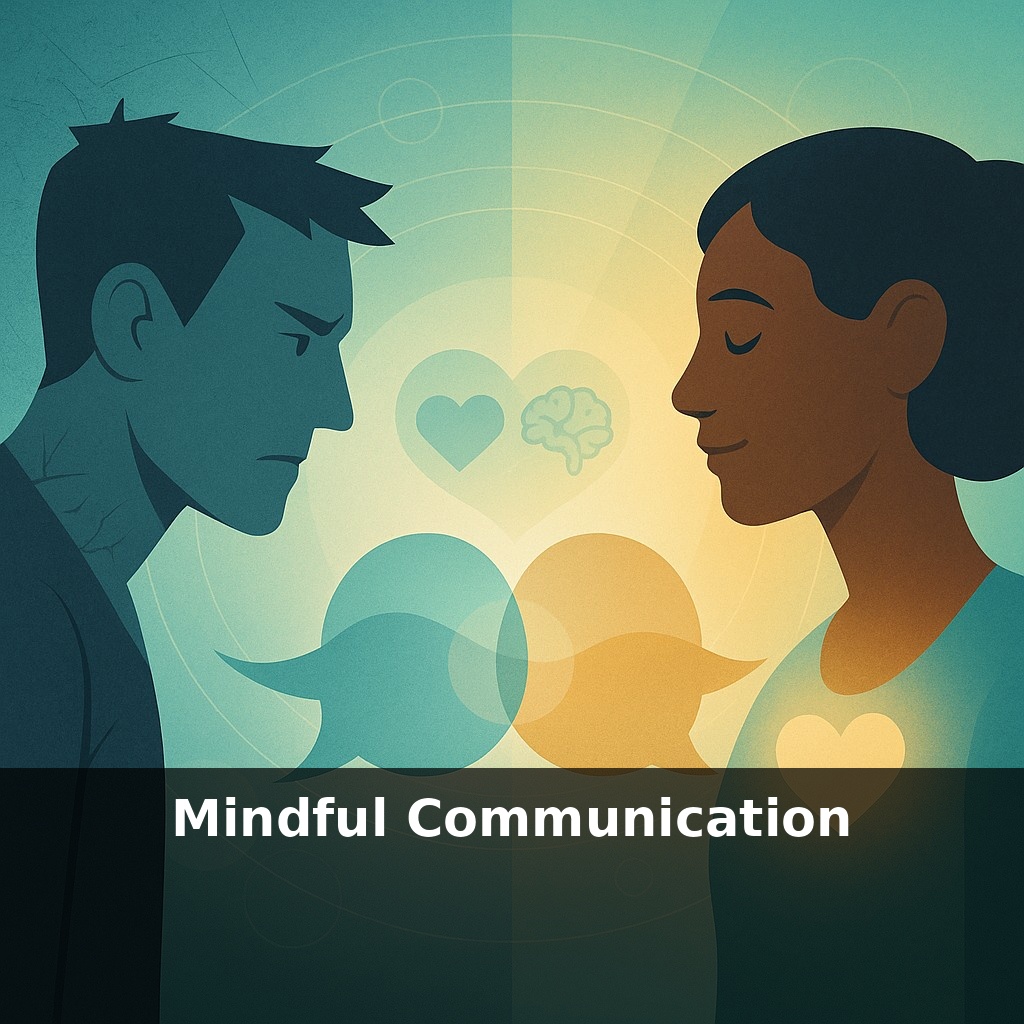
“Most people spend more time planning a weekend than preparing for a hard conversation.” You’re in a tense meeting; voices tighten, shoulders rise. One person slows down, asks a simple, curious question—suddenly the room softens. Same conflict, same people… completely different outcome.
A 15-minute mindfulness exercise can boost listening recall by 34%. That’s not a personality change; that’s a settings change. Mindful communication is less about “being nice” and more about updating the internal software that runs your reactions in real time.
In Buddhist terms, speech is one of the eight core paths to awakening, yet in modern life it’s the one we treat as background noise. We upgrade our phones, not our default way of talking to a colleague, a partner, or a stranger who cuts ahead in line.
Neuroscience quietly backs up the old monastic hunch: when you bring awareness to tone, timing, and body language, the prefrontal cortex steadies the amygdala. Less hijack, more choice. This is where philosophy gets practical—ethics, attention, and emotion regulation collapsing into a single sentence you’re about to say.
A 2020 meta-analysis found that simply training how we speak and listen nudged workplace relationships almost half a standard deviation better. That’s a huge shift for something most of us treat as automatic. And in clinical settings, mindful communication has moved patient ratings from below average to well above it, without changing staffing, equipment, or protocols. The leverage point isn’t more content; it’s more awareness in the channel itself. Think of your next meeting or argument less as a battle of ideas and more as shared “signal engineering”—clarifying what’s sent, received, and distorted in transit.
Mindful communication in Buddhist thought starts with a blunt question: before you open your mouth, *what are you serving*—your habits, or your intentions? Classical teachings break this down into three simple filters: is it true, is it beneficial, is it timely. Neuroscience quietly adds a fourth: is your nervous system regulated enough to tell.
Notice how different that is from “be nice.” You can be mindfully sharp, even confrontational, if you’re anchored in those filters. A blunt performance review, a breakup, a whistleblower report—none of these are gentle, but all can be done without cruelty or distortion.
Modern workplaces accidentally train the opposite. Slack pings, rapid-fire meetings, and performance dashboards reward speed over reflection. The result is “latency-free” speech: you feel, you fire. The Buddhist move is to deliberately insert latency—not as silence forever, but as a micro-gap where awareness can check:
- What’s actually happening in my body right now? - What story am I telling about this person? - What outcome am I about to make more likely with this next sentence?
Organizational data show that when groups normalize this micro-gap, culture shifts. At Cleveland Clinic, the physician course didn’t just soften bedside manner; it changed how teams debriefed bad outcomes—less blame, more shared problem-solving. Google’s program reports people staying calm *in difficult situations*, not avoiding them. Mindful disagreement becomes a form of collaborative thinking instead of covert warfare.
This is where Buddhist ethics slide into design thinking. You’re not just trying to be a “good person”; you’re iterating on conversational prototypes in real time: test a curious question instead of a jab, a transparent feeling instead of a veiled accusation, a specific request instead of a global judgment. Watch what actually happens in the relationship, not what your indignation predicted.
And you don’t need a meditation cushion to start. You need one breath you notice before you reply-all, one extra beat before you say “as I already explained,” one moment of listening past the words to the fear or hope underneath. Those tiny shifts, repeated, accumulate into a very different life-sized philosophy: every sentence is a decision about the kind of world you’re co-creating.
In practice, this looks very ordinary. A product lead hears, “This timeline is impossible,” and instead of defending, they say, “Walk me through what would make it possible.” Same data, different move: the engineer feels consulted, not dismissed, and suddenly they’re co-designing a scope reduction instead of trading complaints.
Or at home: your partner snaps, “You never listen.” The reflex is to fire back a counterexample. The experimental move is to paraphrase: “You’re feeling like I’m checked out when you talk about work—did I get that?” Often the heat drops just because someone finally named the right movie playing in the other person’s mind.
Think of it like debugging a live system: rather than rewriting the whole app, you insert a few well-placed logs—“Here’s what I’m hearing… here’s what I’m feeling… here’s what I’m actually asking for.” Suddenly you’re both looking *at* the interaction together, not just *through* it, which is where genuine collaboration starts to become possible.
A quiet implication hides in all this: your “voice” is becoming part of your philosophical practice. As AI handles more routine replies, the few sentences you *do* choose personally become high‑leverage events, like keystrokes in a shared repo that others must live with. Companies will likely treat conversational logs as practice fields—spaces to review not just *what* was decided but *how* minds met. Over time, careers may hinge less on volume of output and more on the wake your words leave behind.
Your challenge this week: treat each talk, text, or meeting as a small lab. Once a day, pick one exchange and replay 30 seconds of it in your head: where did your attention narrow, where did it widen, and what did you *actually* care about there? Over time, those tiny “replays” become like reviewing game footage, training a more intentional, honest way of meeting minds.