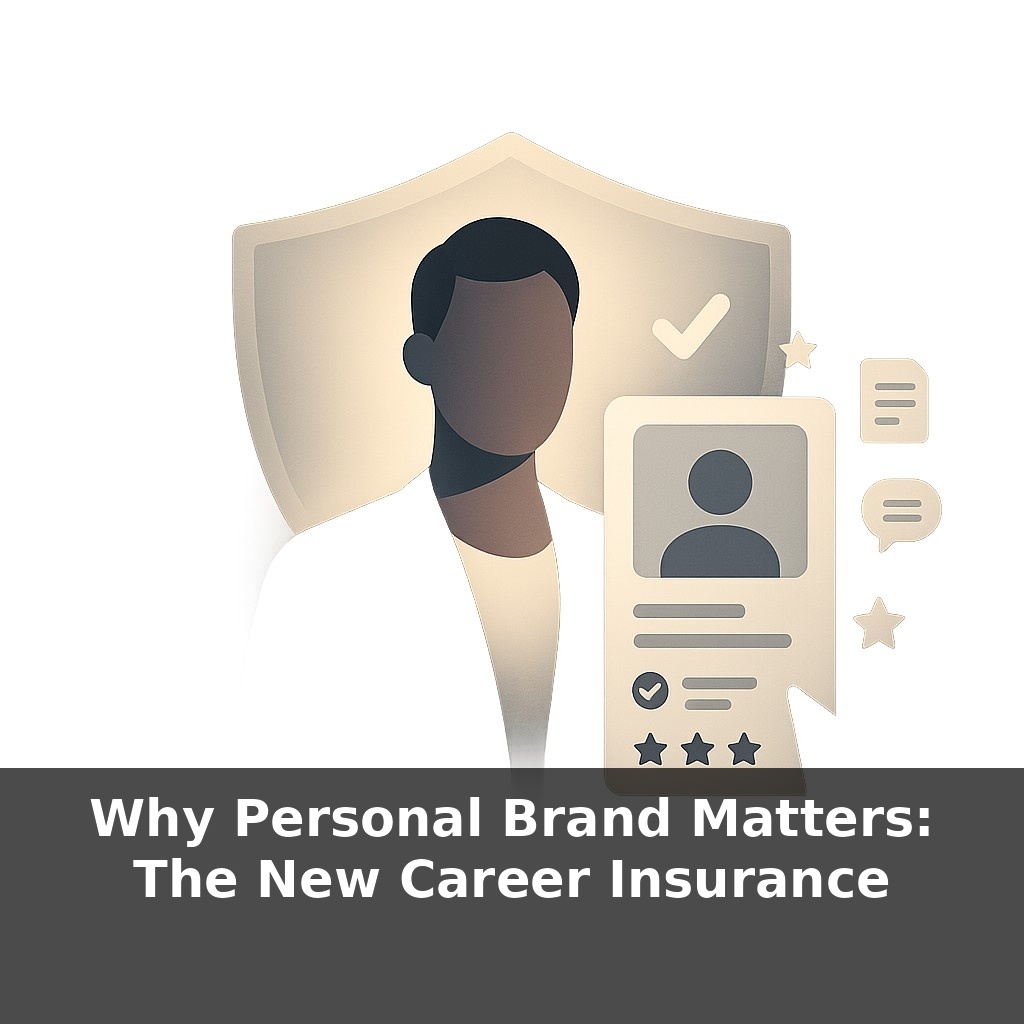
Why Personal Brand Matters: The New Career Insurance
📝 Transcript
You’re more searchable than you think. Right now, a recruiter you’ll never meet is skimming profiles, making snap decisions in under a heartbeat. In that tiny window, your name either signals “must talk to this person” or quietly disappears into the scroll.
Your personal brand is what fills in the silence after someone clicks your name. Past the quick skim and the first impression, people start hunting for proof: Do your projects line up with what you claim? Do others vouch for you? Is there a consistent thread in how you talk about your work? That trail—posts, comments, recommendations, talks, case studies—is what quietly separates “qualified” from “must not miss.” In a job market where roles can vanish overnight and algorithms can bury even strong résumés, this trail becomes a buffer. Not because it guarantees safety, but because it keeps you discoverable, memorable, and easier to trust. Instead of starting from zero every time you need a new role, your brand lets opportunities pre-warm: people already feel like they know what you’re good at—and where you’re headed next.
That’s why your online presence can’t be treated like a static CV you update only when you’re in trouble. Algorithms reward activity and clarity: profiles with a sharp headline, a relevant banner, and a professional photo simply surface more. Weekly posters grow their networks dramatically faster—not because they’re louder, but because they create more “entry points” for others to find and remember them. Think of short posts, thoughtful comments, and case snippets as steady, low-effort signals that you’re active, learning, and available for the right kind of work, long before you ever hit “open to new opportunities.”
Here’s the quiet truth: most “lucky breaks” you see on LinkedIn aren’t luck at all—they’re the compound interest of a clear, consistent signal over time.
Once someone lands on your name and sees that you’re relevant, their next question is, “Relevant for what, exactly?” That’s where many careers stall. The experience is there, the achievements are there, but there’s no throughline. One week you “do a bit of everything,” next week you’re “open to all opportunities.” It feels flexible, but it reads as fuzzy.
What works better is intentional positioning: deciding the two or three problems you want to be known for and letting everything you share orbit those themes. A marketer who repeatedly breaks down how they run A/B tests becomes “the experiment person.” A project manager who posts debriefs of failed timelines becomes “the realistic delivery person.” Specialists are easier to remember, easier to refer, and easier to bet on.
This doesn’t mean narrowing your career, it means sharpening your signal. You can still do many things, but you choose which stories you tell in public. People buy into patterns, not isolated moments: a single good post is interesting; a six‑month trail of related insights suggests mastery.
Social proof strengthens this pattern. Recommendations that mention the same strengths, colleagues tagging you into similar conversations, even the way you comment on others’ work—all of it converges into a narrative about where you create outsized value. That narrative often travels where you can’t: into private Slack communities, internal hiring chats, referral emails.
The paradox is that the safest careers now belong to people who act as if they’re slightly independent of any one employer. By continuously showing how you think, what you’re learning, and who you help, you turn each role into a chapter of a bigger story instead of a single point of failure. When one chapter ends abruptly—a reorg, a layoff—the story is still in motion, and your next collaborators already have a mental draft of the role you should play.
A useful way to think about this is through concrete scenarios. Take two software engineers laid off on the same day. Both are competent. One quietly updates their résumé and starts cold‑applying. The other has spent the last year sharing short write‑ups of tricky bugs they’ve solved, commenting thoughtfully on others’ code reviews, and speaking once at a local meetup. When news of the layoff hits, the second engineer posts Reflecting on our earlier discussion about the impact of a clear personal brand, envision this: you update with a specific “here’s what I do, here’s what I’m looking for” statement. Former colleagues reshare it, a past hiring manager messages, a recruiter who bookmarked their debugging thread months ago finally reaches out. None of those responses are random; they’re delayed reactions to earlier signals.
Building on the earlier discussion about the value of a strong personal brand, consider how your public work acts like a health baseline. In medicine, you don’t wait for a crisis to build your health baseline; you get regular checkups so small issues are caught early. Treat your public work the same way: ongoing, light‑touch, never only in emergencies.
When AI tools can draft decent résumés in seconds, what still sets you apart is the trail of thinking only you could have produced. That trail will soon stretch beyond one platform: verified micro‑credentials, public project logs, even voice or video “portfolios” could travel with you between employers and countries. Treat each post, talk, or collab as a small future reference letter—evidence that you’re not just employable today, but adaptable to jobs that don’t exist yet.
Think of this less as polishing a shop window and more as quietly building a studio where your best work lives. As roles bend, blend, and disappear, that studio becomes a place people seek out when they’re unsure what they need—but know they need someone sharp. Your challenge this week: pick one theme you want to be found for, and make a single, specific post about it.
From this course
Build Your Personal Brand on LinkedIn
7 episodesUnlock all episodes
Full access to 7 episodes and everything on OwlUp.
Subscribe — $1.99/monthLess than a coffee ☕ · Cancel anytime