Eight people are hired on LinkedIn every single minute—yet most of them have barely posted anything. In this episode, we’ll step into three very different careers and follow what actually turns quiet profile views into job offers, clients, and real opportunities.
Eight people are hired on LinkedIn every minute—yet most professionals treat it like a billboard on a deserted highway: something you put up once and hope the right person drives by. Today we’re going to zoom in on what actually turns casual attention into something you can say yes to: offers, introductions, referrals, and doors you didn’t know existed.
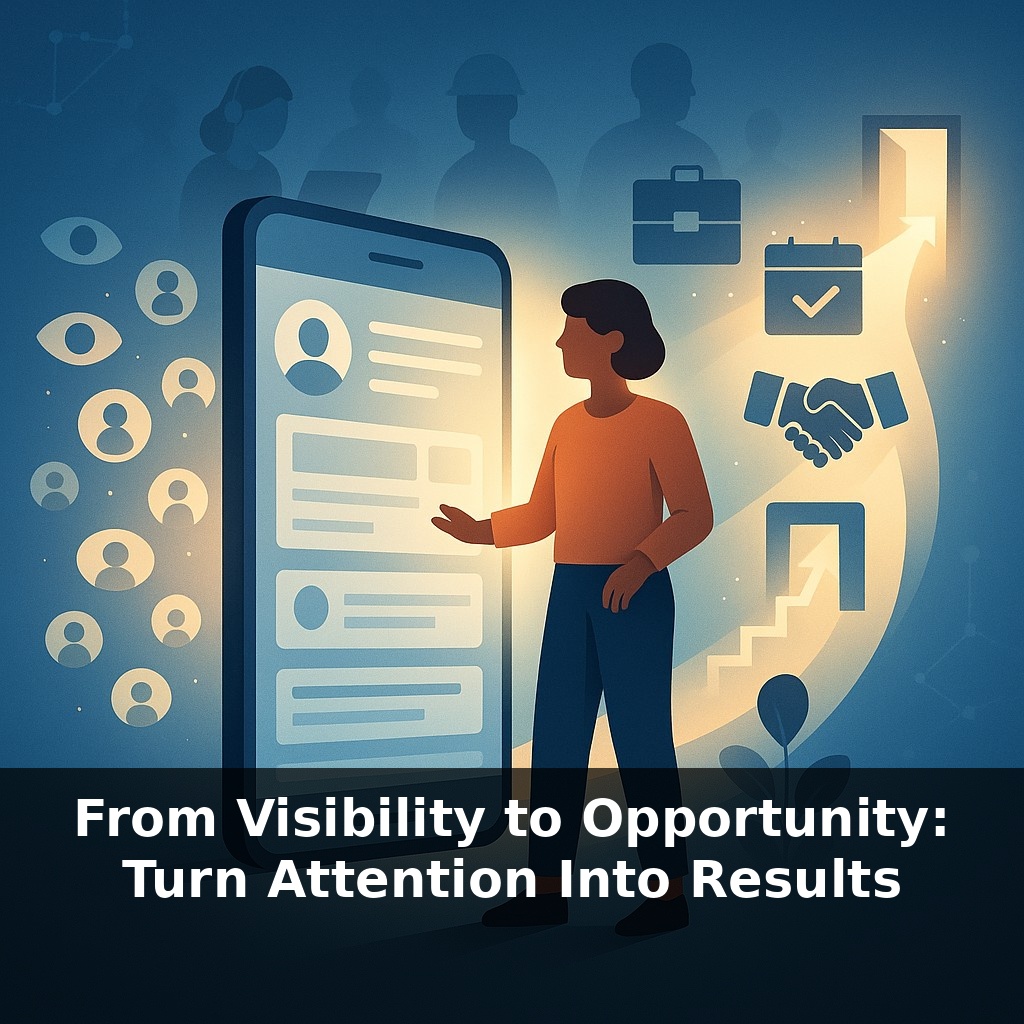
We’ll look at the “missing middle” between someone seeing your name and someone sending you a concrete opportunity. That middle is where most careers quietly stall—not because you’re not good enough, but because there’s no clear path for people to move from “interesting profile” to “I should reach out.”
Instead of chasing more views, we’ll focus on building a simple system: how people find you, how they experience you, and how you invite them to take the next step with you—on purpose.
Think of what we’re doing today as shifting from “posting and praying” to running a simple experiment in cause and effect. Instead of hoping that visibility magically produces results, we’re going to trace the path from a single post or comment all the way to a conversation that could change your trajectory. That path usually breaks at one of three points: people can’t immediately see what you’re about, your ideas never consistently reach the right circles, or there’s no obvious next move for someone who’s interested. Fixing even one of those breaks can dramatically change what your existing visibility is worth.
A lot of people try to “fix” LinkedIn by yanking just one lever harder: they post more, or they rewrite their headline, or they start mass-DM’ing strangers. The research is blunt: results show up when three levers move together, even if each one moves just a little.
Start with the profile—but treat it as a promise, not a postcard. A good photo and clear headline get you seen; a focused story makes that attention feel safe. The fastest trust-builders are specifics: a sharp “who I help / what I do / how I do it” line, a short About section that sounds like you actually talk, and 3–5 concrete proof points (metrics, projects, outcomes). Those details are what make a recruiter or potential client think, “I can picture this person solving my problem.”
Then, give people new reasons to bump into you. Frequent posting alone won’t do it if your content could belong to anyone in your field. Insight-driven content sounds like: “Here’s a pattern I keep seeing,” “Here’s a mistake that keeps costing teams money,” or “Here’s how I’d approach X differently in 2025.” When even a small circle comments thoughtfully, you trigger the algorithm to test your ideas with adjacent networks. That’s how your name travels into rooms you’re not in yet.
The last lever is where most professionals quietly opt out: creating intentional paths for people to respond. That can be as simple as ending a post with, “If you’re wrestling with this on your team, message me ‘playbook’ and I’ll share how I’ve handled it,” or, “We’re building something around this—comment ‘guide’ if you want the draft.” It can also look like checking who engaged with your last three posts and sending five tailored notes a week: “Saw your comment about X—curious how your team is handling Y.” You’re not pitching; you’re turning a tiny signal of attention into an actual conversation.
One way to see this system is like a weather pattern: your profile is the climate (the steady backdrop), your content creates the changing conditions people notice, and your outreach is the moment you actually decide to fly the plane. None of those in isolation guarantees a smooth journey—but together, they dramatically increase your odds of landing somewhere new.
A useful way to make this concrete is to zoom into three tiny “moments of truth.”
First, the profile: think of a product page on Amazon. When you land there, you’re scanning for three things in seconds—what it is, who it’s for, and whether people like you got results from it. Your LinkedIn profile works the same way: a strong headline is the product name, your About is the description, and your featured work plus recommendations are the reviews that lower the risk of reaching out.
Second, content: instead of broadcasting, treat each post like hosting a roundtable. You’re not lecturing; you’re putting one sharp question or observation on the table so the right people reveal themselves in the comments. Those names are your opt‑in list.
Third, conversion: when someone engages twice, that’s your signal. Reply publicly, then move one step closer: “This is such a common pattern—want to compare notes over a 15‑minute call?” Each step feels natural because it matches the level of interest they’ve already shown.
Attention online is starting to behave more like currency: as AI scrapes, summarizes, and routes your activity, even a small “balance” in the right niche can unlock outsized access. Think of your feed as a live lab notebook: each post is a data point teaching algorithms and humans what to send your way. The more consistently you publish specific, useful patterns, the more you train the system to recognize you as “the person for this,” even when you’re not actively searching.
You don’t have to overhaul everything at once. Think of this more like tuning an instrument between songs: small twists that make each note ring clearer. As you refine your profile, posts, and follow‑ups, watch for patterns in who responds, what they mention, and which doors crack open. That data is your map—adjust, test, and let it quietly reroute your career.
Before next week, ask yourself: - “Looking at the places I’m already getting attention (podcast guest spots, LinkedIn posts, newsletter mentions, etc.), where am I currently leaving people with nowhere clear to go next—and what’s one specific next step (a consult link, a ‘start here’ page, a mini-offer) I can plug in there today?” - “If someone discovered me for the first time through my most-viewed piece of content, what problem would they assume I help with—and does my current ‘pathway’ (bio links, website, pinned content) actually guide them toward that specific solution?” - “Which one relationship or opportunity I already have (an existing client, a collaborator, a host who’s had me on) could I deepen this week by making a concrete offer—for example, suggesting a co-created workshop, an upsell that solves their next problem, or an intro to something that moves them closer to their goals?”