The 3 Numbers That Matter: Revenue, Profit, and Cash Flow
📝 Transcript
Your business can hit record sales and still be days from running out of money. One founder sold out a launch, watched the orders roll in, and then couldn’t make payroll. How does that even happen—and how close are you to the same problem without realizing it?
That kind of “sold out but broke” moment usually comes from staring at one number in isolation. Most founders obsess over top-line sales, some track profit, and a few live inside their banking app—but it’s the relationship between revenue, profit, and cash flow that actually tells you whether your business is healthy or quietly bleeding out.
Think of how a doctor looks at blood pressure, heart rate, and oxygen levels together. One great reading can’t offset a red-flag in the others; it’s the pattern that matters. Business finance is the same: three core numbers, one overall diagnosis.
In this episode, we’ll zoom out from single metrics and learn to read the *pattern*. You’ll see why high revenue can hide waste, how profit can mislead you for months, and why strong cash can mask a flatlining business. By the end, you’ll be able to glance at these three numbers and instantly know whether you’re safe, at risk, or on borrowed time.
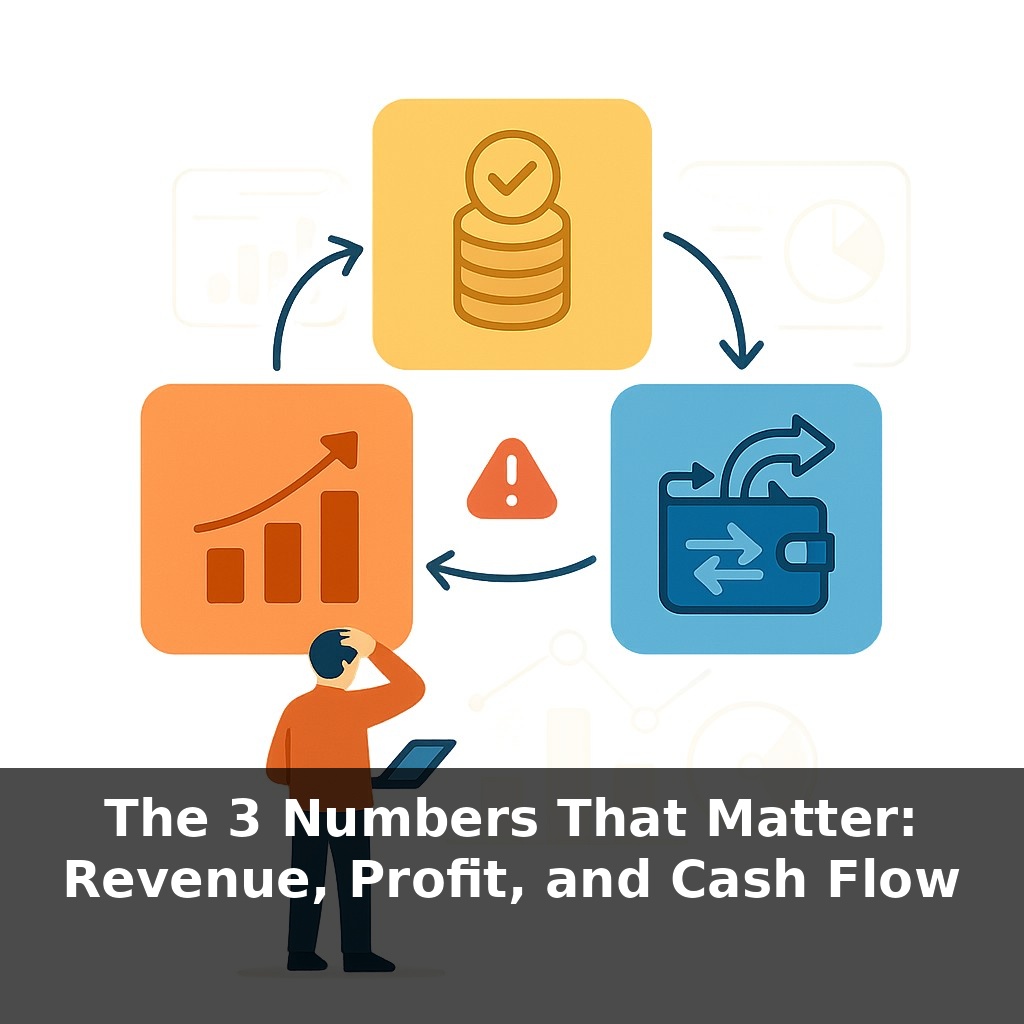
Here’s the shift most owners miss: each of your three numbers answers a different question. Revenue asks, “Is the market paying attention?” Profit asks, “Are we turning that attention into something worth keeping?” Cash flow asks, “Can we actually survive the timing of all this?” When those answers don’t line up, you get that uneasy sense that things are “going well” on paper but feel tight in real life—like a band playing three good songs in three different keys. Nothing is technically wrong, but you can hear that something is off. Our goal is to train your ear for that dissonance.
Start with the number that seduces everyone: revenue. It’s loud, it grows fast, and it’s easy to celebrate. In 2006, Jeff Bezos highlighted that Amazon’s recommendation engine drove a 35% lift in sales. That single tweak to how products were suggested added billions to the top line over time. But here’s the part most people miss: even with all that volume, Amazon ran on razor-thin margins for years. The surface number looked thrilling; the underlying engine was tuned for something else entirely.
This is where the quiet numbers start to matter. Profit tells you whether your engine design makes sense, but the real test of survival happens in the bank account. In 2022, Amazon generated about US$59B in operating cash flow—despite those thin margins—because its model pulls cash in from customers faster than it has to pay suppliers. The story isn’t “high sales”; it’s “beautiful timing.”
That timing is why regulators care so much about reconciling reported earnings to actual cash movement. FASB forces public companies to walk you from net income down to operating cash flow, line by line. Hidden in that bridge are huge non-cash items: across the S&P 500 in 2023, there was roughly US$787B of depreciation and amortization alone. On the income statement, those charges quietly reduce profit. On the cash-flow statement, they’re added back because no money left the bank for them this year.
Now zoom out to the macro level. By the end of 2023, U.S. public companies were collectively sitting on about US$2.1 trillion in cash and equivalents. That mountain doesn’t exist because everyone suddenly became wildly profitable in the same year. It exists because over time they protected the gap between what they earned, what they spent, and when the money actually moved.
Here’s your challenge this week: grab your latest income statement *and* cash-flow statement. Identify the single largest non-cash expense (like depreciation) and the single largest real cash outflow (like loan payments or equipment purchases). Track how each changes over the last four quarters. By the end of the week, you’ll see whether your reported results and your money reality are drifting apart—and where to look first if they are.
Think about a tiny design studio with three recurring projects. Client A pays a big retainer once a quarter, Client B pays small invoices every week, and Client C is a prestigious brand that pays 90 days late but looks great in your portfolio. On your reports, Client C might look like the star: impressive rates, glossy logos, big annual total. But when rent hits next week, it’s Client B’s steady trickle that quietly keeps the lights on, and Client A’s chunky payment that lets you finally upgrade equipment.
Or take a SaaS startup running a limited-time annual plan discount. For a month, cash pours in from those upfront payments. Six months later, new signups slow—yet expenses keep climbing. The earlier surge now has a shadow: revenue is “already counted,” while the bills you fueled with it are very current and very real. Those moments—who really funds today, who creates tomorrow’s crunch—are where your three numbers stop being abstract and start telling you who, and what, your business truly runs on.
As AI reshapes industries, those three numbers get stress‑tested in new ways. Data centers, for example, eat huge upfront spend long before the payoff—like planting an orchard instead of buying fruit at the market. The real edge goes to leaders who can see beyond this quarter’s spike or dip and model how today’s pricing, hiring, and automation choices echo three to five years out. Expect investors, banks, and even regulators to push harder on that longer narrative, not just the next headline.
Treat these three numbers like coordinates on a map: alone they hint, together they locate where you really stand. Over time you’ll spot “weather patterns”—seasonal dips, launch spikes, hiring storms. Instead of reacting to every cloud, you’re planning like a pilot: fuel checked, route chosen, alternates ready when conditions shift faster than your forecasts.
Try this experiment: For the next 7 days, open your bank account and bookkeeping tool at the same time and track just three numbers at the end of each day: total sales for the day (revenue), what’s left after direct costs (profit), and actual cash in the bank (cash flow). Then, choose one lever to pull for 3 days—either raise one price by 5–10%, cut one recurring expense, or speed up one invoice by offering a small early-pay discount—and watch how all three numbers shift. At the end of the week, compare which lever changed profit the most versus which actually improved cash in the bank, and decide which lever you’ll keep using next week.
From this course

Business Numbers Made Simple
7 episodesUnlock all episodes
Full access to 7 episodes and everything on OwlUp.
Subscribe — $1.99/monthLess than a coffee ☕ · Cancel anytime