The Birth of Capitalism: Tales from the Industrial Revolution
📝 Transcript
Factories once turned quiet villages into cities almost overnight—Manchester ballooned from a small town to hundreds of thousands of people in a few generations. In this episode, we step inside those roaring mills to ask: how did spinning thread spin up capitalism itself?
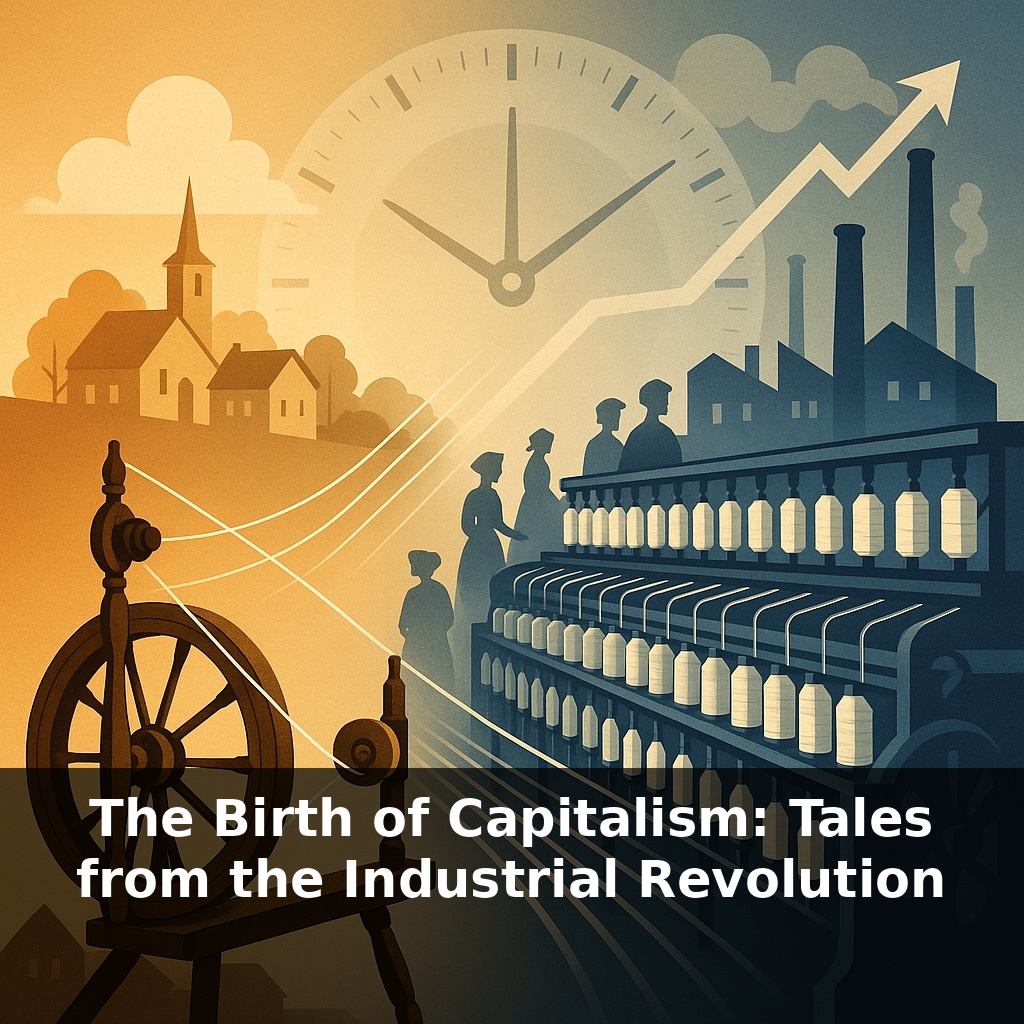
The shock wasn’t just how much more stuff factories could produce—it was how they rewired daily life. A weaver who once set their own hours now followed the rhythm of a steam engine’s pistons; the village bell gave way to the factory whistle. Time itself became sliced into shifts, breaks, and quotas, turning days into a kind of economic grid. In this new landscape, people weren’t simply making goods; they were selling their hours, their stamina, their precision.
Steam, iron, and coal didn’t just power machines; they powered new kinds of relationships. Investors who never touched a spindle suddenly had enormous influence over those who did, as ownership separated from labor. Laws shifted too: rules about property, contracts, and even child workdays were rewritten to fit the needs of this humming industrial organism. In the space of a few decades, the ordinary rhythms of work and home were bent around the factory’s clockwork heart.
While the factory whistle set the tempo inside, a different transformation unfolded outside its walls. Cities swelled as canals, turnpikes, and finally railways stitched once-distant markets into a single restless web. A bolt of cotton cloth woven in Lancashire could soon be worn in Calcutta; coal dug in Newcastle might fuel engines a county—or a continent—away. Money, too, began to move differently: banks, joint‑stock companies, and insurers emerged to juggle risk at scales no village lender could imagine. Daily choices—where to live, what to buy, how to work—were slowly pulled into this widening industrial orbit.
Walk through an early cotton mill and the first thing that hits you is not what’s made, but how bodies are arranged. Tasks once done start‑to‑finish by a single craftsperson were sliced into narrow motions—drawing, spinning, piecing threads, tending frames. No one had to know the whole process to keep the line moving. Skill didn’t disappear, but it was repackaged: a few engineers and overseers designed and maintained the system; rows of workers executed its logic hour after hour.
This reordering demanded something new: steady cash to buy machines, buildings, and raw cotton long before any cloth could be sold. Merchants who had once advanced modest sums to scattered weavers now had to sink fortunes into fixed sites. That pressure helped create a new figure in history—the industrial capitalist—whose success hinged on turning large, lumpy investments into constant throughput. Idle machinery wasn’t just quiet; it was financial blood loss.
Credit and risk‑sharing instruments proliferated to feed this hunger. Banks extended larger, longer loans; insurers wrote policies against fire, shipwreck, and even political turmoil; joint‑stock firms let dozens or hundreds of small investors pool resources into a single mill or mine. Profit became less a lucky margin on a voyage and more a disciplined calculation over years: depreciation schedules, cost per unit, interest rates, and wage bills all entered the arithmetic.
On the shop floor, that arithmetic translated into intense scrutiny of time and motion. Output per worker could now be counted in identical pieces per day, per machine, per spindle. Differences in posture, speed, or coordination showed up directly in ledgers. Some owners experimented with bonuses; others tightened supervision, stretching workdays or cramming more bodies alongside the frames.
Outside, these choices ricocheted through households. A family that once blended farming, spinning, and seasonal side jobs now faced a starker mix: factory wages, or nothing. When cotton prices slumped or a new machine made certain roles redundant, entire neighborhoods felt the shock. Crowded lodging houses, pawnshops, and poor relief offices became barometers of distant decisions made in counting rooms or board meetings.
Your challenge this week: trace one ordinary object you use—say a T‑shirt or a ceramic mug—back through at least three steps of its making. Identify where large up‑front investments likely sit (a kiln, a loom, a shipping fleet) and where repetitive human labor still threads through the process. Notice how much of your daily life rests on that early industrial logic of heavy capital on one side, standardized tasks on the other.
Think of an old-growth forest: towering trunks reach for light while a shaded underlayer of saplings and shrubs fights for space. Early industrial towns formed their own economic canopy and undergrowth. At the top stood iron‑masters, mill‑owners, coal‑mine leaseholders—often backed by banks in London, Liverpool, or Glasgow—locking in long leases, patent rights, and shipping contracts. Beneath them, a dense layer of small workshop‑keepers, repairers, and tool‑makers clustered near the mills, mending frames, sharpening saws, and improvising fixes when imported machinery broke. Below that, hawkers sold food at factory gates, lodging‑house keepers rented damp corners by the week, and dressmakers turned coarse cloth into wearable status. Even early unions and friendly societies fit this forest image: tangled roots linking hundreds of workers so one accident or wage cut didn’t fell a household overnight, but spread the strain across a wider, hidden network of mutual aid.
Industrial capitalism didn’t just change how people worked; it rewired how they **imagined the future**. Long projects, from laying telegraph cables to funding global shipping lines, trained investors and states to think in decades, not seasons. That habit seeps into today’s climate debates and AI rollouts: whose capital sets the timeline, whose risks get socialized, and whose voices shape the long bet? The next “revolution” may hinge less on new machines than on who gets to plan that future at all.
Conclusion The story doesn’t end with steam and soot. The same logic that once filled mills now shapes app updates, global staffing, and warehouse robots. Like a river that’s been dammed and redirected, flows of effort and reward keep being channeled into new courses. The live question for us is less “How did this start?” than “Who gets to redraw the riverbed next?”
To go deeper, here are 3 next steps: Pick up Robert C. Allen’s *The Industrial Revolution: A Very Short Introduction* and read the chapter on textile mills, then pause to search online for diagrams of Arkwright’s water frame so you can literally see the tech that kicked off factory capitalism. Watch the BBC documentary episode “Andrew Carnegie & the Age of Steel” (from their industrial revolution series) and jot down every way you see wages, hours, and working conditions shift as capital concentrates. Finally, open Our World in Data’s “Economic Growth” and “Energy Use” charts, set the time range to 1700–1900, and compare the curves while you listen to the episode again—notice exactly where coal, steam, and GDP all start to bend upward together.
Unlock all episodes
Full access to 5 episodes and everything on OwlUp.
Subscribe — $1.99/monthLess than a coffee ☕ · Cancel anytime