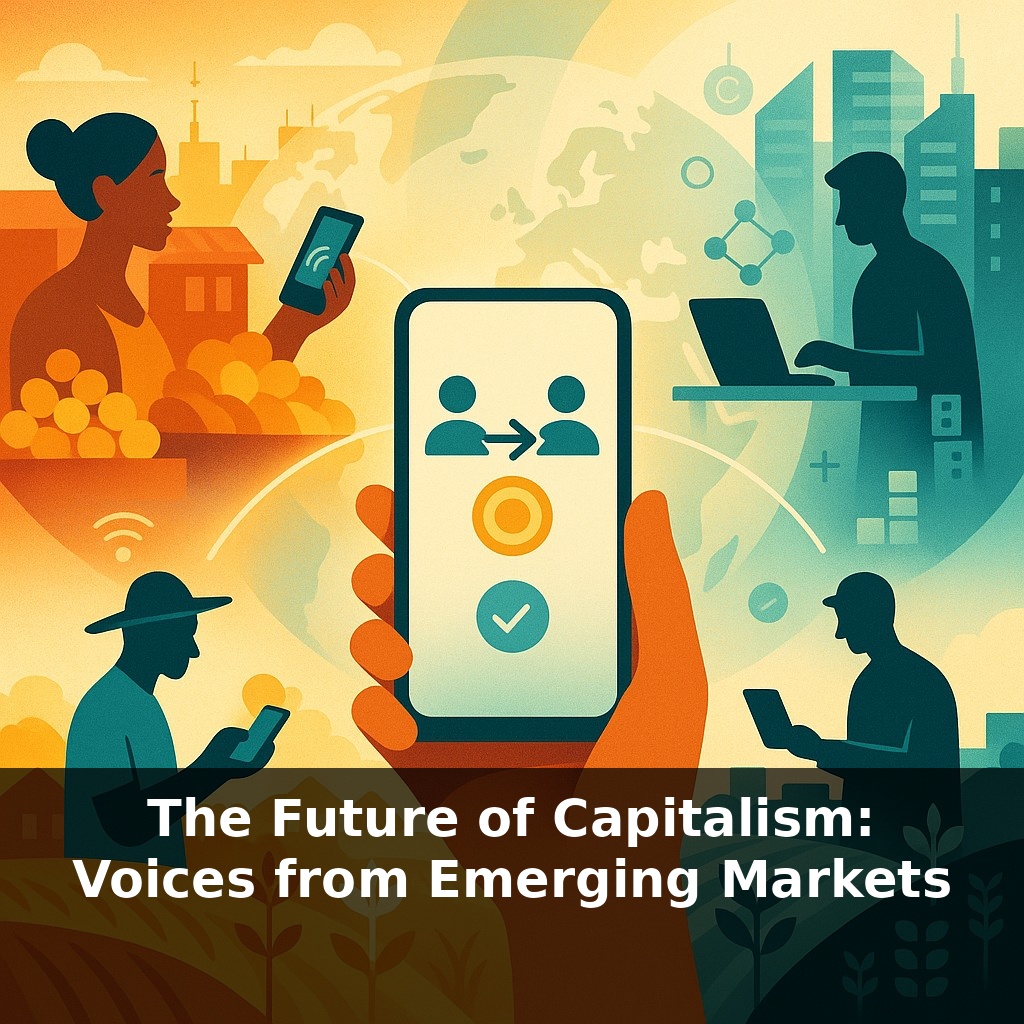
Last year, countries once labeled “developing” created most of the world’s new economic growth. A street vendor in Nairobi, a farmer in rural India, a cosmetics founder in Brazil—each is quietly rewriting the rules of capitalism, starting far from Wall Street.
In a settlement on Nairobi’s outskirts, a fruit seller takes payments through her phone, splits the day’s earnings with a cousin miles away, and repays a tiny loan—without ever touching a bank branch. In São Paulo, a startup prices loans lower for companies that restore degraded land. In a small Indian town, a parent pays school fees instantly using a free public digital rail that even roadside stalls accept.
These aren’t side stories to the “real” economy; they’re frontline experiments in a different way of doing business. Profit still matters, but so do reach, resilience, and repair: reaching people formal finance ignored, keeping systems running through shocks, and repairing social and ecological damage others treated as “external.” Together, these experiments hint that the next big upgrade to global markets may be coming from places long treated as peripheral.
In boardrooms from Lagos to Jakarta, founders now pitch investors with a twist: yes, they promise returns—but also cheaper remittances, cleaner air, or wider internet access as part of the core business model, not a CSR slide at the end. Governments are experimenting too, swapping old subsidies and tax breaks for policies that reward companies which include low-income customers or regenerate ecosystems. Think of it as updating the “rules of the game” so that solving hard social problems isn’t charity or regulation-driven—it’s how you win.
In this emerging remix, three threads keep appearing.
First, the infrastructure is often public, even when the services are private. India’s digital rails, for instance, are built like a city’s open metro system: the government lays the tracks, private “trains” compete to offer better rides. That design flips a common script. Instead of a few giant platforms owning the pipes and charging tolls, the basic rails are treated more like a shared utility. Startups then layer on credit, insurance, and savings tools without having to build everything from scratch—or lock users into a single gatekeeper.
Second, inclusion stops being an afterthought and becomes a source of advantage. Kenyan mobile money agents didn’t wait for glass branches to appear; they turned corner kiosks and tiny shops into financial access points. The result is a dense mesh of human infrastructure. Companies learn from millions of small, messy interactions in markets where power cuts, floods, or political unrest are not rare events but basic design constraints. Products that survive there tend to be rugged, cheap to run, and less dependent on fragile assumptions about stable jobs or perfect connectivity.
Third, nature and social risk show up directly on the balance sheet. In Brazil, banks are testing loan models that charge more if farmers clear native vegetation, less if they restore it. Investors buying sustainable bonds from Jakarta or Johannesburg aren’t just chasing virtue; they are betting that firms managing water stress, heat, and community conflict today will be less likely to blow up tomorrow. In places where droughts, floods, and protests already cut into profits, “ESG” is less branding exercise, more survival strategy.
None of this is a tidy blueprint. Some experiments will fail; some will be captured by old elites in new clothes. But taken together, they point to a quiet inversion: instead of importing ready‑made market templates, emerging economies are exporting practical hacks for wiring profit to wider access and ecological limits. The question is not whether these hybrids are “pure” capitalism, but whether they work—and which parts the rest of the world will choose to copy.
In Bangladesh, garment factories once known only for low‑cost exports are experimenting with “living wage lines,” where efficiency gains and digital tracking tools are shared with workers as higher pay. In Vietnam, rooftop solar cooperatives knit together thousands of small panels, selling surplus power back to the grid through long‑term community contracts. In Nigeria, agri‑fintech platforms turn harvest data into collateral, letting smallholders pre‑sell a portion of their crops to urban restaurants.
Think of these as a new kind of travel itinerary for capital: instead of flying in, extracting quick returns, and leaving, money is asked to stay longer, learn the language, and invest in the neighborhood. Chilean pension funds are allocating slices of their portfolios to startups that restore fisheries; Indonesian city governments are tying procurement to inclusive hiring. These aren’t charity detours—they’re test routes showing how returns, local trust, and long‑term stability might move together.
Boardrooms in London or New York may soon benchmark against standards born in São Paulo or Bangalore, much as chefs borrow spices from distant kitchens. Legal teams could parse Nairobi‑designed clauses on data sharing or forest risk. Pension funds might treat exposure to exclusion or heat stress like a hidden debt, discounting firms that ignore it. Your own savings, without you noticing, could be routed through funds that must report not just quarterly earnings, but how they handle land, labour, and code.
As these experiments spread, expectations may shift quietly, like a city adjusting to a new transit line. Consumers start asking where their money “sleeps” at night. Entrepreneurs design for village clinics as readily as luxury malls. Regulators test rules that reward long‑term repair. We’re not just spectators here; our daily choices help decide which hybrids take root.
To go deeper, here are 3 next steps: (1) Explore how capital is flowing into emerging markets by spending 15 minutes on the IFC’s “Emerging Markets Compass” brief and the most recent World Bank “Global Economic Prospects” report, focusing on the chapters covering your region of interest. (2) Pick one featured country or sector from the episode (for example, fintech in Nigeria or green infrastructure in India) and read the latest case study or deal overview on it from the IFC or CDC/BII website, noting which parts of the capital stack (concessional, impact, commercial) were actually used. (3) If you want to act as an investor, open a free account on a platform like Kiva or Trine and, before the end of today, direct a small amount of capital to a project in an emerging market that aligns with the “future of capitalism” themes from the episode—such as climate resilience, digital inclusion, or SME financing.