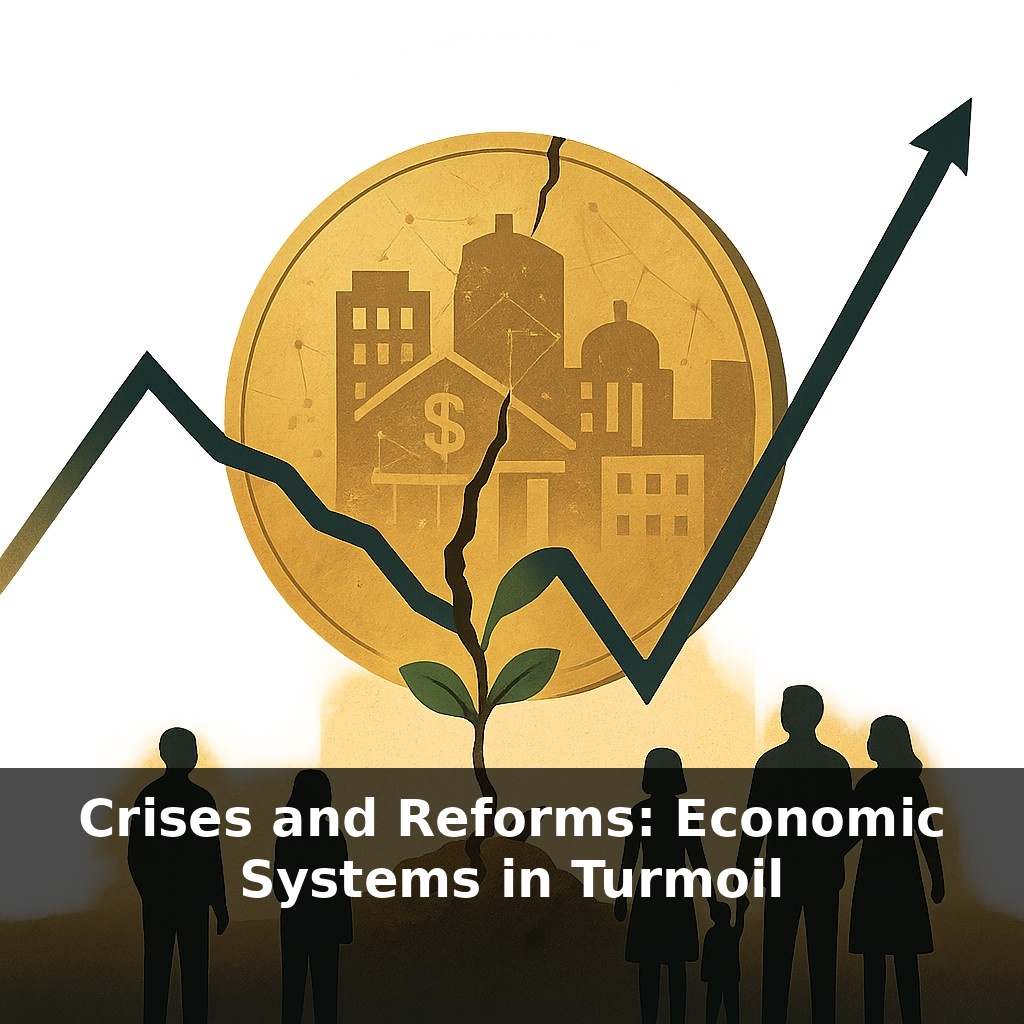
Banks once closed overnight, and by the end of the week, families had lost not just savings, but jobs, homes, and the sense that tomorrow was knowable. Yet out of those breakdowns came new rules that quietly shape every paycheck you earn and every price you see today.
By the time crises show up as headlines, the decisions that will define the next decade are already being negotiated in back rooms and midnight conference calls. Politicians, central bankers, CEOs, and sometimes street protesters are all pulling on the same tangled rope: who absorbs the losses, and who gets a safety net woven beneath them. Out of that struggle come reforms that sound technical—“capital requirements,” “swap lines,” “automatic stabilizers”—but quietly redirect who can fail, who must be rescued, and who is left to start over.
These turning points don’t just tweak interest rates; they redraw the social contract. A crisis can justify bailing out banks while cutting public services—or expanding unemployment insurance while tightening financial rules. In this episode, we’ll trace how breakdowns became blueprints, and how each fix both patched one hole and opened another.
In the 1930s, the crash wasn’t just about markets—it was breadlines, mass unemployment, and political parties openly flirting with fascism or revolution. By the late 1990s, the Asian crisis looked different: currencies collapsed in days, foreign investors bolted, and IMF rescue packages arrived with thick instruction manuals attached. In 2008, the fault lines ran through mortgage contracts, opaque derivatives, and “too big to fail” institutions. Each time, the tools changed, but the core question stayed: how much chaos will societies tolerate before they trade some market freedom for tighter guardrails?
A third of U.S. economic output vanished between 1929 and 1933, but what followed was not just emergency relief—it was architectural work on capitalism itself. The U.S. separated commercial and investment banking, guaranteed small deposits, and empowered central bankers to act earlier and more aggressively. Similar dramas unfolded elsewhere: Scandinavian banking failures in the early 1990s led to temporary bank nationalizations; Mexico’s 1994–95 “Tequila Crisis” pushed the U.S. and IMF to devise rapid-response loan facilities; the Asian turmoil of 1997–98 seeded debates on capital controls and “self‑insurance” through giant foreign‑exchange reserves.
One pattern stands out: reforms rarely aim to make finance “safe” in some absolute sense. Instead, they decide *where* danger is allowed to live. After the Great Depression, risk was nudged away from small savers toward governments and central banks. After 2008, higher loss‑absorbing buffers at big banks made them sturdier, but complex risks migrated to hedge funds, money‑market funds, and private‑credit funds that face lighter oversight.
You can see this as a kind of urban planning for risk. When one neighborhood burns down, authorities change building codes there—but sometimes the flammable material just ends up stacked in a different district with fewer inspectors. Shadow‑bank runs in 2020, when COVID‑19 froze funding markets, were an example: the official banking sector held up, but the “unregulated district” needed massive central‑bank support.
Each crisis also rewrites how countries coordinate—or collide—with each other. The Asian crisis sparked resentment against externally imposed austerity and helped drive the creation of regional safety nets like the Chiang Mai Initiative. The 2008 shock, in contrast, saw central banks in rich economies quietly extend support to one another, even as public debates focused on domestic bailouts and foreclosures.
Underlying all of this is a recurring gamble. Reformers hope they can design rules that calm markets without smothering innovation, protect citizens without destroying incentives to be prudent, and share risk across borders without surrendering democratic control. Whether they succeed tends to be revealed only when the next downturn tests the new wiring.
When Iceland’s banks exploded in 2008, the country chose a path very different from the U.S.: it let its oversized banks go under, imposed capital controls, and even jailed some executives. The immediate pain was brutal—its currency collapsed, imports became expensive—but the political message was stark: in this version of capitalism, some failures would be allowed to stick. Contrast that with Germany after 2008, which quietly funneled support to key institutions while insisting on strict budget rules at home and in Europe. Same storm, different blueprints.
Think of how artists respond to a canvas that’s gone wrong. Some scrape everything off and start again; others paint over the mistake, letting old layers shape the final image in ways a casual viewer never sees. Economic reforms after crises work similarly: some countries rewrite bankruptcy laws, others redesign welfare states, others build vast foreign‑exchange reserves that silently shape every trade deal and investment decision that follows.
A future crisis may not start in banks at all. A stablecoin failure, a hacked exchange, or a sudden plunge in carbon‑heavy assets could ripple faster than old tools can respond. Experiments like CBDCs and macro‑prudential brakes are early drafts, not finished systems. Your challenge this week: when you see a new financial app, green bond, or crypto token, ask yourself not just “What’s the upside?” but “If this blows up, who quietly pays the bill?”
Crises don’t just break systems; they reveal which promises a society refuses to abandon. Each reform is a kind of edit to that promise, like adding a new layer of lacquer to a table that’s already full of scratches. Over time, the shine can hide deep cracks—unless we keep asking, with every boom and bust: whose risks are we quietly agreeing to share?
Try this experiment: For the next seven days, treat your personal finances like a mini-economy going through a crisis-and-reform cycle. On day 1, impose a “shock” by banning one non-essential spending category you usually rely on (e.g., food delivery or rideshares), then track how your “system” adapts—where does the money and your time actually shift? Midweek, introduce a “reform” by redirecting the saved amount into a specific, real asset (e.g., an inflation-protected bond ETF or paying down a high-interest debt) and note how that changes your sense of stability. At the end of the week, compare your stress level, spending pattern, and savings to last week’s baseline and decide whether to keep, adjust, or roll back your new “policy.”