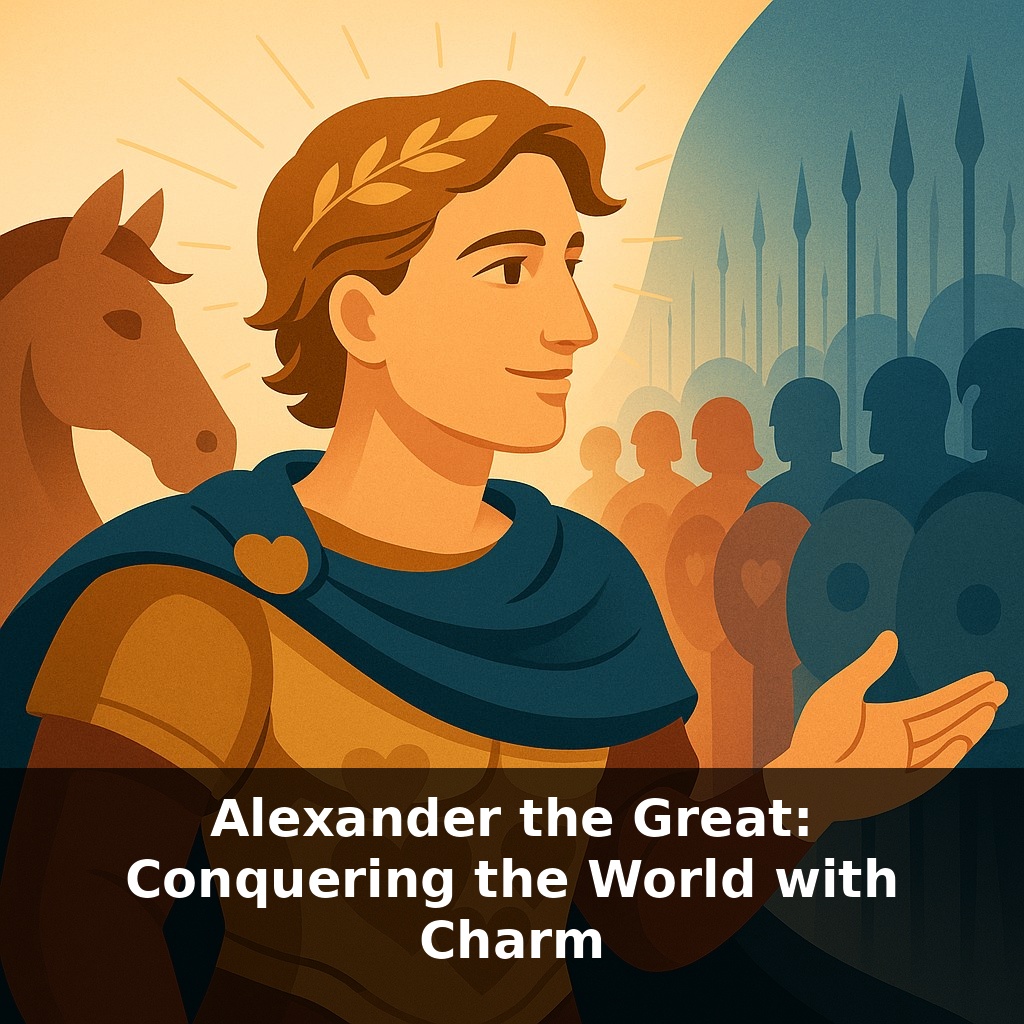
Alexander the Great: Conquering the World with Charm
📝 Transcript
A young king rides into battle against an empire several times larger than his own—and wins, again and again. Not just with sharper spears, but with sharper charm. This episode asks: how far can charisma really take you when the stakes are life, death, and an entire world?
Alexander doesn’t start by dazzling a crowd; he starts by rewiring how people relate to him and to each other. In a world used to distant, untouchable monarchs, he fights in the front line, bleeds where his men bleed, and then spends the night walking through the camp, listening to gripes and joking like an older brother who also happens to command the payroll, the strategy, and the glory. Officers from rival factions, Greek intellectuals, and rough Macedonian veterans all end up orbiting the same magnetic center: a leader who makes them feel both chosen and challenged. That mix is crucial. Too much “chosen” and you get entitled followers; too much “challenged” and they burn out or rebel. The real lesson isn’t that Alexander was special—it’s that he consistently engineered situations where loyalty felt like the most exciting option in the room.
Alexander also designs his world so that his charm has somewhere to land. He reorganizes his forces like a flexible project team: different units with different strengths, constantly recombined for the next campaign. He mixes veterans with newcomers, locals with outsiders, so no one social circle can fully detach from him. He rewards in public and corrects in private, turning ceremonies into glue that holds rivals in the same room. In modern terms, he’s not just “being charismatic”; he’s architecting the culture—rituals, symbols, and shared stories—that makes people interpret his every word as a meaningful signal about their future.
Alexander’s edge isn’t only that people like him; it’s that he keeps turning that like into momentum. Watch what he does after a victory. Most kings would celebrate, punish enemies, and move on. Alexander stages a kind of rolling roadshow of inclusion. He keeps former opponents close, not just under guard but under contract.
At Gaugamela, many of the Persian elite who should have hated him end up serving him. He doesn’t insist they become Macedonian; he gives them commands, lets them keep some status, and then quietly ties their success to his. Their local knowledge suddenly has a new “API”: route it through Alexander, and it pays off. Refuse, and you’re locked out of the new operating system of power.
He does the same with ideas. After entering Egypt, he doesn’t erase the local religion; he visits the oracle of Ammon and allows the rumor that he’s a kind of divine son to circulate. Greek followers hear one thing, Egyptians hear another, but both interpretations point upward to the same person. He’s layering meanings so different groups can plug their hopes into the same figure without feeling like they’ve betrayed their own background.
The cities he founds—especially Alexandria in Egypt—are physical versions of this strategy. They’re not just military outposts; they’re hubs where traders, scholars, and officials from across the empire collide. Greek becomes the common tongue not because he issues a memo, but because it’s the most efficient way to get things done in those hubs. If you wanted opportunity, you learned the language that unlocked the widest network.
His coinage works similarly. Putting his image on money is more than ego; it’s a constant, portable reminder of who guarantees value and order. Every transaction whispers: this deal happens in Alexander’s world. It’s an early form of personal branding that travels farther than his voice ever could.
This scaling matters, because no charm can cover five million square kilometers by direct contact alone. Alexander keeps asking a brutal, practical question: “How can people who never meet me still feel like they’re part of my story?” His answer—shared language, shared symbols, shared incentives—is what turns brief conquests into a culture that outlives him.
Alexander’s approach looks less mysterious when you compare it to how a modern tech company rolls out a product across continents. Think of how a platform like Android spread: not by owning every phone factory, but by making it attractive for wildly different manufacturers and developers to plug into the same system. Alexander does something similar with people instead of code.
He doesn’t ask every region to become a copy of Macedon. In Central Asia, he marries Roxana, a local princess, and encourages his officers to marry locally too. That’s not just romance; it’s account‑sharing between power bases. Children, in‑laws, and land all sit at the intersection of old elites and new rulers. Walking away from Alexander would mean walking away from family and property.
In some cities, he lets local laws and councils continue, then quietly inserts his own officials alongside them. Over time, decisions require cross‑signoff. The old system isn’t smashed; it’s wrapped, like legacy software inside a new interface. People keep familiar forms, but the real “save” button now routes upward to him.
Alexander’s experiment hints at a bigger question: what happens when “us vs. them” permanently blurs? His world didn’t just swap one flag for another; it prototyped mixed identities—people who were comfortably both Greek and local. Today’s cross‑border teams face a similar tension: how much do you blend, how much do you protect? New tools—from AI simulations of his campaigns to DNA work on his dynasty—may soon test whether his model scales better than our modern ones.
Alexander’s real legacy may be a question, not an empire: how do you build something that survives when you’re no longer in the room? His answer wasn’t perfection; it was momentum. Treat your life like a map of small “Alexandrias”—conversations, habits, shared projects—each a port where people dock, trade value, and leave slightly changed.
Start with this tiny habit: When you open a new email or chat at work, quickly ask yourself, “What would Alexander do to win this person over?” and then add one charming detail—like using their name, acknowledging a recent win of theirs, or referencing something they care about (just one line). Over time, you’re training yourself, like Alexander with his officers, to see every interaction as a chance to build loyalty, not just exchange information.
From this course
Charisma Chronicles: Great Leaders Unveiled
5 episodesUnlock all episodes
Full access to 5 episodes and everything on OwlUp.
Subscribe — $1.99/monthLess than a coffee ☕ · Cancel anytime