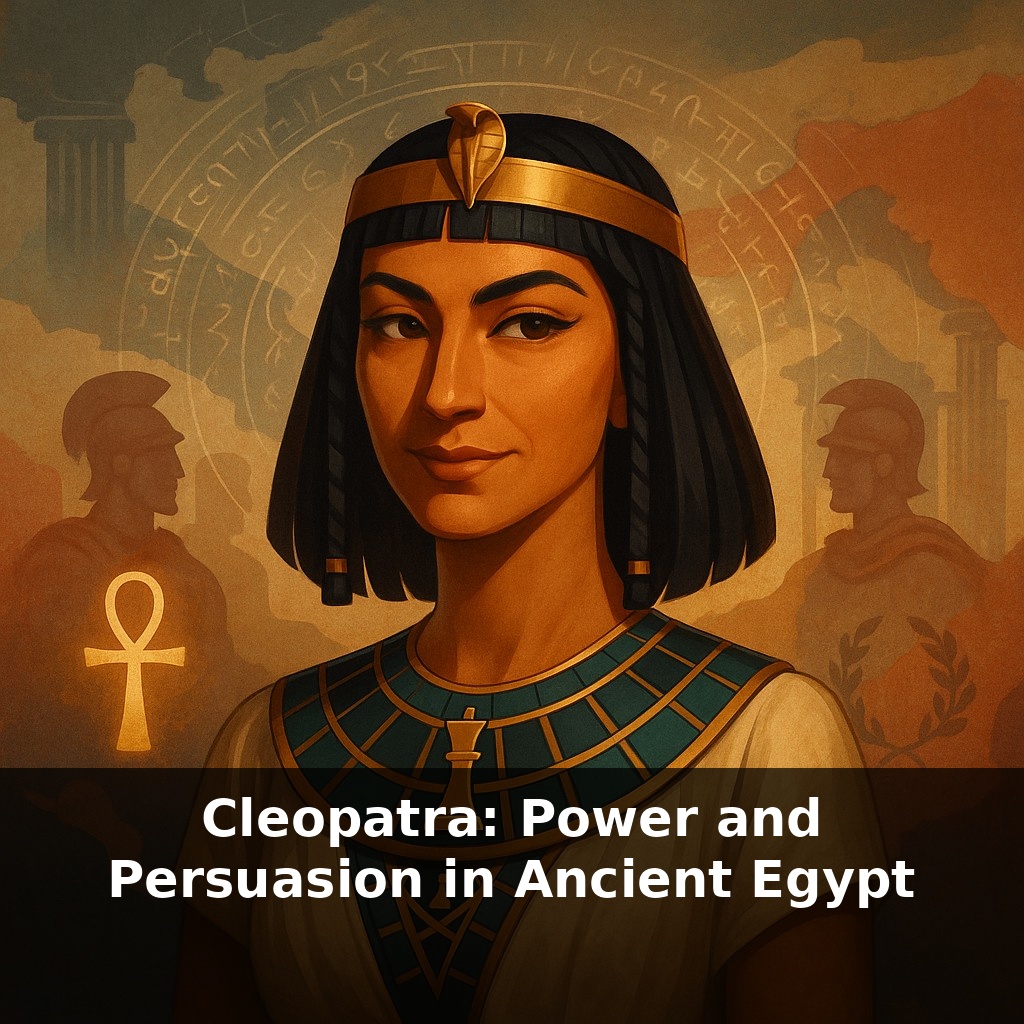
A queen walks into a room of Roman generals—and they stop talking. Not because of her beauty, but because she speaks to each of them in their own language. Tonight, we’re not chasing Cleopatra the seductress; we’re hunting Cleopatra the strategist behind the legend.
Cleopatra didn’t inherit a stable throne; she inherited a knife fight in a palace. Civil war, famine, a restless priesthood, and a Roman superpower parked just across the Mediterranean—she steps into power with all of that already in motion. What makes her fascinating for anyone studying charisma and relationships is how she turns volatility into leverage. Instead of projecting one fixed image, she runs a portfolio of selves: philosopher–queen in intellectual circles, living goddess in temple ritual, hard-nosed negotiator in Roman war camps. Think of it less as “being fake” and more as running different apps on the same operating system—each interface tailored to the user, but all drawing on the same core processor of ambition, training, and control. In this episode, we’ll look at how that flexible identity let her steer alliances, command loyalty, and hold a fragile kingdom together for twenty years.
Her edge wasn’t just performance; it was paperwork. Cleopatra understood that power in the Mediterranean ran on scrolls, seals, and shipments. Surviving documents show her handwriting squeezed into the margins of tax petitions—sharp, decisive notes that overruled officials and bound distant elites to her word. In temples, she appeared not only as a goddess, but as guarantor of ritual funding, which meant priests had a direct stake in her survival. In Roman terms, she controlled the “backend”: grain quotas, port fees, naval provisioning. When she charmed, she was spending influence she’d already banked in ledgers and warehouses.
Power for Cleopatra wasn’t an abstract aura; it was choreographed contact. Start with the basics: who was allowed in the room, and when. Roman sources hint that audiences with her were rare and highly staged. You didn’t just “drop by” the palace; you were filtered through layers of ritual, timing, and rumor. By the time someone actually saw her, they’d already been primed: stories about her learning, her generosity, her temper. Their expectations walked in ahead of them—and she could choose to confirm or disrupt those expectations on command.
Modern historians point out that she leaned hard into religious theater. On Nile processions, she appeared as Isis made flesh—heavy gold, deliberate slowness, controlled distance. In private negotiations, though, reports describe her as quick, funny, even cutting. Same person, radically different distance. Public Cleopatra was almost untouchable; private Cleopatra got close enough to make powerful men feel singled out, then responsible for her fate.
Her relationship with Julius Caesar shows how she weaponised timing. She didn’t rush into alliance the moment he arrived in Alexandria. She waited until he was entangled in local conflict, then appeared not as a supplicant but as the solution: a co-ruler who could stabilise Egypt and keep grain exports flowing. With Mark Antony, she reversed the script. At Tarsus, she arrived with overwhelming spectacle—perfumed sails, purple-draped barge, a floating stage of musicians and attendants. But once the scene hooked him, she shifted into financier and war partner: funding his campaigns, negotiating cities and territories like items in a contract.
Notice what’s happening in both cases: she doesn’t start with “Here’s what I need.” She starts with “Here’s who I can be for you—politically, financially, symbolically.” Only when that identity lands does she press for concessions: territories returned, tax exemptions, recognition of her children. It’s not manipulation in the cartoon sense; it’s sequencing. She understood that people say yes more easily when they first say, “This person is valuable to me.”
There’s a parallel to a top architect presenting designs: you don’t open with cost; you open with the vision of how the building transforms a skyline. Once the client emotionally owns that future, the negotiation over materials and timelines becomes secondary. Cleopatra’s genius was applying that same order of operations to people, empires, and even gods.
Cleopatra’s real edge shows up when you look at how she matched her “version” of herself to the stakes of the moment. With minor eastern client-kings, she used generosity as a leash: gifts of ships, grain rights, or marriage ties that made it more expensive to betray her than to stay loyal. With Alexandrian elites, she appeared in law courts and public ceremonies, not just as a monarch but as a working arbiter—someone who could cut through local rivalries and make decisions stick. In crises, she shifted again. When Nile floods failed and hunger loomed, she appeared in grain warehouses and temples, physically visible at the pressure points of the city, signalling: “I’m where the risk is.” That pattern maps cleanly onto modern high-stakes leadership. A good startup founder, for instance, doesn’t talk to investors, engineers, and regulators in the same way; they rotate roles—visionary, technician, safe pair of hands—so each group can see a version of them that justifies betting on their survival.
Future implications
Cleopatra’s next act may be written not by biographers but by scanners and divers. As more papyri are digitised, we may finally see how her decrees were copied, circulated, and contested—more like tracking edits in a shared document than reading sacred scripture. Underwater digs at Alexandria could surface statues or inscriptions that clash with Roman smear campaigns, forcing a rewrite of how we teach female power, media framing, and “electability” in leadership programs worldwide.
Cleopatra’s legacy sits like an unsolved equation between propaganda and evidence, inviting you to test your own reading of power. Your challenge this week: watch one leader in your life—at work, online, or in politics—and note how they shift voice, posture, or setting with different audiences. Where is it mask, where is it method—and what does that say about their future?